
8th Pay Commission: Drafting Committee Meets Today; 3.25 Fitment Factor and 7% Annual Hike Top Agenda. The process for the much-anticipated 8th Central Pay Commission (CPC) has reached a critical milestone today. The Drafting Committee of the National Council (Staff Side) – Joint Consultative Machinery (NC-JCM) has convened in the national capital for a week-long session to finalize a unified memorandum of demands for over 1 crore central government employees and pensioners.
The meeting, led by NC-JCM Secretary Shiva Gopal Mishra, follows the recent allotment of office space for the 8th Pay Commission at the Chandralok Building on Janpath. With the commission—chaired by Justice Ranjana Prakash Desai—now entering its operational phase, employee federations are moving swiftly to consolidate their recommendations into a single, cohesive document.
The “Akroyd Formula” and Graduated Fitment Factors
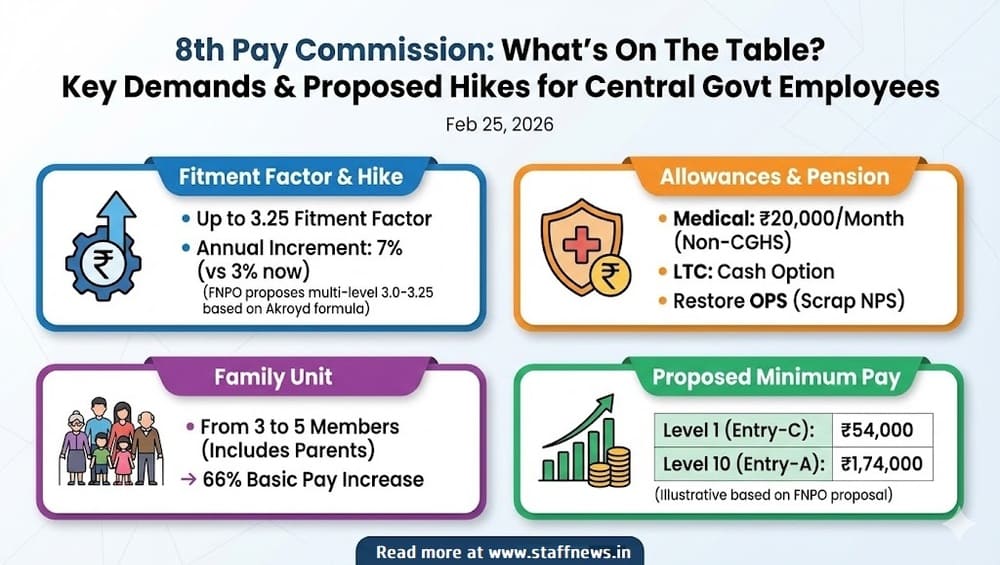
The Federation of National Postal Organisations (FNPO) has introduced a sophisticated “Multi-Level Fitment Factor” proposal. Unlike previous commissions that often applied a uniform multiplier, the FNPO is advocating for a graduated scale ranging from 3.0 to 3.25.
According to FNPO Secretary General Sivaji Vasireddy, these calculations are rooted in the Akroyd Formula, which determines the minimum living wage based on the nutritional and essential needs of a four-member family.
Proposed Tiered Fitment Structure:
- Levels 1 to 5: A 3.00 factor to provide a strong wage correction for the lowest-earning cadres.
- Levels 6 to 12: A factor of 3.05 to 3.10 to recognize increased supervisory and technical responsibilities.
- Levels 16 and Above: Up to 3.25 to prevent “pay compression” at the highest echelons of the hierarchy.
Charter of Demands: Beyond the Basic Pay
While the fitment factor remains the centerpiece, other major federations, including the Central Government Employees’ Confederation and the All India Defence Employees’ Federation (AIDEF), have submitted high-stakes demands to the drafting committee:
- Annual Increments: A significant push to increase the annual increment rate from the current 3% to 7% (or 5% as suggested by FNPO) to ensure meaningful career-long financial progression.
- Family Unit Expansion: A demand to increase the family unit count from 3 to 5 (to include dependent parents), which would mathematically trigger a 66% increase in basic salary calculations.
- Medical & Travel Allowances: Proposals to hike the Fixed Medical Allowance (FMA) from Rs 1,000 to Rs 20,000/month for those in non-CGHS areas and to provide Leave Travel Concession (LTC) in cash.
- Retirement Benefits: Increasing leave encashment limits from 300 to 400 days.
- Pension Reform: A renewed and forceful demand for the total restoration of the Old Pension Scheme (OPS) by scrapping NPS and UPS.
Illustrative 8th CPC Pay Scale (Proposed by FNPO)
| Level | Status / Category | 7th CPC Entry Pay (Rs) | Proposed Fitment Factor | Proposed Minimum Pay – 8th CPC (Rs) |
| Level 1 | Entry Level (Group C) | 18,000 | 3.00 | 54,000 |
| Level 2 | Group C | 19,900 | 3.00 | 59,700 |
| Level 3 | Group C | 21,700 | 3.00 | 65,100 |
| Level 4 | Group C | 25,500 | 3.00 | 76,500 |
| Level 5 | Group C | 29,200 | 3.00 | 87,600 |
| Level 6 | Group B Entry | 35,400 | 3.05 | 1,08,000 |
| Level 7 | Group B | 44,900 | 3.05 | 1,37,000 |
| Level 8 | Group B | 47,600 | 3.05 | 1,45,200 |
| Level 9 | Group B | 53,100 | 3.05 | 1,62,000 |
| Level 10 | Group A Entry | 56,100 | 3.10 | 1,74,000 |
| Level 11 | Group A | 67,700 | 3.10 | 2,09,900 |
| Level 12 | Group A | 78,800 | 3.10 | 2,44,300 |
| Level 13 | Senior Administrative | 1,18,500 | 3.05 | 3,61,500 |
| Level 13A | Senior Administrative | 1,31,100 | 3.05 | 3,99,900 |
| Level 14 | Senior Administrative | 1,44,200 | 3.15 | 4,54,300 |
| Level 15 | HAG | 1,82,200 | 3.15 | 5,74,000 |
| Level 16 | HAG+ | 2,05,400 | 3.20 | 6,57,300 |
| Level 17 | Apex Scale | 2,25,000 | 3.25 | 7,31,300 |
| Level 18 | Cabinet Secretary | 2,50,000 | 3.25 | 8,12,500 |
The drafting committee members will remain in Delhi until early March to iron out differences between departmental proposals. Once finalized, the joint memorandum will be submitted to Justice Ranjana Prakash Desai. While the 8th CPC is expected to be implemented retrospectively from January 1, 2026, the actual disbursement of revised salaries—and the resulting arrears—will depend on how quickly the commission submits its final report to the Union Cabinet.
****
COMMENTS
Good suggestion, but question still remains stable that till what extent the recommendation will be fulfilled or again the ruling govt will make fool to everyone.
If it is fulfilled ok otherwise trust will be no more in future.
Thankyou.
Fitment factor expected slightly reduced by Cpc.Annual incrementmay 5% and FMA 2000.No possibility to restore old person.
After every 5 years beyond 65 years there should be a minimum 5% increase in pension.
One Rank one pension should also be made applicable in CAPFS(Para Military personnel) owing to the reasons that pension of a Assistant Commandant Class+1 Gazetted officer is less than a inspector which is very insulting and full of humiliation.
The present period of 10 years is at once lengthy one. Some of the states like Karnataka, AP & Tamil Nadu are constituting Pay commissions once in five years by which the State Govt servants and pensioners are getting suitable amounts of salaries and pensions. This is helpful to political parties also to gain votes of employees and pensioners
What will be the minimum and maximum increase in r/o pensioners.
Minimum 5-10% should be increased after every 5 years in r/o pensioners beyond,65 years onwards.
One Rank one pension should also be made applicable in r/o CAPFS Personnel (Para Military personnel)
pension should be revised by the 8 th cpc on the basis of corresponding revised pay scale .
All this is useless activity.
Govt will do whatever the senior IAS officers decide.
Do not dream in eastman colour and get disappointment when you wakeup. Too much to expect from this CPC whose independence and thought process has been controlled and restricted on it’s birthday itself.
Fitment factor should be minimum 2.25 or increase in BASIC
It alright, set fitment factor uniform @3 to all levels, if necessary reduce the reduce the levels, merge the levels, uniform fitment factor for convenience!!!
There should be a uniformity in fitment factor for all right from bottom to top and it should be between 3.50 to 3.70 taking into consideration the present sky high inflation. Moreover, restoration of full pension after completion of 10 years 8 months should be on top priority.
I think we have to be practical present d. a. Which is to be merged is 60% of basic + at least 40% we needs hike due to present scenerio of inflation + 7 cpc has cut down family = 3 person but now due to unemployment family mean at least 5 person even after retirement at least 4 person so we demand fitment at least thrice means three times of present basic but in negosessions we have to compromise at least 2.5 two point fifty % hike of basic for welfare of senior citizens
Comment
Lower level employee salary is low hence reset the fitment factor reorder below to high 3.25 to C and 3.05 to B and 3 to A
Cpc should be implement soon.
3.25 fitment factor? कर्मचारियों के point of view को मध्यानजर रखते हुए ख्याल अच्छा है। अगर ऐसा हो जाए तो हमारी वर्तमान पेंशन में 103% का इजाफा हो जाएगा। पिछले चार वेतन आयोग लागू होते हुए देखा है शायद इतनी बढ़ोतरी कभी नहीं देखी गई।
Suggestions 1 house rent only 3 categories a cities in metro 30% population more than 20 lakhs 25% & below 20 lakhs even in small village 20% of basic. Pension increased 3% every year after retirement, every pensioner & his dependants are entitle to get one 3 a.c free pass of railway to visit pligrims in every 3 years.
Fitment factor will not be more the