
8th Central Pay Commission – Draft Memorandum by BPMS on Minimum Pay, Multiplication Factor, Merger of Pay Levels, Annual Increment, Pay Matrix for suggestion invited from Members of Bharatiya Pratiraksha Mazdoor Sangh
भारतीय प्रतिरक्षा मजदूर संघ
Bharatiya Pratiraksha Mazdoor Sangh
(AN ALL INDIA FEDERATION OF DEFENCE WORKERS)
(AN INDUSTRIAL UNIT OF B.M.S.)
(RECOGNISED BY MINISTRY OF DEFENCE, GOVT. OF INDIA)
CENTRAL OFFICE: 2-A, NAVIN MARKET, KANPUR-1
PH.: (0512) 2332222 FAX: (0512) 2296229
Mob.: 09335621629, 09415726924, 09415733686
E-mail: gensecbpms[at]yahoo.co.in, cecbpms[at]yahoo.in
Dated: 16.04.2026
Dear Members,
Kindly go through the draft on 8th CPC on the topics of Minimum Pay, Multiplication Factor, Merger of Pay Levels, Annual Increment, Pay Matrix. Kindly offer your valuable suggestions.
Regards,
Sd/-
(Rabindra Kr Mishra)
General Secretary
8th Pay Commission Draft for Suggestions
Minimum Pay-
Principle adopted for minimum pay determination
The determination of minimum pay for Government employees has historically been guided by a careful balance between economic realities, social justice, and administrative sustainability. It is not merely a matter of wage fixation, but a broader exercise aimed at ensuring that the lowest-paid employee is able to maintain a dignified standard of living in line with the prevailing socio-economic.
Over successive Pay Commissions, various methodologies have been examined, including needs-based approaches, consumption standards, and income-based benchmarks. Among these, the concept of linking minimum pay with growth in national income has emerged as a rational and equitable framework, as it aligns the earnings of Government employees with the overall progress of the economy.
In this context, the approach adopted by the Fifth Central Pay Commission marked a significant evolution in pay determination philosophy by introducing a modified version of the Constant Relative Income Criterion, thereby ensuring that wage growth reflects changes in per capita income levels. The relevant extract of the recommendation is reproduced below:
“We would like to adopt a modified version of the Constant Relative Income Criterion as possibly the most equitable norm, both from the point of view of the employee as well as the Government. Taking Rs.750 as the basic pay fixed in 1986, and dearness allowance of Rs. 1110 as on 1.1.96 we may adopt a compensation factor of 30.9% (See Annexe-41.5) as being the increase in the per capita net national product during When it is added to the existing basic pay (Rs.750) the period 1986-1995. This comes to Rs.574.74. and dearness allowance as on 1.1.96 (Rs.1110), the total works out as Rs.2434.75. This figure could be rounded off to Rs.2440, mean more than which would also incidentally a threefold jump in the basic pay from Rs. 750 to Rs.2440. The interim reliefs of Rs.200 paid so far to the lowest functionary would naturally subsumed be within the above mentioned figure.“
Annexe 41.5
Percentage increase in Per Capita Net National Product at factor cost
| Year | Per Capita Net National Product (at factor cost) at constant prices |
| 1986-87 | 1,871 |
| 1987-88 | 1,901 |
| 1988-89 | 2,059 |
| 1989-90 | 2,157 |
| 1990-91 | 2,222 |
| 1991-92 | 2,175 |
| 1992-93 | 2,239 |
| 1993-94 | 2,292 |
| 1994-95 | 2,449 |
Percentage increase in 1994-95 over 1986-87: 30.9
Determination of minimum pay under the 8th Central Pay Commission
In the same analogy, the revision of pay scales should be guided by objective economic indicators and prevailing socio-economic conditions. In this regard, the growth in Per Capita Net National Product (NNP) at factor cost provides a reasonable and scientific benchmark for assessing the increase in income levels over time.
As per data published by the Ministry of Statistics and Programme Implementation (MoSPI), the Per Capita Net National Income at current prices has increased from ₹1,03,219 in 2016-17 to ₹1,92,774 in 2024-25. This reflects an increase of approximately 86.76% over the period.
The calculation is summarized below:
- Absolute Increase: ₹1,92,774 – ₹1,03,219 = ₹89,555
- Percentage Increase: (₹89,555 ÷ ₹1,03,219) x 100 = 86.76% (approx.)
It is pertinent to mention that this increase represents nominal growth at current prices and reflects the overall rise in income levels, including inflationary effects.
Applying the above growth factor to the existing minimum pay determined by the 7th Central Pay Commission yields the following:
- Minimum Pay (7th CPC): ₹18,000
- Dearness Allowance @ 58%: ₹10,440
- Sub-total: ₹ 28,440
- Increase @ 86.76%: ₹24,674.54
- Revised Minimum Pay: ₹53,114.54
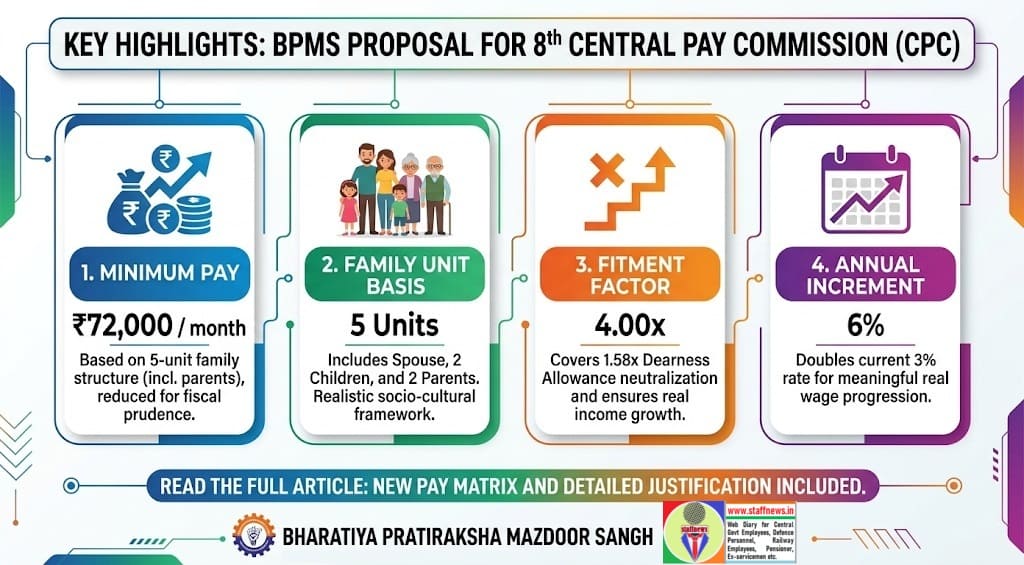
However, the minimum pay determined by the 7th Central Pay Commission was based on a 3-unit family structure, which does not adequately reflect the prevailing Indian socio-cultural framework. In Indian conditions, a government employee is generally responsible not only for the spouse and children but also for dependent parents.
Accordingly, a more realistic family composition may be considered as under:
- Government Servant: 1 Unit
- Spouse (gender-neutral): 1 Unit
- Two Minor Children: 1.5
- Parents: 1.5
- Total Family Size: 5
On this basis, the revised minimum pay works out to:
(₹53,114.54 ÷ 3) x 5 = ₹88,524.24
While the above calculation yields a minimum pay of ₹88,524.24 based on objective economic growth and a realistic family unit structure, it is equally important to recognise the broader fiscal implications for the Government. Pay revision impacts not only Central Government employees but also has cascading effects on pensions, allowances, and State Government pay structures. Therefore, any recommendation must balance adequacy of wages with fiscal sustainability, keeping in view factors such as revenue growth, fiscal deficit targets, and competing demands on public expenditure including infrastructure, social welfare, and defence.
At the same time, it is submitted that the minimum pay should not fall below a level that ensures a dignified standard of living, as envisaged in the principles of fair wages and earlier Pay Commission recommendations. The erosion of real income due to inflation, rising costs of essential services such as housing, education, and healthcare, and the increasing financial responsibilities of employees necessitate a reasonable upward revision.
In this context, a moderated and pragmatic approach is proposed. Instead of adopting the full computed figure of ₹88,524.24, a calibrated level of ₹72,000 per month may be considered appropriate. This figure represents a balanced midpoint between the existing pay structure and the fully justified requirement, thereby ensuring:
- Partial but meaningful neutralization of inflationary pressures;
- Improvement in living standards without imposing excessive fiscal strain;
- Administrative feasibility and smoother implementation; and
- Alignment with long-term fiscal consolidation goals of the Government.
Thus, the suggested minimum pay of ₹72,000 per month emerges as a prudent, sustainable, and socially just benchmark, reconciling economic justification with fiscal responsibility. It is, therefore, requested that the Hon’ble Commission may kindly consider:
- Adoption of growth in Per Capita NNP as a benchmark for pay revision.
- Revision of the family unit structure from 3 units to 5 units.
- Fixation of minimum pay at an appropriate and just level, preferably around ₹72,000 per month.
Fitment Factor
The minimum pay has been proposed at ₹72,000 per month, corresponding to the starting pay of ₹18,000 as determined by the 7th Central Pay Commission and implemented with effect from 01.01.2016. The proposed figure thus represents a fourfold increase over the base pay prevailing at the time of implementation of the VII CPC recommendations.
This enhancement is grounded in objective economic analysis. As established earlier, the Per Capita Net National Product (NNP) at current prices has increased by approximately 86.76% during the period from 2016-17 to 2024-25. When this growth is applied to the existing pay structure along with Dearness Allowance neutralisation, the revised minimum pay works out to ₹53,114.54 for a 3-unit family. Further, when adjusted to a more realistic 5-unit family structure, the minimum pay requirement rises to ₹88,524.24.
In this context, the proposed minimum pay of ₹72,000 represents a balanced and moderated outcome, positioned between the computed requirement and fiscal considerations. The implied fitment factor of 4.00 (72,000 ÷ 18,000) is therefore justified not only as a simple multiplier but as a reflection of cumulative economic growth, inflationary trends, and evolving household responsibilities. It is also pertinent to note that this fitment factor includes a component of 1.58 on account of Dearness Allowance (DA) neutralisation, which compensates for the erosion in real wages due to inflation since 01.01.2016. The remaining portion of the fitment factor represents the real increase necessary to ensure a dignified standard of living, consistent with the principles adopted by previous Pay Commissions. Accordingly, the proposed fitment factor of 4.00, to be applied uniformly across all employees, ensures equity, transparency, and administrative simplicity, while adequately balancing economic justification, social realities, and fiscal prudence.
Annual Increment
Justification for Enhancing Annual Increment to 6% for Central Government Employees under the 8th CPC
The structure of pay revision in Government service rests on three foundational elements—basic pay, Dearness Allowance (DA), and annual increment. While periodic Pay Commissions address structural revisions and DA neutralises inflation, the annual increment represents the only assured mechanism for real wage growth within a pay cycle. In this context, a strong case emerges for revising the rate of annual increment from the existing 3% to 6% under the forthcoming 8th Central Pay Commission.
1. Historical Context and Need for Revision
The rate of annual increment at 3% of basic pay was standardised by the Sixth Central Pay Commission and retained by the Seventh Central Pay Commission. At the time of its introduction, this rate was considered adequate in a relatively moderate inflation environment and in conjunction with other structural changes in pay.
However, over the past decade, economic conditions have undergone significant transformation:
- Sustained inflationary pressures have eroded real income levels.
- Consumption patterns and cost of living have increased substantially.
- Household financial responsibilities have expanded, particularly in urban and semi-urban contexts.
In such a scenario, the continuation of a 3% increment rate appears inadequate to ensure meaningful real wage progression.
2. Distinction Between DA and Annual Increment
A critical conceptual distinction must be maintained:
- Dearness Allowance (DA) compensates for inflation and protects purchasing power.
- Annual Increment provides real income growth and rewards experience and service continuity.
Thus, while DA ensures survival, the annual increment ensures improvement in standard of living. A low increment rate effectively leads to wage stagnation in real terms, particularly between Pay Commission.
3. Comparison with Broader Economic Trends
Recent data indicates that Per Capita Net National Product (NNP) at current prices has increased by approximately 86.76% between 2016-17 and 2024-25. This reflects a substantial rise in across the economy.
At the same time:
- The private sector in India provides average annual increments of 8%-10%, combining both inflation and performance-linked growth.
- Even in organised sectors, annual increases commonly exceed 6%.
In contrast, Central Government employees receive:
- 3% annual increment (real growth)
- DA adjustments separately
This creates a widening gap between government compensation growth and overall economic income trends, potentially affecting talent attraction and retention.
4. Inadequacy of 3% Increment Over a Pay Cycle
Over a typical 10-year Pay Commission cycle, a 3% annual increment results in limited real growth:
- The cumulative increase remains modest when compared with rising living costs.
- Employees at lower pay levels experience greater financial stress, as increments are calculated on a smaller base.
- The gap between entry-level and mid-career compensation remains compressed, affecting motivation.
A 6% increment, on the other hand:
- Provides a more meaningful progression over time.
- Reduces dependence on periodic pay revisions for income correction.
- Ensures a smoother and more continuous growth trajectory.
5. Alignment with Family-Based Needs and Social Realities
As highlighted in pay determination principles, the wage structure must support a family-based consumption model. In Indian conditions, an employee typically supports:
- Spouse
- Children
- Dependent parents
Given rising costs in education, healthcare, housing, and elderly care, the current increment rate does not adequately support evolving family needs. Enhancing the increment rate to 6% would help partially bridge this gap in a sustained manner.
6. Administrative Simplicity and Equity
One of the strengths of the current system is its uniformity and transparency. Increasing the increment rate to 6%:
- maintains structure (percentage of basic pay)
- applies across all levels
- aligns with performance-linked pay systems
Thus, the proposal enhances adequacy without compromising administrative efficiency.
7. Fiscal Sustainability
While any increase in increment rate has fiscal implications, the proposal remains moderate and sustainable:
- It does not involve immediate large-scale pay restructuring.
- The impact is gradual and spread over time.
- It reduces the need for sharp corrections in future Pay Commissions.
A calibrated increase to 6% represents a balanced approach, reconciling employee welfare with fiscal prudence.
Conclusion
The existing 3% annual increment, though historically justified, no longer aligns with present economic realities and societal needs. A revision to 6% annual increment is justified on the grounds of:
- Sustained increase in national income levels
- Rising cost of living and changing consumption patterns
- Need for meaningful real wage growth
- Alignment with broader market trends
- Support for family-based financial responsibilities
Accordingly, it is recommended that the 8th Central Pay Commission may consider enhancing the rate of annual increment to 6% of basic pay, thereby ensuring a more realistic, equitable, and forward-looking compensation framework for Central Government employees.
Proposed Pay Matrix
| Pay Band | Grade | Pre-revised Pay | Level | Fitment Factor | Revised Entry Pay | Pay on DNI | Maximum Pay |
| 5200-20200 | 1800 | 18000 | 1 | 4 | 72000 | 76300 | 587100 |
| 5200-20200 | 1900 & 2000 | 19900 & 21700 | 2 & 3 | 4 | 86800 | 92000 | 629500 |
| 5200-20200 | 2400 & 2800 | 25500 & 29200 | 4 & 5 | 4 | 116800 | 123800 | 670500 |
| 9300-34800 | 4200 | 35400 | 6 | 4 | 141600 | 150100 | 682300 |
| 9300-34800 | 4600 | 44900 | 7 | 4 | 179600 | 190400 | 686100 |
| 9300-34800 | 4800 | 47600 | 8 | 4 | 190400 | 201800 | 686100 |
| 15600-39100 | 5400 | 53100 & 56100 | 9 & 10 | 4 | 224400 | 237900 | 762800 |
| 15600-39100 | 6600 | 67700 | 11 | 4 | 270800 | 287000 | 772600 |
| 15600-39100 | 7600 | 78800 | 12 | 4 | 315200 | 334100 | 800300 |
| 37400-67000 | 8700 | 118500 | 13 | 4 | 474000 | 502400 | 800800 |
| 37400-67000 | 8900 | 131100 | 13A | 4 | 524400 | 555900 | 835900 |
| 37400-67000 | 10000 | 144200 | 14 | 4 | 576800 | 611400 | 867300 |
| 67000-79000 | – | 182200 | 15 | 4 | 728800 | 772500 | 86800 |
| 75500-80000 | – | 205400 | 16 | 4 | 821600 | 870900 | 870900 |
| 80000 | – | 225000 | 17 | 4 | 900000 | – | Fixed |
| 90000 | – | 250000 | 18 | 4 | 1000000 | – | Fixed |
(Note: Data for Steps 3-37 as indicated in the matrix tables for relevant levels )
(Rabindra Kr Mishra)
General Secretary
COMMENTS
So where both husband and wife are working and parents are pensioner, family unit must be consider as 2, and salary should be decreased appropriately. In nowhere one get annual increment of 6% and DA both. In net it is around 11% annual increment and that also with very high job security.
So salary revision should be such that to consider the overall wages in country, financial health of government and other such factors.
Wat abt bank employees getting pension of deceased spouse & their own pension too ?
Kitna pement badega
What about increment to Pensioners. Considering age factor pensioners should also get increment to support their medical and other personal attendent support