
Pay Matters – Minimum Pay Rs.69,000, Fitment 3.883, Annual Increment 6%: Memorandum to 8th Central Pay Commission by Staff Side of NC- JCM
(No. NC-JCM-2026/8th CPC dated 14-04-2026)
JCM
STAFF SIDE OF NATIONAL COUNCIL – JCM
for
Central Government Employees
MEMORANDUM
Submitted to
8th Central Pay Commission
on
Pay Matters
Q 1. What concerns / views do you have related to pay matters? Select those which are applicable
- Basic Pay
- Minimum Pay
- Increment / Annual Increment
- Level in Pay Matrix
- Maximum of Pay Level
- Any Other
Answer :- (1626 WORDS & 9756 CHARACTERS)
Central Government Employees are the backbone of Government of India and plays a very important role in implementing its policies and programs and ensure that the same reaches the citizens throughout the country. The major workforce are in the Group C & B category who are Industrial Employees in the Railways and Ministry of Defence. Pay is the foundation of Dignity, Motivation and Efficiency in Public Service. 8th CPC must ensure that real wages are protected and reasonably enhanced and not merely adjusted.
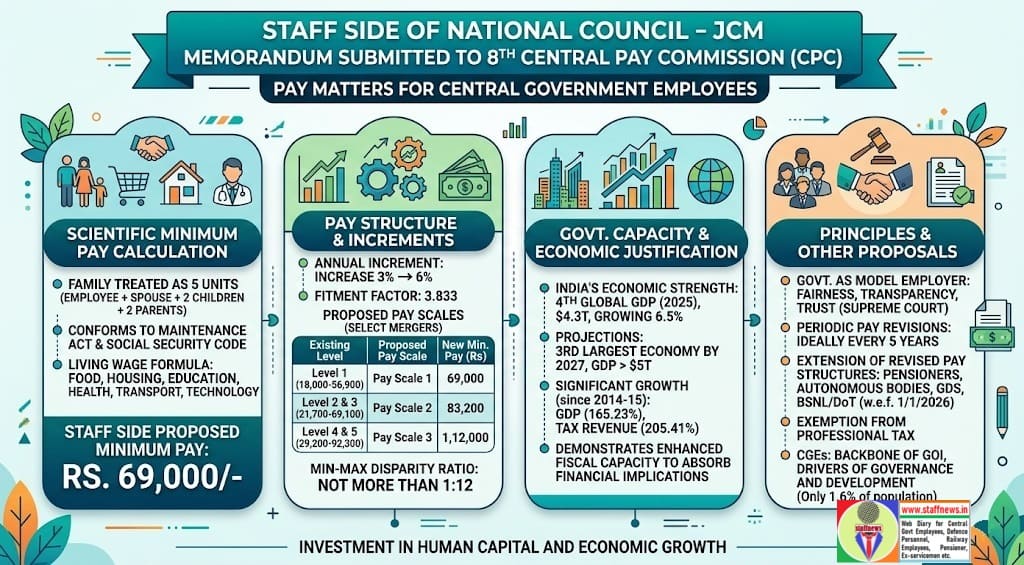
Minimum Pay must be based on a scientific living wage formula covering Food, Housing, Education, Health Care, Transport and the Technological / Digital Needs. The Present system of treating a family as 3 Units should be dispensed with and the Family should be treated as 5 Units (employee 1 Unit, Spouse 1 Unit (No Gender Discrimination), 2 Children, 0.8 Units each of the parents 0.8 Units. This works out to a total of 5.2 Units (Rounded off to 5 Units). This is in conformity with the legal obligations under the Maintenance and Welfare of Parents and Senior Citizens Act which mandates Children to support dependent parents. It is pertinent to mention here that in the Social Security Code 2020 in the definition of “family” dependent parents, and female employees can include their parent-in-laws as part of their family. The fact is that Government services is not merely contractual but a status that carries expectation of fairness and dignity. The observations of the Hon’ble Supreme Court in Bhupendra Nath Hazarika Vs State of Assam highlight that the legitimate aspirations of employees should not be frustrated and that the government must act as a model employer by ensuring fairness, trust, and transparency in its treatment of employees. The current Minimum Pay is inadequate and must ensure a decent standard of living and not subsistence.
Food and Nutrition Norms
The earlier 2700 Kcal norm is inadequate.
The ICMR recommendation of ~3490 Kcal should be adopted, especially for physically demanding work.
The food basket must include:
- Adequate protein sources (milk, eggs, meat, fish)
- Dairy consumption (~30-35 litres/month for 5 units)
- Fruits, vegetables, and balanced nutrition
- Spices, beverages, and processed food
Nutrition must ensure health, productivity, and dignity, not mere survival.
Government employees are Drivers of Governance and Development. Fair Pay enhances Productivity, Morale and Talent Retention. Pay Revision is an investment in human capital and economic growth, not merely expenditure. Therefore, considering the average retail prices of the Food items, Clothing expenditure, 7.5% for Housing, 20% for Fuel, Electricity, Water Charges, 25% for Skill Development, 25% for Additional Expenditure towards marriage, recreation, festival etc., as per Supreme Court Judgment of 1991 and Technology Charges at the rate of 5%, the minimum pay computed by the Staff Side National Council (JCM) is Rs. 69,000/- for 5 Unit Family. Accordingly, the Fitment Formula for the existing employees and pensioners will be 3.833. The Minimum Wage and the Fitment Factor calculated by us is enclosed as Annexure-I of this Memorandum.
We propose the rate of annual increment should be increased from the existing 3% to 6%. We propose the following Merger of Pay Scales and the Revised Pay Scales of 8th CPC.
MERGER OF PAY SCALE
1) Level 2 & Level 3 should be merged in to one pay scale at level 3.
2) Level 4 & Level 5 should be merged in to one pay scale at level 5.
3) Level 7 & Level 8 should be merged in to one pay scale at level 8.
4) Level 9 & Level 10 should be merged in to one pay scale at level 10.
5) Existing employees in Level 5 should be upgraded and merged with Level 6 as a one time measure.
Standardized Pay Scales / Number of Pay Scales after Merger of Pay Scales
| S.NO | Proposed Level | Existing Pay Matrix | Proposed 8th CPC Pay Scale by applying 3.833 fitment factor |
| 1 | Pay Scale-1 (existing Level 1) | Existing 18,000 – 56,900 | Rs. 69,000 |
| 2 | Pay Scale-2 (after Merger of existing Level 2 & 3) | Existing 21,700 – 69,100 | Rs. 83,200 |
| 3 | Pay Scale-3 (after merger of existing Level 4 & 5) | Existing 29,200 – 92,300 | Rs. 1,12,000 |
| 4 | Pay Scale-4 (existing Level 6) | Existing 35,400 – 1,12,400 | Rs. 1,35,700 |
| 5 | Pay Scale- 5 (after merger of existing Level 7 & 8) | Existing 47,600 – 1,51,100 | Rs. 1,82,500 |
| 6 | Pay Scale 6 (after merger of existing Level 9 & 10) | Existing 56,100 – 1,77,500 | Rs. 2,15,100 |
| 7 | Existing Level 11 to Level 17 may be renumbered as Pay Scale 7, Pay Scale 8, Pay Scale 9, Pay Scale – 10, Pay Scale 11, Pay Scale -12, Pay Scale -13 | Can be retained by using Fitment Factor 3.833 |
Annual Increment as already mentioned will be 6% of the Basic Pay in the proposed Pay Scale. The gap between Minimum and Maximum Pay should be balanced to avoid excess disparity. The ratio should not been more than 1:12. This will help in reducing income in equality, improving morale and reinforcing the Governments role as a model employer committed to fairness and Social Justice. Moreover the Pay Scales also should not have a wide gap between one pay scale and the other pay scale and a structural balance may be maintained.
Government Expenditure on Salaries
At present, the Central Government spends approximately 13% of its revenue expenditure on salaries, allowances, and pensions. With the implementation of the 8th Central Pay Commission (CPC), this expenditure is expected to rise during 2026-27. However, such expenditure should be viewed as an investment rather than a burden because:
- Higher salaries increase purchasing power
- Increased consumption boosts demand
- Higher demand leads to greater tax collections
Thus, pay revisions contribute positively to economic growth and fiscal sustainability.
Need for a Sound Pay Structure
A fair and rational pay structure is essential to:
- Attract talented individuals to government service
- Retain skilled and experienced personnel
- Ensure efficiency in governance
In view of rising cost of living and changing economic conditions, there is a strong need for periodic pay revision, ideally every five years, to maintain adequacy and relevance.
Principle of Fair Treatment
The 7th Central Pay Commission (Para 1.29) emphasized that government service is not merely contractual but carries a status with expectations of fairness and dignity. Further, the Hon’ble Supreme Court in Bhupendra Nath Hazarika vs State of Assam observed that:
- Legitimate aspirations of employees should not be frustrated
- The Government must act as a model employer
- Fairness, transparency, and trust must guide employer-employee relations
Contribution of Central Government Employees
Central Government employees contribute significantly across sectors:
- Revenue Departments: Enhance tax collection
- Defence & Paramilitary Forces including Defence Civilian Employees: Protect national security
- Railways: Ensure transportation
- Scientific Community: Drive innovation
- Administrative Services: Implement policies
Their role is fundamental to national development. The functioning of government departments cannot be judged on profit and loss principles, as the State has a social obligation to provide essential services such as defence, infrastructure, health, food security, postal services, and public utilities. Moreover, India is one of the lowest ratios of Government employees to population globally. Only about 1.6% of the population is employed in Government service.
India’s Economic Strength and Capacity
In the Union Budget 2025-26 the Central Government has allotted Rs. 2.85 Lakh Crore for salaries and Rs. 2.65 Lakh Crore for pensions, together making up nearly Rs. 5.5 Lakh Crore of Expenditure. Expenditure on pay and allowances and pension is approximately accounting for about 12 to 15% of the total union budget expenditure including pension for the Armed Forces, Pay & Allowances. Excluding Defence it is 7.1% on salary + 4% on pension.
India is currently ranked 4th in global GDP (2025), with an economy valued at approximately $4.3 trillion and growing at around 6.5%. According to IMF projections:
- India is expected to become the 3rd largest economy by 2027
- GDP likely to cross $5 trillion
- Growth projected at 6.2% (2025) and 6.3% (2026)
Comparatively:
- China: ~4.0%
- USA: ~1.8%
- Global average: ~2.8%
This demonstrates that India’s economic position is strong and expanding, providing adequate fiscal space to ensure fair compensation for government employees.
At this juncture, it is considered appropriate to briefly advert to the growth trends of two additional macroeconomic parameters over the same period. The first pertains to India’s GDP at current prices. As reported in the Economic Survey 2025-26, GDP at current prices has increased from Rs. 1,24,67,959 crore in FY 2014-15 to Rs. 3,30,68,145 crore, reflecting a growth of 165.23%.
The second parameter relates to the revenue collection of the Government. As per figures reported in the respective Union Finance Bills of India, the combined direct and indirect tax revenue has risen from Rs. 12,41,681 Crore in FY 2014-15 to Rs. 37,92,250 crore, registering a growth of 205.41%. Both these parameters assume considerable significance, as they represent the aggregate outcome of policy implementation in which Government employees play a pivotal role. More importantly, the substantial and sustained growth, particularly in revenue collection, clearly evidences the enhanced fiscal capacity of the Government. This, in turn, establishes that the Government is well-positioned to comfortably absorb the financial implications arising from a meaningful revision of minimum wages and the broader expenditure associated with the implementation of revised pay structures pursuant to the recommendations of the 8th Central Pay Commission.
Revision of Pay structure to following shall also be recommended with effect from 1/1/2026:
- Extension of revised pay structures to Central Government Pensioners who are retired before 1/1/2026
- Extension of revised pay structures to autonomous bodies approved by Parliament and other Autonomous Institutions of Government of India and Union Territories (effective 1 January 2026)
- Revision of Gramin Dak Sevaks (GDS) pay scales to strengthen rural services.
- BSNL & DoT Pensioners
Conclusion
The fixation of salaries and allowances for Central Government employees should not be guided solely by revenue expenditure considerations. It must take into account:
- Their critical role in nation-building
- The need to attract and retain talent
- The broader economic benefits of higher wages
A fair, transparent, and dynamic pay structure, supported by a permanent pay review mechanism, is essential to ensure motivated, efficient, and accountable public service.
We also propose that all Central Government employees may be exempted from Professional Tax being recovered by the State Governments from the salary of the employees. Already the employees are subjected to payment of Income Tax and GST etc. Over and above this the Central Government employees are burdened with the recovery of Perfossnal Tax. 8th CPC may kindly recommend for exemption of Professional Tax from the Wages of the employees.
Annexure-I
MINMUM WAGE:
The following table suggest the increase in wages as per NNI:
| Pay Commission | Net Average National Income | Average Growth of Per Capita Income | Average Growth % | Minimum Wage as per CPC |
| IV CPC-01-01-1986 | Rs 258 | 149.8 | Rs 750 | |
| V CPC-01-01-1996 | Rs 837 | 224.4 | 324.6 | Rs 2550 |
| VI CPC-01-01-2006 | Rs 2166 | 158.6 | 258.6 | Rs 7000 |
| VII CPC-01-01-2016 | Rs 7221 | 233.4 | 334.4% | Rs 19900 for 3 unitsRs 33,169 For 5 units |
| VIII CPC-01-01-2026 | Rs 16,680 (as on 1/1/25) | 131.0*
as on 1/1/25 136% estimated as on 1/1/2026 |
Rs 80,444 (for 5 units as on 1/1/26) |
Table 1:
Minimum Wage as on Jan 2026 for average of 2025 prices As per retail prices – Retail prices All India – 5 units
| Sl. No | Item | Per Month (5 units) | Average Rate | Amount (Rs) |
| 1 | Rice/Wheat Super fine | 71.25 | 60.00 | 4275.000 |
| 2 | Dal (Toor/Urid/Moong) | 12.00 | 139.00 | 1668.000 |
| 3 | Raw Vegetables | 15.00 | 62.00 | 930.000 |
| 4 | Green Vegetables | 18.75 | 37.00 | 693.750 |
| 5 | Other Vegetables | 11.25 | 60.00 | 675.000 |
| 6 | Fruits | 18.00 | 120.00 | 2160.000 |
| 7 | Milk | 30.00 | 63.00 | 1890.000 |
| 8 | Sugar/Jaggery | 8.40 | 55.00 | 462.000 |
| 9 | Edible Oil | 6.00 | 180.00 | 1080.000 |
| 10 | Fish | 4.16 | 688.00 | 2862.080 |
| 11 | Meat | 8.33 | 804.00 | 6697.320 |
| 12 | Egg | 150.00 | 7.00 | 1050.000 |
| 13 | Total Food | – | – | 24443.150 |
| 14 | Other food (10% of food charges) | – | – | 2444.315 |
| 15 | Detergents | Lumpsum | 655.00 | 655.000 |
| 16 | Clothes | 9.2 | 222.00 | 2035.000 |
| 17 | Stitching charges | Lumpsum | – | 3000.000 |
| 18 | Total (13 to 17) | – | – | 32577.465 |
| 19 | Housing @ 7.5% of 18 | – | – | 2443.310 |
| 20 | Fuel, Electricity, Water @ 20% | – | – | 7004.155 |
| 21 | Skill Add-on (25% of 18 to 20) | – | – | 10506.232 |
| 22 | Social/Misc (25% of 18 to 21) | – | – | 13132.791 |
| 23 | Technology charges @ 5% | 0 | – | 3283.198 |
| 24 | Grand Total | – | – | 68947.151 |
| 25 | Min Pay (Group C) Rounded | – | – | 69000.000 |
| 26 | Fitment Formula | – | – | 3.833 |
Table:2 Other Food items
Rates as per Hyderabad society
Spices List (Monthly)
| Sl. No | Item | Quantity | Amount (Rs) |
| 1 | Cloves | 50 gms | 51 |
| 2 | Cardamom | 25 gms | 94 |
| 3 | Cumin | 250 gms | 107 |
| 4 | Turmeric | 500 gms | 142 |
| 5 | Coriander | 250 gms | 48 |
| 6 | Garam Masala | 50 gms | 49 |
| 7 | Black pepper | 50 gms | 48 |
| 8 | Cinnamon | 50 gms | 23 |
| 9 | Fennel | 100 gms | 40 |
| 10 | Bay leaves | 50 gms | 12 |
| 11 | Red chilly | 250 gms | 50 |
| 12 | Asafetida | 50 gms | 85 |
| 13 | Fenugreek | 100 gms | 19 |
| 14 | Saffron | 5 gms | 150 |
| 15 | Jeera | 100 gms | 90 |
| 16 | Mustard | 100 gms | 50 |
| Total Spices | 1058 |
Other Important
| No | Item | Quantity | Amount (Rs) |
| 1 | Coffee/Tea powder | 2 kg | 1800 |
| 2 | Salt | 2 kg | 50 |
| 3 | Tamarind | 1 kg | 250 |
| 4 | Other beverages | LS | 200 |
| 5 | Processed food | LS | 500 |
| Total Other Food | 2800 |
Total: Rs 1058+2800 = Rs. 3858
Table 3
Non Food items – Monthly needs
| Sl. No | Item | Quantity | Amount (Rs) |
| 1 | Hair oil | 1/2 lt | 100 |
| 2 | Bathroom cleaner | 1 lt | 115 |
| 3 | Foot wear | LS | 500 |
| 4 | Tooth brush | 4 | 70 |
| 5 | Tooth paste | 1 | 80 |
| 6 | Hair cutting | 4 | 400 |
| 7 | Bucket | 2 | 500 |
| 8 | Internet & Mobile pack | 4 | 1000 |
| 9 | News paper | – | 150 |
| 10 | Electric bulb | – | 100 |
| 11 | Shaving razor | – | 80 |
| Total | 3095 |
Table 4
Non Food items yearly needs -digital expenses
| Sl. No | Item | Qty | Amount (Rs) | Lifecycle |
| 1 | Mobile handset | 4 | 20000 | 3 years |
| 2 | Television | 1 | 15000 | 5 years |
| 3 | Fan | 4 | 6000 | 6 years |
| 4 | Iron Box | 1 | 1500 | 7 years |
| 5 | Laptop/Computer | 1 | 50000 | 5 years |
| 7 | Refrigerator | LS | 8000 | 5 years |
| 8 | Watch | LS | 5000 | 3 years |
| 9 | Washing machine | LS | 5000 | 5 years |
| 10 | Mixi/Grinder | – | 5000 | 5 years |
| Total Yearly | 115500 | |||
| Every Month expenses in Rs | 1925 |
Non Digital
| Slno | Item | Qty | Amount | ||
| 1 | Vessel | LS | 10000 | 3 years life | |
| 2 | Stove | 1 | 1500 | ||
| Basic Furniture | LS | 30000 | |||
| Total | 41500 | ||||
| Every Month expenses in Rs | 1383.33 |
Total Expenses per
month = Rs.6403/-
Prices of various grocery items, vegetables, fruits, fish, meat etc as on 2025 & 15th Feb 2026 – City wise
Prices of essential commodities collected from
various cites across the county – 2025
| Slno | Item | Unit | Bengaluru | Chennai | Hyderabad | Mumbai | Delhi | Kolkata | Karnal Haryana | Patna | Jamm | BBSR | Average |
| l | Rice Super fine | kg | 74 | 76 | 64 | 107 | 62 | 80 | 60 | 65 | 74 | ||
| 2 | Wheat | kg | 52 | 64 | 49 | 30 | 49 | 35 | 38 | 40 | 54 | 46 | |
| Average | 60 | ||||||||||||
| 3 | Dal – Toor | kg | 207 | 144 | 122 | 171 | 145 | 140 | 150 | 150 | 138 | 152 | |
| 4 | Dal Urid | Kg | 160 | 148 | 116 | 118 | 134 | 120 | 135 | 120 | 134 | 134 | |
| 5 | Dal-Moong | Kg | 134 | 152 | 116 | 130 | 172 | 130 | 120 | 120 | 134 | 134 | |
| Average | 139 | ||||||||||||
| 6 | Onion | Kg | 45 | 45 | 60 | 56 | 50 | 70 | 55 | 66 | 68 | 70 | 59 |
| 7 | Potato | Kg | 49 | 40 | 40 | 40 | 30 | 45 | 41 | 41 | 45 | 42 | 41 |
| 8 | Tomato | Kg | 26 | 25 | 31 | 31 | 30 | 31 | 30 | 28 | 24 | 25 | 28 |
| 9 | Beans | ka | 75 | 76 | 75 | 70 | 86 | 48 | 71 | 65 | 75 | 76 | 69 |
| 10 | Radish | kg | 55 | 46 | 45 | 40 | 40 | 45 | 41 | 30 | 42 | 43 | |
| 11 | Brinjal | kg | 49 | 51 | 50 | 60 | 30 | 44 | 55 | 55 | 51 | 52 | 50 |
| 12 | Carrot | kg | 77 | 75 | 75 | 70 | 70 | 65 | 65 | 64 | 39 | 67 | |
| 13 | Mushroom | ka | 140 | 130 | 120 | 140 | 171 | 112 | 120 | 148 | 115 | 149 | 135 |
| 14 | Green peas | ka | 81 | 70 | 92 | 91 | 92 | 90 | 85 | 92 | 94 | 95 | 88 |
| Average | 64 | ||||||||||||
| 14 | Spinach/Palak | kg | 50 | 21 | 18 | 28 | 60 | 50 | 40 | 40 | 32 | 28 | 37 |
| 15 | Apple | kg | 225 | 298 | 231 | 200 | 200 | 180 | 220 | 299 | 232 | ||
| 16 | Orange | kg | 102 | 115 | 88 | 90 | 20 | 80 | 100 | 70 | 129 | 88 | |
| 17 | Banana | kg | 94 | 114 | 78 | 80 | 84 | 60 | 60 | 75 | 81 | ||
| 18 | Average | 133 | |||||||||||
| 19 | Milk | kg | 58 | 55 | 60 | 55 | 66 | 70 | 70 | 65 | 74 | 58 | 63 |
| 20 | Sugar | kg | 43.81 | 50 | 57 | 48 | 48 | 47 | 47 | 49 | |||
| Jaggery | kg | 66 | 82 | 65 | 50 | 45 | 50 | 67.5 | 61 | ||||
| 21 | Average | 55 | |||||||||||
| 22 | Refined oil | Lt | 160 | 141 | 160 | 166 | 190 | 190 | 175 | 179 | 170 | ||
| Ground nut Oil | Lt | 202 | 162 | 238 | 170 | 200 | 175 | 185 | 190 | ||||
| 23 | Average | 180 | |||||||||||
| 24 | Fish- Pormfret | kg | 720 | 680 | 665 | 635 | 850 | 700 | 680 | 650 | 660 | 635 | 688 |
| Meat | kg | 750 | 800 | 775 | 735 | 1000 | 860 | 790 | 760 | 770 | 800 | 804 | |
| 25 | Egg | unit | 5.04 | 7 | 8 | 7 | 7 | 7 | 7 | 7 | |||
| 26 | Detergents | kg | 420 | 420 | |||||||||
| 27 | Clothes – Cotton | Mt | 159 | 159 |
Prices of essential commodities collected from
various cites across the county – Jan 2026
| Slno | Item | Unit | Bengaluru | Chennai | Hyderabad | Mumbai | Delhi | Kolkata | Kerala | Patna | Jammu | BBSR | Average |
| 1 | Rice Super fine | kg | 84 | 90 | 60 | 62 | 74 | ||||||
| 2 | Wheat | kg | 57 | 50 | 48 | 54 | |||||||
| Average | 64 | ||||||||||||
| 3 | Dal – Toor |
kg | 140 | 150 | 170 | 180 | 160 | ||||||
| 4 | Dal Urid | kg | 142 | 130 | 170 | 150 | 148 | ||||||
| 5 | Dal- Moong |
kg | 142 | 160 | 136 | 137 | |||||||
| Average | 148 | ||||||||||||
| 6 | Onion | kg | 50 | 45 | 53 | 50 | 51 | 50 | 50 | 45 | 55 | 50 | I 50 |
| 7 | Potato | kg | 45 | 44 | 43 | 44 | 41 | 42 | 45 | 43 | 41 | 45 | 43 |
| 8 | Tomato | kg | 45 | 40 | 45 | 44 | 75 | 40 | 38 | 35 | 40 | 45 | 45 |
| 9 | Beans | kg | 68 | 73 | 70 | 72 | 71 | 70 | 70 | 70 | 71 | 71 | |
| 10 | Radish | kg | 43 | 45 | 44 | 50 | 52 | 40 | 50 | 41 | 45 | 50 | 46 |
| 11 | Brinjal | kg | 53 | 65 | 62 | 50 | 54 | 55 | 65 | 65 | 50 | 65 | 58 |
| 12 | Carrot | kg | 60 | 55 | 56 | 61 | 61 | 60 | 55 | 65 | 62 | 60 | 60 |
| 13 | Mushro om |
kg | 120 | 115 | 128 | 120 | 125 | 115 | 50 | 11 8 |
115 | 110 | 112 |
| 14 | Green peas | kg | 72 | 73 | 65 | 75 | 63 | 72 | 73 | 75 | 73 | 75 | 72 |
| Average | 62 | ||||||||||||
| 14 | Spinach/ Palak | kg | 18 | 20 | 21 | 22 | 23 | 22 | 20 | 20 | 17 | 24 | 21 |
| 15 | Apple | kg | 170 | 180 | 220 | 150 | 200 | 190 | 185 | ||||
| 16 | Sapota | kg | 60 | 49 | 90 | 80 | 80 | 66 | 71 | ||||
| 17 | Banana | kg | 60 | 80 | 80 | 65 | 65 | 70 | |||||
| 18 | Grapes | kg | 130 | 130 | 80 | 82 | 120 | 108 | |||||
| 19 | Mango | kg | 120 | 110 | 70 | 113 | 120 | 107 | |||||
| Average | 109 | ||||||||||||
| 20 | Milk | kg | 58 | 90 | 58 | 69 | |||||||
| 21 | Sugar | kg | 51.00 | 45 | 47 | 48 | |||||||
| 22 | Jaggcry | kg | 66 | 80 | 67.5 | 71 | |||||||
| Average | 59 | ||||||||||||
| 23 | Refined oil | Lt | 202 | 220 | 178 | 179 | 195 | ||||||
| 24 | Ground nut Oil | lt | 180 | 250 | 215 | ||||||||
| Average | 205 | ||||||||||||
| 25 | Fish- Pomfret | kg | 880 | 1200 | 900 | 635 | 904 | ||||||
| 26 | Meat | kg | 850 | 800 | 800 | 800 | 813 | ||||||
| 27 | Egg | Unit | 6.50 | 7 | 7 | 7 | |||||||
| 28 | Detergents | kg | 420 | 420 | |||||||||
| 29 | Clothes – Cotton |
Mt | 159 | 159 |
Table 4.2: Average calorie, protein and fats requirements of households with casual and regular wage earnings as their main source of livelihood.
| Age-Sex-Occupation* Composition | Population (%) | Nutrient requirements per day per person | |||||||
| Calorie (K/cal) | Protein Grams | Fat Grams | Weighted nutrient requirements** | ||||||
| Calorie | Protein | Fat | |||||||
| Less than 1 | 1.51 | 585 | 10.2 | 19 | 8.8 | 0.2 | 0.3 | ||
| 1-3 | 5.76 | 1060 | 16.7 | 27 | 61.1 | 1 | 1.6 | ||
| 4-6 | 5.94 | 1350 | 20.1 | 25 | 80.2 | 1.2 | 1.5 | ||
| 7-9 | 6.5 | 1690 | 29.5 | 30 | 109.9 | 1.9 | 2 | ||
| 10-12 | 6 | 2100 | 40 | 35 | 126 | 2.4 | 2.1 | ||
| 13-14 | Male | 2.37 | 2750 | 54.3 | 45 | 65.2 | 1.3 | 1.1 | |
| 13-14 | Female | 2.1 | 2330 | 51.9 | 40 | 48.9 | 1.1 | 0.8 | |
| 15-59 | Male | Sedentary | 0.18 | 2320 | 60 | 25 | 4.2 | 0.11 | 0.05 |
| Moderate | 8.5 | 2730 | 60 | 30 | 232.1 | 5.1 | 2.6 | ||
| Heavy | 21.95 | 3490 | 60 | 40 | 766.1 | 13.2 | 8.8 | ||
| Non-worker | 4.73 | 2320 | 60 | 25 | 109.7 | 2.8 | 1.2 | ||
| 15-59 | Female | Sedentary | 0.11 | 1900 | 55 | 20 | 2.1 | 0.1 | 0.02 |
| Moderate | 2.1 | 2230 | 55 | 25 | 46.8 | 1.2 | 0.5 | ||
| Heavy | 8.93 | 2850 | 55 | 30 | 254.5 | 4.9 | 2.7 | ||
| Non-worker | 17.08 | 1900 | 55 | 20 | 324.5 | 9.4 | 3.4 | ||
| 60 & above | Male | 3.05 | 2320 | 60 | 25 | 70.8 | 1.8 | 0.8 | |
| 60 & above | Female | 3.2 | 1900 | 55 | 20 | 60.8 | 1.8 | 0.6 | |
| All | 100 | 2371.6 | 49.3 | 29.9 | |||||
Source: Col. 2 based on EUS 2011-12, Cols. 3, 4 and 5 based on ICMR 2010, and Cols. 6, 7 and 8 based on the Committee’s estimate.
Note: * The types of work have been classified into sedentary, moderate and heavy, using the National Classification of Occupations (NCO) 2004 codes at the 3-digit level. The Committee has categorized sedentary workers as those engaged in occupations with codes between 111 and 246; moderate between 311 and 644; and heavy between 811 and 933. ** The weighted average has been estimated by multiplying each nutrient requirement per person per day by the population share in each category.
4.16 Furthermore, a 10 per cent margin in the calorie consumption may be allowed instead of fixing the same as a single point unit. Literature reflects that a lower or higher intake of calorie consumption in the margin of 10 per cent on a daily basis is not likely to affect a person’s working capacity (Sukhatme, 1981; GoI., 2014). This allows a variation in the calorie requirements in the range of 2,160-2640 K/cal. per day per adult person. Allowing a 10 per cent margin in calorie intake also helped capture a larger number of households in the CES 2011-12 sample for the purpose of estimating a ‘balanced diet’ consumption basket, compared to fixing the calorie norm at 2,400 K/cal as a single point.
View/Download the PDFView:-
COMMENTS
Excellent proposal and justified. The honorable Chair person and the members of the 8 CPC wii definitely do the needful justification.
JAI HIND
JAI BHARAT.