
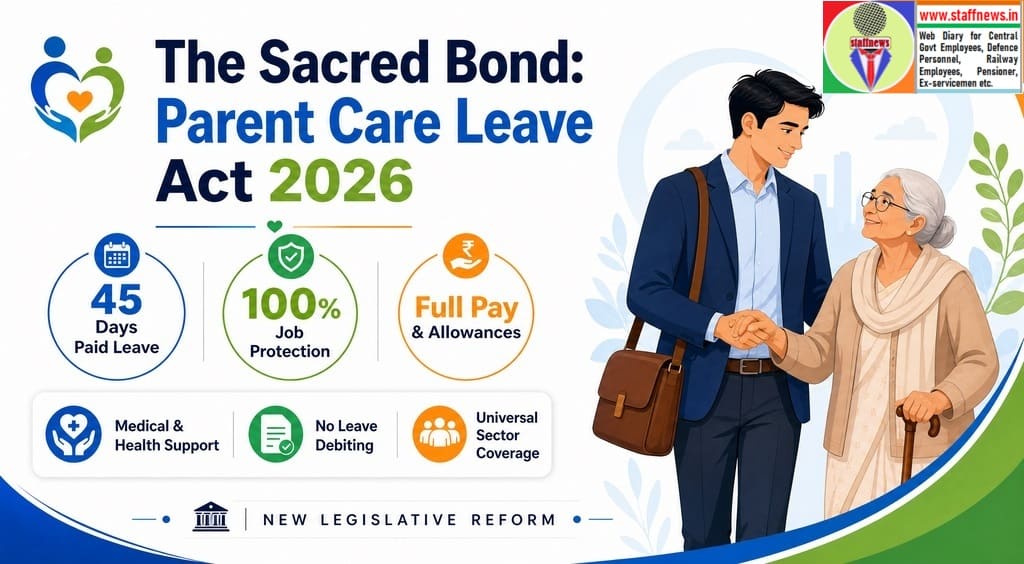
Parent Care Leave Act, 2026 – Bill No. XXV of 2026: 45 Days of Paid Leave for parental care with Full Pay & Allowances. The Sacred Bond (Parent Care Leave) Act, 2026, introduces a 45-day aggregate paid leave entitlement for employees to attend to the medical and wellbeing needs of parents aged sixty or above. This legislative intervention applies to both government and private establishments with ten or more employees. The Act ensures full pay and protects against career discrimination while providing a one-time aggregate leave pool. Aimed at supporting the “sandwich generation,” it bridges a critical gap in India’s labour laws, balancing modern professional demands with cultural filial duties through mandated compliance and strict employer penalties.
THE GAZETTE OF INDIA EXTRAORDINARY
[Part II Sec. 2]
XVIII
Bill No. XXV of 2026
A Bill to provide for parent care leave to enable employees to attend to the medical, health and wellbeing needs of their aged parents, and for matters connected therewith or incidental thereto. BE it enacted by Parliament in the Seventy-seventh Year of the Republic of India as follows:-
Short title and commencement.
1. (1) This Act may be called the Sacred Bond (Parent Care Leave) Act, 2026.
(2) It shall come into force on such date as the Central Government may, by notification in the Official Gazette, appoint. Short title and commencement.
Definitions.
2. In this Act, unless the context otherwise requires,—
(a) “appropriate Government” means—
(i) in relation to an establishment which is established, owned, controlled or wholly or substantially financed by funds provided directly or indirectly—
(A) by the Central Government or the Union territory administration, the Central Government;
(B) by the State Government, the State Government;
(ii) in relation to any establishment not covered under sub-clause (i) and falling within its territory, the State Government;
(b)”employee” means a person employed in any establishment for any work on regular, temporary or contractual basis, either directly or through an agent, including a contractor, with or, without the knowledge of the principal employer, and includes a contract worker, probationer, trainee, apprentice or called by any other such name;
(c) “employer” means—
(i) in relation to any department, organisation, undertaking, enterprise, institution, office, branch or unit of the appropriate Government or a local authority, the head of that department, organisation, undertaking, enterprise, institution, office, branch or unit or such other officer as the appropriate Government or the local authority, as the case may be, may by an order specify in this behalf;
(ii) in any establishment not covered under sub-clause (i), any person responsible for the management, supervision and control of the establishment.
Explanation. For the purposes of this sub-clause “management” includes the person or board or committee responsible for formulation and administration of polices for such organisation;
(iii) in relation to the establishment covered under sub-clauses (i) and (ii), the person discharging contractual obligations with respect to his employees;
(d) “establishment” includes—
(i) any department, organisation, undertaking, enterprise, institution, office, branch or unit which is established, owned, controlled or wholly or substantially financed by funds provided directly or indirectly by the appropriate Government or the local authority or a Government company or a corporation or a co-operative society;
(ii) any private sector organisation or a private venture, undertaking, enterprise, institution, society, trust, non-governmental organisation, unit, service provider or a person carrying on commercial, professional, vocational, educational, entertainmental, industrial, health services or financial activities including production, supply, sale, distribution or service and employing ten or more employees;
(e) “parent” means a biological, step, adoptive, or foster parent, or a parent-in-law of the employee, who has attained the age of sixty years;
(f) “parent care leave” means leave granted under section 3; and (g) “prescribed” means prescribed by rules made under this Act.
Entitlement to parent care leave.
3. (1) Every employee shall be entitled, during the entire period of service, to parent care leave not exceeding forty-five days in aggregate, for attending to the medical, health and wellbeing needs of his parent.
(2) The leave under sub-section (1) may be availed in one continuous stretch or in multiple spells, subject to the prior approval of the employer or in such manner as may be prescribed.
(3) Parent care leave shall—
(a) be granted with full pay and allowances as admissible to the employee; and
(b) not be debited against any other leave account.
(4) The entitlement under this section shall be a one-time or aggregate entitlement during the entire period of service and shall not be encashable.
Application and documentation.
4. (1) An employee seeking parent care leave shall make an application to the employer in such form and manner as may be prescribed and shall furnish such documents as may be prescribed, including medical certificate and hospital admission records, evidencing the need for such leave.
(2) In case of emergency, an employee may proceed on parent care leave without prior sanction, subject to submission of prescribed documents within seven working days from the commencement of such leave.
(3) The employer shall, as far as practicable, dispose of the application within forty-eight hours of its receipt: Provided that where leave is refused on account of exigencies of service, the reasons for such refusal shall be recorded in writing and communicated to the employee.
Protection against discrimination.
5. No employee shall suffer any adverse consequence in service, including denial of promotion, increment, posting, transfer or other career progression, solely on the ground of having availed parent care leave under this Act.
Penalty for non-compliance.
6. (1) Any employer who, without sufficient cause, denies parent care leave to an eligible employee or subjects an employee to adverse action for availing such leave, shall be liable to a penalty, which shall not be less than fifty thousand rupees, but which may extend to two lakh rupees.
(2) Any employee who knowingly submits false or fabricated documents for the purpose of availing parent care leave shall be liable to disciplinary action in accordance with the applicable service rules, and may also be required to refund the salary and allowances drawn during such leave.
Grievance redressal.
7. (1) Any employee aggrieved by denial of parent care leave or by discrimination under section 5 may prefer a complaint in accordance with this section.
(2) In the case of employees in Government service, the complaint shall be dealt with in accordance with the applicable service rules and regulations.
(3) In the case of employees in the private sector, the complaint shall be filed before the Labour Commissioner or such other authority as may be notified by the appropriate Government, who shall enquire into the complaint and pass appropriate orders within sixty days from the date of receipt.
Power to make rules.
8. (1) The appropriate Government may, by notification in the Official Gazette, make rules for carrying out the provisions of this Act.
(2) In particular, and without prejudice to the generality of the foregoing power, such rules may provide for—
(a) procedure for availing parent care leave under sub-section (2) of section 3;
(b) the form and manner of application and documentary requirements for parent care leave under sub-section (1) of section 4;
(c) the authority before whom complaints may be filed under sub-section (3) of section 7; and
(d) any other matter which is required to be, or may be, prescribed.
(3) Every rule made by the Central Government under this Act shall be laid, as soon as may be after it is made, before each House of Parliament, while it is in session, for a total period of thirty days which may be comprised in one session or in two or more successive sessions, and if, before the expiry of the session immediately following the session or the successive sessions aforesaid, both Houses agree in making any modification in the rule or both Houses agree that the rule should not be made, the rule shall thereafter have effect only in such modified form or be of no effect, as the case may be; so, however, that any such modification or annulment shall be without prejudice to the validity of anything previously done under that rule.
(4) Every rule made by the State Government under this Act shall be laid, as soon as may be after it is made, before each House of the State Legislature where it consists of two Houses, or where such Legislature consists of one House, before that House.
Act not in derogation of any other law.
9. The provisions of this Act shall be in addition to, and not in derogation of, any other leave entitlement available under any other law or service rules for the time being in force.
Power to remove difficulties.
10. (1) If any difficulty arises in giving effect to the provisions of this Act, the Central Government may, by order published in the Official Gazette, make such provisions, not inconsistent with the provisions of this Act, as may appear to it to be necessary or expedient for removing such difficulty.
(2) Every order made under this section shall be laid, as soon as may be after it is made, before each House of Parliament.
STATEMENT OF OBJECTS AND REASONS
India stands at the threshold of a profound demographic transformation. The nation’s population structure is rapidly ageing, presenting both unprecedented challenges and moral imperatives that demand immediate legislative intervention. According to the Census of India 2011, there were 10.38 crore persons aged 60 years and above, constituting 8.6 per cent of the total population. The Longitudinal Ageing Study in India (LASI) Wave-1 (2017-18) revealed that this number had already risen to approximately 13.8 crore elderly persons. The United Nations Population Fund (UNFPA) projects that by 2050, nearly 20 per cent of India’s population approximately 34 crore individuals will be above the age of 60 years. This exponential growth in the elderly population, coupled with increasing life expectancy now averaging 70.19 years (2018-2022), creates an urgent need for supportive social infrastructure.
2. The traditional joint family system, which historically served as the primary caregiving mechanism for elderly parents, has undergone significant erosion due to rapid urbanization, economic migration, and changing social dynamics. The National Sample Survey Organization’s (NSSO) 75th Round on Social Consumption: Health (2017-18) indicates that approximately 68 per cent of India’s working-age population (20-59 years) now lives away from their parental homes, primarily in pursuit of employment, education, or entrepreneurial opportunities. Major metropolitan cities such as Delhi, Mumbai, Bengaluru, Hyderabad and Pune have witnessed an influx of 15-20 million young professionals who maintain separate households from their parents. This geographical separation, while economically beneficial, creates a critical gap in caregiving when elderly parents face medical emergencies, chronic illnesses, or general health deterioration.
3. A particularly vulnerable demographic cohort is the ‘sandwich generation’ i.e., employees aged between 35 and 55 years who are simultaneously responsible for raising their own children while caring for ageing parents. Research by the Indian Institute of Management, Ahmedabad (IIMA) and the Tata Institute of Social Sciences (TISS) indicates that approximately 42 per cent of India’s working population belongs to this sandwich generation, facing dual caregiving obligations that create severe emotional, financial and professional stress. The Household Social Consumption on Health Survey (2017-18) reveals that 56 per cent of sandwich generation employees report experiencing burnout, with women bearing a disproportionate burden. Seventy three per cent of female employees in this cohort serve as primary caregivers for both children and parents. The National Mental Health Survey (2015-16) found that sandwich generation caregivers have 2.8 times higher risk of developing depression and anxiety disorders compared to their peers without dual caregiving responsibilities. This demographic reality necessitates targeted legislative intervention that recognizes the unique pressures faced by employees managing intergenerational care responsibilities while maintaining professional commitments.
4. The health profile of India’s elderly population presents an alarming picture that necessitates regular physical presence and care from family members. The LASI Report reveals that 75 per cent of elderly Indians suffer from at least one chronic disease, with 40 per cent having two or more co-morbidities including diabetes, hypertension, cardiovascular diseases, arthritis and respiratory ailments. The prevalence of geriatric mental health issues is equally concerning—approximately 22.4 per cent of elderly persons experience depression, anxiety or dementia-related disorders. The India Ageing Report, 2023 by the Ministry of Social Justice and Empowerment highlights that 27 per cent of elderly persons require assistance in Activities of Daily Living (ADL), while 43 per cent need support in Instrumental Activities of Daily Living (IADL). Post-operative care, rehabilitation after falls or fractures, management of terminal illnesses, and end-of-life care require sustained physical presence that cannot be adequately substituted by hired caregivers or institutional support alone.
5. Despite the evident need, there exists a glaring legislative vacuum in India’s labour and employment framework regarding leave provisions for parent care. While maternity leave (26 weeks under the Maternity Benefit Act, 2017), paternity leave (15 days for Central Government employees), and child care leave (730 days over entire service for Central Government employees) have received progressive legislative recognition, care for ageing parents remains conspicuously absent from formal leave entitlements. The Central Civil Services (Leave) Rules, 1972, and corresponding State service rules do not provide for dedicated parent care leave. Private sector employees, constituting approximately 90 per cent of India’s organized workforce, are even more vulnerable as most employment contracts and establishment policies offer no structured provision for attending to parental health emergencies. This absence forces employees, particularly those in the sandwich generation, into an untenable choice: either utilizing precious earned leave, casual leave, or loss of pay to care for parents, or, in many distressing cases, being unable to attend to their parents during critical medical situations due to fear of employment consequences.
6. The human cost of this legislative lacuna is profound and multifaceted. A study by the International Institute for Population Sciences (IIPS), Mumbai, revealed that 62 per cent of working professionals reported experiencing severe emotional distress and guilt from being unable to be physically present with their parents during medical crises. The psychological burden manifests in increased workplace stress, reduced productivity, higher rates of anxiety and depression among employees, and strained family relationships. Furthermore, 34 per cent of employees surveyed reported having to resign or take extended unpaid leave at some point in their careers to care for ageing parents, leading to significant career disruptions, loss of income, erosion of professional skills, and diminished retirement savings. For women employees, who constitute 48.5 per cent of the urban workforce as per the Periodic Labour Force Survey (PLFS) 2022-23, this burden is disproportionately heavier due to prevailing societal expectations of caregiving, often resulting in permanent workforce exit.
7. The constitutional and cultural imperatives for this legislation are equally compelling. Article 41 of the Constitution of India directs the State to make effective provision for securing the right to public assistance in cases of old age, sickness and disablement, within the limits of its economic capacity. While the Maintenance and Welfare of Parents and Senior Citizens Act, 2007, establishes the legal obligation of children to maintain their parents, it provides no structural mechanism through employment law to enable such care. India’s civilizational ethos, reflected in the concept of ‘Matru Devo Bhava, Pitru Devo Bhava’ (Mother is God, Father is God) from the Taittiriya Upanishad, and the principle of ‘Putra Dharma’ (duty of children towards parents), places filial responsibility at the very core of our social and ethical framework. The proposed legislation seeks to harmonize constitutional obligations, cultural values, and contemporary socio-economic realities by creating an enabling legal framework that recognizes and facilitates this sacred bond.
8. International best practices provide instructive precedents for such legislative intervention. Countries facing similar demographic transitions have enacted progressive parent care leave provisions viz., New Zealand provides ten days of paid leave for caring for sick family members including parents; the United Kingdom offers unpaid parental leave and time off for dependents including elderly parents; Belgium grants ‘time credit’ schemes allowing employees to reduce working hours to care for aged parents; and Canada’s Employment Insurance Compassionate Care Benefit provides 26 weeks of leave to care for gravely ill family members. The International Labour Organization (ILO) Convention No. 156 on Workers with Family Responsibilities recognizes that employees with responsibilities towards dependent family members, including elderly parents, should be enabled to engage in employment without being subject to discrimination and, to the extent possible, without conflict between their employment and family responsibilities. India, as a signatory to various international human rights instruments and as an emerging global economic power, has both the moral obligation and economic capacity to establish similar protective provisions.
9. The Bill proposes a carefully calibrated framework that balances employee welfare with organizational operational requirements. The provision of 45 days of parent care leave during the entire period of service is based on empirical analysis of typical critical caregiving needs that may arise during an employee’s career: major surgeries and serious illnesses requiring hospitalization and post-operative care (14-28 days), management of acute episodes of chronic diseases (7-14 days). end-of-life care and final rites (7-15 days), and critical health emergencies requiring immediate family presence. Unlike child care leave which spans 730 days over entire service for raising children, parent care leave is designed for acute medical and health crises affecting aged parents, typically concentrated in specific periods rather than spread across years. The leave shall be on full pay and allowances, ensuring that employees, particularly those in the sandwich generation managing dual financial obligations towards children and parents, do not face financial hardship while fulfilling their filial obligations. The leave is designed not to be debited against existing leave accounts, recognizing that casual leave, earned leave, child care leave, and medical leave serve distinct purposes and should not be depleted for parent care. To prevent misuse while maintaining sensitivity to genuine needs, the Bill mandates submission of medical certificates, hospital records, or other prescribed documents, with provisions for emergency leave followed by documentation within seven working days. The provision as a one-time total entitlement rather than an annual allocation reflects the understanding that parental health crises requiring sustained physical presence are typically episodic and concentrated rather than recurring annually, while ensuring the leave serves its intended caregiving purpose rather than becoming a routine benefit.
10. The Bill’s comprehensive coverage across employment sectors reflects the principle of universal applicability and non-discrimination. By extending to Central Government, State Governments, Union Territories, public sector undertakings, banks, autonomous bodies, and private sector establishments employing ten or more persons, the Bill ensures that approximately 85 to 90 per cent of India’s organized workforce falls within its protective ambit. The threshold of ten employees for private sector applicability follows the precedent of several existing labour laws, balancing social welfare objectives with concerns about regulatory burden on micro and small enterprises. The Bill explicitly states that parent care leave shall be in addition to and not in derogation of existing leave entitlements under the Central Civil Services (Leave) Rules, 1972, or any State rules, thereby creating a supplementary benefit rather than displacing existing provisions.
11. Recognizing that statutory provisions are effective only when accompanied by robust enforcement mechanisms, the Bill incorporates a three-tiered compliance architecture. First, it establishes the substantive right to parent care leave with clear eligibility criteria and application procedures. Second, it prohibits any discrimination or adverse employment consequences arising from the legitimate exercise of this right, protecting employees from retaliatory actions such as denial of promotion, transfer to unfavorable postings, or hostile work environment. Third, it creates a deterrent framework through financial penalties for employers who unlawfully deny parent care leave (50,000 to 2,00,000) and disciplinary consequences for employees who submit fraudulent documentation, ensuring that the system is neither exploited nor denied. The Bill also establishes accessible grievance redressal mechanisms: for government employees through existing departmental channels, and for private sector employees through Labour Commissioners or notified authorities who must dispose of complaints within sixty days, ensuring swift justice.
12. The Bill adopts a principle of delegated legislation, empowering the Central Government to frame detailed rules regarding application formats, documentation requirements, approval procedures, complaint mechanisms, and penalty quantum for misuse. This approach provides necessary flexibility to adapt implementation modalities to diverse sectoral contexts, technological advancements, and evolving caregiving patterns while maintaining uniform core entitlements across the country. The mandatory laying of rules before Parliament ensures democratic oversight and parliamentary supremacy in the rule-making process, with provisions for modification or annulment by both Houses within prescribed timeframes. This balance between statutory clarity and regulatory adaptability is essential for effective implementation across India’s vast and varied employment landscape.
13. Beyond its immediate caregiving objectives, this legislation carries profound implications for social cohesion, workplace culture, and national values. By formally recognizing filial responsibility as a legitimate concern of employment law, the Bill sends a powerful signal about the importance of intergenerational bonds and family solidarity in contemporary India. It acknowledges that employees are not merely economic units but human beings embedded in complex networks of relationships and responsibilities. The legislation will reduce employee stress and anxiety, leading to improved mental health, enhanced workplace morale and productivity, lower attrition rates and associated recruitment costs, and strengthened employer-employee trust and loyalty. For the elderly, the assurance that their children can be present during times of vulnerability provides immense psychological comfort and security, potentially improving health outcomes through better adherence to medical regimens, faster post-operative recovery, and reduced incidence of depression and social isolation. For the sandwich generation, this provision offers critical relief from the impossible burden of choosing between children’s needs and parents’ care.
14. This Bill aligns with several ongoing policy initiatives of the Government of India. The National Policy on Senior Citizens, 2011, envisages provision of care and protection to senior citizens through family-based support systems. The National Programme for the Health Care of the Elderly (NPHCE) under the Ministry of Health and Family Welfare emphasizes comprehensive healthcare for the elderly but requires family participation for its effectiveness. The recent emphasis on ‘Ease of Living’ as a governance philosophy necessitates creating structural enablers that allow citizens to fulfill their family obligations without professional or financial penalty. This legislation complements these policies by addressing a critical gap in the employment-family care nexus.
15. In conclusion, the Bill represents a necessary and timely legislative intervention that responds to demographic realities, honors cultural values, fulfills constitutional mandates, and addresses genuine human needs. It recognizes that caring for aged parents is not a personal indulgence but a social responsibility that deserves institutional support. As India aspires to become a developed nation by 2047, we must ensure that our march towards economic prosperity does not come at the cost of abandoning those who nurtured the current generation. This Bill is a modest but significant step towards creating a society where professional success and filial duty are not mutually exclusive, where the elderly are cared for with dignity, where the sandwich generation receives the support it desperately needs, and where the sacred bond between parents and children is honored not merely in rhetoric but through concrete, actionable legal provisions.
Hence, this Bill.
SUMITRA BALMIK.
MEMORANDUM REGARDING DELEGATED LEGISLATION
Clause 8 of the Bill empowers the appropriate Government to make rules for carrying out the provisions of this Act. Clause 10 of the Bill empowers the Central Government to make provisions through an order to remove any difficulties likely to arise in giving effect to the provisions of the Bill.
As the rules and orders will relate to matters of detail only, the delegation of legislative power is of a normal character.
P.C. MODY,
Secretary-General.
COMMENTS