
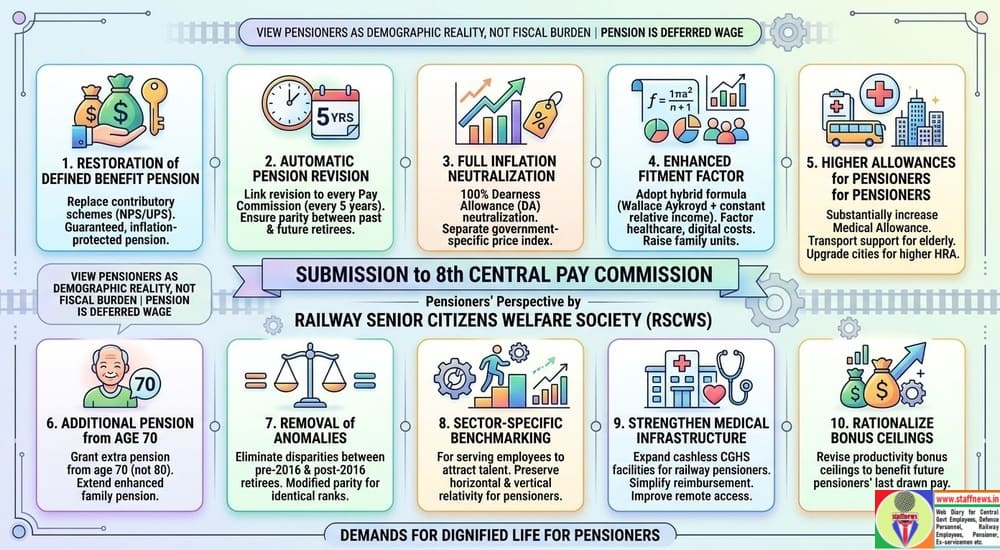
8th Central Pay Commission – Submission on Pay, Allowances and Pension – Pensioners’ Perspective by Railway Senior Citizens Welfare Society. The RSCWS submission urges the 8th Pay Commission to treat pension as deferred wage, restore defined benefit pension, ensure full inflation neutralization, remove inter-generational anomalies, enhance medical and transport allowances, and view growing pensioners as a demographic reality, not a fiscal burden. Key demands put forth by the Railway Senior Citizens Welfare Society (RSCWS) to the 8th Central Pay Commission:
- Restoration of Defined Benefit Pension – Replace contributory schemes (NPS/UPS) with a guaranteed, inflation-protected defined benefit pension for all employees and pensioners.
- Automatic Pension Revision – Link pension revision to every pay commission cycle (every five years) to ensure parity between past and future retirees.
- Full Inflation Neutralization – Provide 100% dearness allowance neutralization for pensioners and consider a separate government-specific price index.
- Enhanced Fitment Factor – Adopt a hybrid fitment factor combining the Wallace Aykroyd formula and constant relative income approach, factoring in healthcare, digital costs, and insurance premiums, with consumption units per family raised from three to four.
- Higher Allowances for Pensioners – Substantially increase fixed medical allowance; introduce transport allowance support for elderly; upgrade cities with tourism importance for higher HRA classification.
- Additional Pension from Age 70 – Grant extra pension from age 70 instead of the current 80, and extend enhanced family pension for longer duration.
- Removal of Anomalies – Eliminate disparities between pre-2016 and post-2016 retirees, and ensure modified parity for pensioners of identical ranks irrespective of retirement date.
- Sector-Specific Benchmarking – For serving employees, adopt sector-specific pay benchmarking to attract talent, while preserving horizontal and vertical relativity for pensioners.
- Strengthen Medical Infrastructure – Expand cashless CGHS-like facilities for railway pensioners, simplify reimbursement, and improve access in remote areas.
- Rationalize Bonus Ceilings – Revise unrealistic productivity-linked bonus ceilings to benefit future pensioners’ last drawn pay.
Text of RSCWS Memorandum is reproduced below:-
RAILWAY SENIOR CITIZENS WELFARE SOCIETY
(Estd. 1991, Regd. No. 1881 – Under Registration of Societies Act),
IDENTIFIED BY DOP&PW – UNDER PENSIONERS’ PORTAL GOVT. OF INDIA
FORMER MEMBER, SCOVA (STANDING COMMITTEE FOR VOLUNTARY AGENCIES)
AFFILIATED WITH BHARAT PENSION SAMAJ DELHI
No. RSCWS/CHD/8thCPC/2026-12
Dated: 14.03.2026
The Chairperson,
8th Central Pay Commission,
Smt. Justice Ranjana Prakash Desai
3rd and 7th floor,Chanderlok Building, Janpath,
NEW DELHI- 110001.
Subject: Submission on Pay, Allowances and Pension – Pensioners’ Perspective by Railway Senior Citizens Welfare Society.
Respected Madam,
The Railway Senior Citizens Welfare Society (RSCWS), Ex. SCOVA member under the aegis of Department of Pension & Pensioners Welfare and Under the Ministry of Personal, Public Grievance and Pension is a voluntary organization committed to safeguarding and promoting the rights and welfare of retired railway employees and their dependents. Based in the Tricity region, the Society actively raises issues concerning pensioners, including pension, healthcare, and other post- retirement benefits, by representing their concerns before the concerned authorities. Through its website www.rscws.com, the Society provides a dedicated platform to disseminate information, highlight grievances, and advocate policy reforms affecting railway pensioners across the country. Presently, the Society has a membership of around four hundred members in the Tricity & from different parts of India, reflecting its growing role as a collective voice for railway pensioners at personal, regional and national levels.
In and endeavor to update the knowledge of our members, Society regularly conducts Executive Meetings, General Body Meetings, Medical Seminars, Medical Camps on various healthcare issues and publish a quarterly journal named “Pensioners Rail Sampark” (PRS). With Regards,
Sd/-
(G.P. Singh)
Secretary General/RSCWS
On behalf of the Railway Senior Citizens Welfare Society, I respectfully submit the following views on the Questionnaire of the 8th CPC, with primary emphasis on the rights, dignity and financial security of Railway Pensioners and Family Pensioners.
Pay Matters
Q1. Implementation of the recommendations of a Pay Commission has macroeconomics impacts. Some of these are positive in terms of boost to consumption and savings whilst others are negative in terms of the higher fiscal deficit, inflationary potential & crowding out of other expenditure such as for overall development & public welfare. Decisions in this regard involve choices. Based on current state of the economy & the country’s aspirations, what should be the guiding philosophy which must underpin the overall approach of the 8th CPC?
Answer
The guiding philosophy of the 8th Central Pay Commission should be based on social justice, dignity of labour, and protection of deferred wages. Pension is not a charity but a constitutionally recognized right. As held by the Hon’ble Supreme Court in D. S. Nakara vs. Union of India, pension is a “deferred wage” earned for past service and must remain the guiding principle.
While macroeconomic stability is important, the share of pay and pensions in the Central Government’s revenue expenditure has steadily declined. Expenditure on pay and allowances reduced from 10.45% in 2015- 16 to 7.05% in 2022- 23. Central Government services involve complex responsibilities and require highly competent personnel recruited through strict standards.
Pension expenditure should be viewed as a social security investment, not a fiscal burden. The Government must continue to act as a Model Employer, ensuring fair wages and pensions to sustain morale and trust in public institutions.
A decent standard of living should include health, dignity, economic comfort, essential social needs, and protection against unforeseen hardships. The pay structure fixed a decade ago and CPI- IW- based DA calculations no longer reflect actual market prices of consumer goods across the country.
Horizontal Relativity
Q2. Pay determination in organisations including Government involves “horizontal relativity” i.e. for analogous posts across domains/cadres being placed in the same level/scale & “vertical relativity” i.e. on promotion, transition to a higher scale/band of pay. Relativity within different posts of Government has been broadly established over time. However, relativity/positioning between pay and perquisites in Government and the private sector is less established. How should the 8th CPC assess/evaluate relativity between pay & perquisites in Government and the public/private sector?
Answer
Horizontal and vertical relativity within Government services must be preserved to protect parity among retirees of analogous posts. Pensioners must not suffer erosion of status due to distortions in pay structuring. For within Government the spirit of Supreme Court Judgments of “Promotion thus not only covers advancement to higher position or rank but also implies advancement to a higher grade”, 7th CPC recommendations of “when the employee receives a promotion or a non- functional financial upgrade, he/she progresses one level ahead on the horizontal range” and of 6th CPC’s “Grade pay being progressively higher for successive higher posts, the employees on promotion will get monetary benefit on promotion in the form of the increased grade pay apart from the benefit of one additional increment,” should be followed.
Sector- specific benchmarking may be adopted for serving employees; however, for pensioners, the principle of modified parity must be ensured. Pensioners of identical ranks must receive equitable treatment irrespective of date of retirement. Any improvement in pay scales must automatically reflect in pension revision to avoid discrimination between past and future retirees.
Benchmarking
Q3. Should 8th CPC consider uniform horizontal relativity across all government departments, or should it consider sector- specific benchmarking where government functions are compared with their respective industry peers? For instance, should compensation for government engineers be benchmarked against private sector engineering firms, financial officers against the BFSI sector, and healthcare professionals against private healthcare? What would be the advantages and implementation considerations of such an approach?
Answer
8th CPC should consider sector specific benchmarking; this will ensure better talent attraction and retention in critical sectors; skill sets in line with market reality and reduced attraction towards private sectors. Central Government employees’ duties, accountabilities, adherence to Government employees’ role on implementation of policies and regulatory functions should be given weightage. Bench marking based on criteria like size and value of infrastructure installed and maintained, accountability of Government to the public, contribution of particular sector for growth of economy and industry, type of services provided, essentiality of service to the citizens, availability of service round the clock working, accountability in operation, safety, etc, should be considered. Sector specific benchmarking will keep the sector fresh and updated. Administrative & financial rules, subjected for scrutiny & RTI, etc, should be given due weightage.
Administrative & financial rules, subjected for scrutiny & RTI, etc, should be given due weightage.
Factoring Compensation Matrix and Relative positioning viz- a- viz the Private Sector:
Q4. Security of tenure, a training regimen, housing, leave encashment, predictable increments, medical coverage, time bound progression, inflation indexed salary, retiral benefits are certain features associated with most jobs in Government. How should these be factored in while crafting a compensation matrix and relative positioning viz- a- vis the private sector?
Answer
Security of tenure, inflation indexing, housing, medical facilities, and retiral benefits are intrinsic features of Government employment. However, post- retirement medical inflation, reduced earning capacity, and increased healthcare dependency must be recognized distinctly.
Railway pensioners, particularly those in remote areas, face challenges in accessing medical facilities under RELHS. Expansion of cashless medical facilities, uniform empanelment of reputed hospitals at par with CGHS, and simplified reimbursement procedures are essential.
Responsibility of governance and accountability held by Government employees to public work cannot be compared with private sector. Governance includes managing private sectors. While private sector works for profit, Government service is for rendering quality service to public without any favoritism. The principles of equity and social justice cannot be achieved by paying less to the Government employees. Since Government employees are the arms of the Government by which the policies, projects and welfare schemes are implemented and therefore they have to be strong and independent. The financial independence & soundness will help them to make decisions more boldly and judiciously, in the best interest of the policies of the Government.
Influence on Informal/Gig Sector
Q5. Government employment is part of the organized sector. A far larger proportion of the job force is in the informal sector and the gig economy. What influence do you think entry level pay scales implemented by Government have on compensation practices in the informal or gig sector?
Answer
Government pay- scales often serve as benchmarks for organized employment. Fair pay and pension revision positively influence broader wage structures in the economy. Strengthening pension systems also promotes social stability and inter- generational economic balance.
However informal sectors are expected to improve as happened in the past after the implementation of recommendations of previous Pay Commissions. Central Government pay particularly for entry level is expected to set a bench mark for private sectors. When earning proposition of organized sector improves, improvement in informal sector will happen. Implementation of 8th CPC recommendations will have positive influence on the informal sector; it will improve overall living and social standard.
Fitment Factor
Q6. Salaries in Government have a distinct element of compensation for length of service (increment, usually annual), an element of neutralization for changes in cost of living/inflation (clearness allowance) & an element for higher responsibilities based on seniority/merit (pay scale on promotion). In that context, what do you think the “fitment factor” adopted by Pay Commissions should represent? What should such a fitment factor principally aim for?
Answer
The fitment factor should aim at restoring real income lost due to inflation and structural distortions. For pensioners, a uniform and adequate fitment factor must be applied to ensure meaningful enhancement in basic pension.
Hybrid system of calculating fitment factor using Dr. Wallace Aykroyd’s formula followed by 7th CPC and constant relative income approach followed by 5th CPC should be considered. Consumption expenses towards regular consumable items, internet charges, premium towards health insurance should be made part of calculation while calculating fitment factor. Consumption units per family should be made as four instead of three.
Key suggestions:
- Consumption unit per family to be considered as four.
- Inclusion of healthcare inflation, digital connectivity costs, and insurance premiums.
- Multiple fitment factors may be considered for different levels, but pension revision must maintain parity.
Apex/Pinnacle Scale Determination
Q7. Salary of a Secretary in the Central Government typically represents the apex or the pinnacle i.e. the highest end of the scale. What should be the principle for determining this? Should there be a variable pay component for such position?
Answer
While apex pay determination concerns serving officers, pensioners emphasize that maximum pension should reflect responsibility and contribution, without arbitrary ceilings that erode relativity.
Fixation of Pay Scales and Rates
Q8. How can pay scales for all Group A Services be fixed so as to attract candidates of the requisite caliber? Should pay scales be more attractive at entry point or later, after a few years in service? What principles should guide such differentiation to ensure competitive positioning for talent-critical roles while maintaining fiscal prudence?
Answer
Present compensation package does not attract suitable talent in the Government services, as far better packages are offered by the private & corporate sectors. As a result, talented people are staying away from Government Services or leaving at first chance. The guiding principle should be career- long attractiveness, ensuring fiscal prudence and retention of worthy experienced officers and employees.
Frequency of Increments
Q9. How should rates and frequency of increments in respect of different scales of pay be determined? Should these be uniform or vary across scales/time periods during service?
Answer
Reasonable annual increments (suggested 6% ) and promotional increments (12%) (12%) will ensure healthy pension fixation for future retirees. Since pension is linked to last drawn pay, fair increment structure directly influences long- term pension adequacy. It should be more attractive.
Allowances
Q10. Over course of time, many allowances have been introduced or rationalized based on specific nature of work, expenses such as on travel, compensation for hardship/risk/ peculiarities associated with place of posting etc. Most of these are partially inflation indexed. An alternative approach has been the Cafeteria Approach followed by Central Public Sector Enterprises (CPSEs), wherein except for a handful of allowances, executives choose from a set of perquisites & allowances, subject to an overall ceiling of basic pay. Which approach do you think is more appropriate for Central Government employees?
Answer
Allowances should remain inflation- indexed. HRA percentages should be enhanced considering urban cost realities. However, for pensioners:
A fixed Medical Allowance must be substantially enhanced keeping in view the quality health delivery system and vulnerability to ailments at the fag end of life. Transport Allowance equivalent support for elderly pensioners needs to be considered. National Holiday compensation should benefit re- employed pensioners where applicable.
All allowances should be made inflation proof. Payment of HRA shall be continued to pay in percentage to Basic Pay. Existing 27%, 18% & 9% should be enhanced. Cities / towns with tourism importance should be upgraded one level higher for the purpose of HRA to compensate the high- level cost of living.
Pensions – Core Concern
Q11. The Seventh Pay Commission had assessed that in January, 2014, there were about 47 lakh serving Central Government personnel. This included CAPF, Railways & Defence forces. The number of pensioners was just short of 52 lakhs. In 2025-26, the number of Central Government personnel stands at about 50 lakhs, which the number of pensioners is almost 70 lakhs. The increase in the number of pensions has created additional demands on Government’s Budget. What approaches could help to satisfy reasonable expectations of pensioners whilst keeping the fiscal impact within manageable limits?
Answer
The Fifth Central Pay Commission emphasized that pension is not charity but a statutory, inalienable, and enforceable right earned through years of service. Retired government employees should be treated with dignity and courtesy befitting their age. The Eighth Central Pay Commission is requested to uphold this principle in both letter and spirit.
The National Pension System and Unified Pension Scheme have caused significant discontent among employees due to perceived anomalies and disparities. As contributory pension schemes, they are seen as inconsistent with the principle laid down in D. S. Nakara v. Union of India, which defined pension as deferred wages for past service. The growing number of pensioners should be viewed not as a fiscal burden but as a demographic reality resulting from increased life expectancy.
Suggested measures include:
Suggested measures include:
- Restoration of a Defined Benefit Pension for all employees.
- Automatic pension revision every five years with pay revision.
- Additional pension from age 70 instead of 80.
- Full inflation neutralization for all pensioners.
- Enhanced family pension for longer duration.
- Removal of anomalies between pre- and post-2016 retirees.
Pensioners must be treated with dignity, courtesy, and procedural simplicity.
Dearness Allowance
Q12. The Seventh Pay Commission was constituted in 2014 and implemented from 1.1.2016. The period since then has been marked by a lower trajectory of inflation, as compared to earlier decades. This is also reflected in the All- India Consumer Price Index (Industrial Workers) which is used for DA calculation. Should the 8th CPC explore a hybrid indexation approach that factors in both inflation protection and formal sector wage growth trends? What proportion might be reasonable for each component and what implementation considerations would arise? What are your expectations on inflation/CPI increase over the next 10 years?
Answer
The DA formula must be realistic. The recommendation of the 6th CPC for a separate consumption basket for Government employees deserves reconsideration. Dearness Allowance is paid to Central Government employees to adjust the cost of living and to protect their Basic Pay from erosion in the real value on account of inflation. DA is based on the All- India Consumer Price Index (Industrial Workers). Every Pay Commissions observed some inconsistencies in the method of computing dearness allowance. 6th CPC looked into the weightages assigned to various components of consumption and the manner in which the Labor Bureau conducts the survey.
The 8th CPC should:
Consider a government- specific price index.
Follow the principle of 50% DA merger with basic pay/pension as recommended by the 5th CPC. Ensure 100% neutralization for pensioners at all levels.
Railways, CAPF and Defense:
Q13. Railways, CAPF and Defence forces typically account for about 70% of Central Government personnel. What particular considerations, monetary or nonmonetary should be factored in while determining their pay & allowances?
Answer
Railways like Defense have a pan- India work field; rather Railways work 24×7 round the year on a regular basis. Railway employees have also to bear the brunt of transfers across the length & breadth of the country. Indian Railway employees contribute significantly to national logistics and mobility, including to Defense. Despite workforce reduction, revenues have increased substantially. Pensioners who dedicated decades to 24×7 operational service deserve equitable post- retirement security. Gross revenue receipt of Indian Railways has increased by 51.6% from Rs. 1,68,379.6 crores in 2015- 16 to Rs. 2,55,272.63 crore in 2023- 24. In the same period number of employees has been reduced by 6%, from 1.33 lakh to 1.252 lakh. Employees’ contribution towards improved performance of Railways must also be taken into consideration.
Special considerations:
- Enhanced Risk and Hardship recognition in pension fixation.
- Strengthened medical infrastructure for Railway retirees.
- Realistic revision of Productivity Linked Bonus ceiling for serving employees, impacting future pensioners.
Scientists
Q14. Scientists work in certain specialized streams/departments such as Department of Space, Department of Atomic Energy etc. What should be appropriate benchmarks to be kept in mind for fixing their emoluments?
Answer
For scientists of departments such as Department of Space and Department of Atomic Energy, pension structures must recognize long- term intellectual contributions and ensure competitive post- retirement dignity.
Armed Forces
Q15. Military Service Pay is currently admissible to personnel of Armed Forces. This was in recognition of the special nature of their duties. In that context and given the changing nature of their jobs, how should the pay of soldiers, sailors and air force personnel be determined? How should it relate to the starting salary in Government or the pay of a constable in CAPFI Police?
Q16. The nation has many more military pensioners than serving military personnel. In 2025-26, outgo on Defence Pensions is likely to be higher than the outgo on Defence salary and allowances. As overall defence pension bill increases, in line with projections, impact will be visible on equipment and arms purchase, their maintenance and on modernization of defence forces. What changes would you recommend to contain increases in defence manpower costs and its pension bill?
Answer
Armed Forces personnel face extraordinary risks. Defined Benefit Pension must continue. Specialized disability pensions and family pensions must remain protected. Fiscal consolidation should not compromise national safety & gratitude.
Bonus
Q17. Productivity Linked Bonus (PLB) is paid to some employees of Government such as Railways, Postal staff whilst Non-Productivity Linked Bonus is given to specified Central Government employees including some in Armed Forces. How can the Bonus structure be reimagined for rewarding excellence in productivity & performance? Should PLB/ Ad- hoc Bonus continue to be given on uniform basis (e.g. 60 days of salary for all) or be differentiated, based on individual performance?
Answer
Bonus is a deferred wage. Unrealistic ceilings must be revised. Pensioners advocate rational PLB reform so that future retirees are not structurally disadvantaged.
Reforms in Staffing
Q18. Contractual appointments in the form of lateral entry have been tried during the last few years. Do you think this should be expanded and other practices such as part- time work, flexi time etc. be introduced in Government at middle/ higher levels to tap a bigger talent pool? What could be the pros and cons of doing so?
Answer
Excessive contractual appointments may weaken long- term pension security and institutional integrity. Stable career progression ensures predictable pension outcomes and strengthens administrative accountability.
The 8th CPC presents a historic opportunity to reaffirm the Government’s commitment to its retirees, along with commitment of the existing workforce who would look forward to secure pensioners benefits on retirement. Pensioners are nation- builders who have already rendered lifelong service. Financial security in old age is not merely an economic issue but a moral obligation of the State.
We humbly request that the 8th CPC should: Protect Defined Benefit Pension, ensure full inflation neutralization, maintain parity across generations and strengthen medical and social security for retirees.
With respectful regards,
Yours faithfully,
(G.P. Singh)
Secretary General
Railway Senior Citizens Welfare Society
COMMENTS
The Chairman
8th Central Pay Commission
Government of India
New Delhi
Subject: Submission of suggestions on pension reforms for Central Government civilian pensioners
Sir,
1. Pension is the lifeline of a retired Government employee and his family. The Hon’ble Supreme Court has held that pension is not a bounty payable at the mercy of the employer but a deferred portion of compensation for long and devoted service. Retirement benefits form part of the right to livelihood under Article 21 of the Constitution. Inadequate pensionary benefits therefore raise serious constitutional concerns and affect dignity and security in old age. Pension is a social welfare measure intended to ensure that pensioners, after decades of public service, are able to lead a decent and secure life.
2. Our Association places the following specific suggestions for the Commission’s kind consideration:
(a) Fitment factor.
Adopt a uniform fitment factor in the range of 2.15 to 2.50 for revision of pension/family pension, keeping in view erosion of purchasing power since 01.01.2016 and comparability with serving employees’ pay revision.
(b) Minimum and maximum pension.
Fix minimum pension at ₹20,000 per month and cap maximum pension at ₹2,00,000 per month to keep the ratio within 1:10 and reduce disparities.
(c) Merger of Dearness Relief.
Merge 50% of Dearness Relief with basic pension when DR crosses the 50% threshold, and thereafter recalibrate DR on the merged basic pension.
(d) Notional pay fixation.
Revise pension on notional pay basis in the pay matrix, at par with the methodology adopted by the 7th CPC, ensuring parity between past and current retirees of the same grade and length of service.
(e) Health coverage.
(i) Grant Fixed Medical Allowance @ ₹5,000 per month to cover out-patient and chronic medication costs in old age.
(ii) Strengthen CGHS facilities: assured access to private ward on admission. Request change entitlement, cashless treatment in empanelled hospitals without age-related denial, and provision of branded medicines where generics are not suitable or available.
(f) Additional quantum of pension by age. Grant an additional quantum every five years, as under: 65 years – 10%; 70 years – 20%; 75 years – 30%; 80 years – 50% (instead of the present 20%); 85 years – 60%; 90 years – 70%; 95 years – 80%; 100 years – 100%; and thereafter an additional 10% for every five years. The increase at 80 and 100 years should be treated as an extra incentive for longevity and higher medical needs.
(g) Travel facility.
Extend LTC facility to pensioners once in four years for pilgrimage/personal travel, on lines of post-retirement passes available to retired Railway personnel and similar travel concessions admissible to retired transport sector employees.
(h) Commutation restoration.
Restore commuted portion of pension after 10 years instead of the present 15 years, in view of changes in life expectancy, interest rates and recovery periods.
3. We request that the Commission recommend appropriate budgetary protection for pension outgo, periodic indexation, and parity principles so that pensioners are not disadvantaged vis-à-vis serving employees of comparable grade and service.
Yours faithfully,
(Surinder Singh)
Convenor, Army Civilian Pensioners Association, Bharat (Proposed)
Ex-Ordnance Depot Shakurbasti now OSG, COD Delhi Cantt.
Mob: 9810189472
Email: sidhusurinder1942[at]gmail.com
Please offer your comments/rply to my submission to 8th CPC
Pre-2006 pensiones are getting much lower pension than their counterparts.Pension must not be fixed as per date of retirement.Even I am getting much lower pension than the pensioners retiring now in much lower ranks which is grave injustice.Moreover,ACP,MACP,NFU upgradation benefits must be given to each and every pensioner irrespective of date of retirement .A pensioner retired in 10000-15200 5th cpc scale ie.with Rs 6600 grade pay scale is getting much lower pension now than a pensioner retired in 6th cpc /7th cpc in the existing 5th cpc scale of 6500-10500 scale with 6th cpc Rs 4600 grade pay in much lower rank and number of years of service and there lies a huge anomaly amoong the present and past retirees which is grave injustice.If the same is not not rectified now,anomaly will further increase in the further pay commissions.