
8th Central Pay Commission – Submission of Views/Comments on the Questionnaire by BPMS. The Bhartiya Pratiraksha Mazdoor Sangh (BPMS) has submitted its views to the 8th Central Pay Commission (CPC), advocating for a pay structure that ensures fair, adequate, and socially just compensation for government employees, acknowledging their vital role in national development. The BPMS emphasizes that the 8th CPC’s guiding philosophy should uphold the dignity, responsibility, and importance of public service. It calls for a balanced approach that protects employees from rising costs, ensures a reasonable standard of living, and provides social security post-retirement. Fair wages are seen as crucial for boosting purchasing power and supporting economic growth.
Main Demands:
1.Fitment Factor: A substantial and equitable fitment factor is demanded to provide a meaningful increase in pay, compensating for real wage erosion and improving living standards.
2.Private Sector Comparison: Direct comparison with the private sector is deemed inappropriate due to the unique nature of public service. Government pay should be superior and commensurate with responsibilities.
3.Uniform Relativity: BPMS advocates for maintaining uniform horizontal relativity across departments to ensure equity and administrative simplicity, with limited sector-specific incentives for critical roles.
4.Non-Monetary Benefits: Job security, training, housing, medical coverage, and retirement benefits are considered integral service conditions, not substitutes for fair wages.
5.Entry-Level Pay: Government entry-level pay scales should be enhanced to serve as a benchmark for fair wages across the broader labor market.
6.Old Pension Scheme (OPS): A key demand is the restoration of the OPS, viewing pension as a deferred wage and essential for social security.
7.Dearness Allowance (DA): Inflation protection must remain the sole basis for DA determination, opposing hybrid indexation.
8.Special Considerations: Unique working conditions of Railways, CAPF, and Defence Forces require special consideration in pay, allowances, and welfare.
9.Scientists’ Compensation: Competitive compensation is sought for scientists, benchmarked against leading national and international institutions.
10.Military Service Pay: Armed Forces pay must reflect the distinct nature of military service, risks, and shorter service spans, remaining higher than comparable civilian posts.
11.Bonus Structure: PLB/Ad-hoc Bonus should continue on a uniform, equitable basis, recognizing collective institutional effort, with an enhanced calculation ceiling.
12.Contractual Appointments: BPMS opposes the expansion of contractual appointments, lateral entry, and outsourcing, advocating for strengthening regular recruitment.
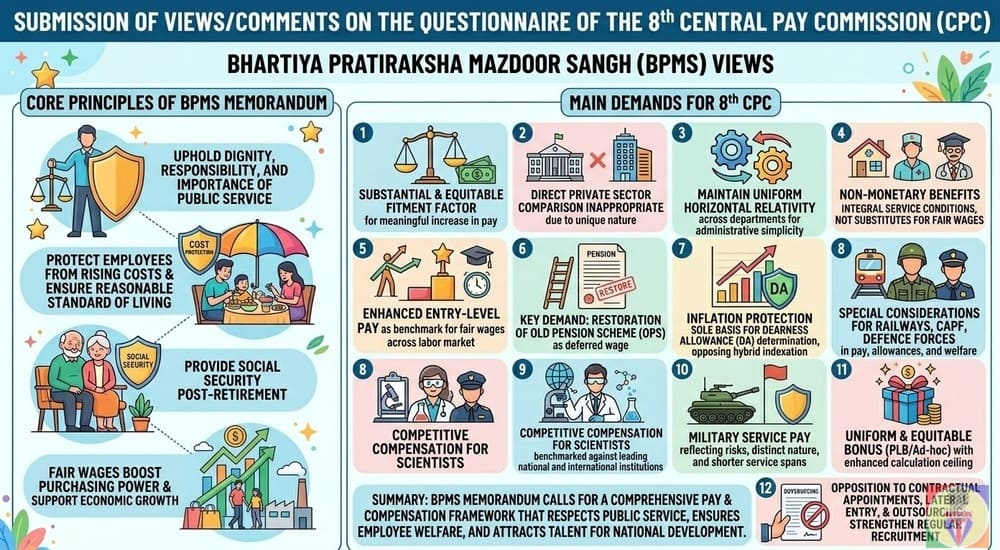
In essence, the BPMS memorandum calls for a comprehensive pay and compensation framework that respects the value of public service, ensures employee welfare, and attracts talent for national development. The text of BPMS Circular on 8th CPC is reproduced below:-
Bhartiya Pratiraksha Mazdoor Sangh
(AN ALL INDIA FEDERATION OF DEFENCE WORKERS)
(AN INDUSTRIAL UNIT OF B.M.S.)
(RECOGNISED BY MINISTRY OF DEFENCE, GOVT. OF INDIA)
CENTRAL OFFICE : 2- A, NAVIN MARKET, KANPUR- 1
REF: BPMS/ Cir/ 20th TC/ 22
Dated: 16.03.2026
To,
The Office Bearers/ CEC Members
BPMS &
The Presidents/ General Secretaries
Unions affiliated to this federation
Subject: Submission of Views/Comments on the Questionnaire of the 8th Central Pay Commission.
Dear Brothers and Sisters, Sadar Namaskar,
This is to inform all Office Bearers, Central Executive Committee Members of the Federation, and the Presidents/General Secretaries of all affiliated Unions that the Federation (BPMS) has examined the Questionnaire issued in connection with the 8th Central Pay Commission and has submitted its considered views/comments to the Commission.
The submission reflects the collective concerns and aspirations of Defence Civilian Employees and emphasizes the need for fair, adequate, and socially just compensation, while ensuring parity, transparency, and a realistic pay structure in view of the rising cost of living and the vital role played by Government employees in national development.
A copy of the submission made by the Federation is enclosed herewith for your information and study. All Office Bearers and affiliated Unions are requested to go through the same carefully and create necessary awareness among the members.
This is issued for your information.
With regards,
Brotherly Yours,
(Rabindra Kr Mishra)
General Secretary
8th Pay Commission’s Questionnaires
Q1. Implementation of the recommendations of a Pay Commission has macro economics impacts. Some of these are positive in terms of boost to consumption and savings whilst others are negative in terms of the higher fiscal deficit, inflationary potential & crowding out of other expenditure such as for overall development & public welfare. Decisions in this regard involve choices. Based on current state of the economy & the country’s aspirations, what should be the guiding philosophy which must underpin the overall approach of the 8 CPC?
Answer: In the present Indian context, the guiding philosophy of the 8th Central Pay Commission should be to ensure fair, adequate and socially just compensation to Government employees while supporting national development and economic stability. Government employees play a crucial role in implementing public policies, delivering essential & emergency services and strengthening governance across the country. Therefore, their remuneration must reflect the dignity, responsibility and importance of public service.
The Pay Commission should adopt a balanced and realistic approach that protects employees from the rising cost of living, ensures a reasonable standard of living and provides social security after retirement. At the same time, it should recognize that fair wages for government employees contribute positively to the economy by enhancing purchasing power, increasing domestic demand and supporting economic growth.
The philosophy should also focus on equity, transparency and parity across different cadres and sectors of government service, while addressing long- standing anomalies. Adequate attention should be given to pension security, career progression and working conditions.
While fiscal prudence is necessary, it should not undermine the legitimate expectations of employees who are committed to nation- building. The 8th CPC should therefore aim to create a sustainable, equitable and future- oriented pay structure that strengthens both employee welfare and national development.
Q2. Pay determination in organisations including Government involves “horizontal relativity” i.e. for analogous posts across domains/cadres being placed in the same level/scale & “vertical relativity” i.e. on promotion, transition to a higher scale/band of pay. Relativity within different posts of Government has been broadly established over time. However, relativity/positioning between pay and perquisites in Government and the private sector is less established. How should the 8th CPC assess/evaluate relativity between pay & perquisites in Government and the public/private sector?
Answer: Earlier Central Pay Commissions have consistently observed that a direct comparison between Government and private sector compensation is neither entirely appropriate nor practicable, as the nature, objectives and responsibilities of public service differ significantly from those in the private sector. Government employees are entrusted with implementing national policies, maintaining public institutions and delivering essential services to citizens across the country, often under difficult conditions and with a high degree of public accountability and transparency.
The 8th Central Pay Commission should therefore evaluate relativity between Government and private sector compensation by recognizing the unique character and obligations of public service. Unlike the private sector, Government employees are subject to strict conduct rules, transfer liabilities, limitations on collective bargaining, and greater scrutiny in discharge of their duties. They are also required to serve in remote, difficult and strategically important areas where private sector employment opportunities may not exist.
In view of these responsibilities and constraints, the pay structure of Central Government employees should ensure adequate and respectable compensation that is superior and commensurate with the responsibilities and accountability entrusted to them. Such an approach will help attract and retain capable individuals in public service, maintain morale and ensure efficient delivery of public services.
Therefore, while private sector trends may be used as a broad reference, the guiding principle should be to provide fair, dignified and relatively better compensation for Government service in recognition of its national importance and public responsibilities.
Q3. Should 8th CPC consider uniform horizontal relativity across all government departments, or should it consider sector-specific benchmarking where government functions are compared with their respective industry peers? For instance, should compensation for government engineers be benchmarked against private sector engineering firms, financial officers against the BFSI sector, and healthcare professionals against private healthcare? What would be the advantages and implementation considerations of such an approach?
Answer: Earlier Central Pay Commissions have consistently emphasized the importance of maintaining uniformity and internal relativity in Government pay structures. The 6th and 7th Central Pay Commissions observed that Government functions are part of an integrated administrative system and therefore excessive sector- specific benchmarking with private industry may lead to distortions, disparities and administrative complications within the civil services.
While certain technical and professional categories such as engineers, doctors, scientists and financial specialists may have comparable roles in the private sector, Government service operates under different conditions including public accountability, statutory responsibilities, transfer liability and service in remote or difficult areas. Therefore, direct sector- wise benchmarking with private industry cannot be the primary basis for determining pay.
The 8th CPC should primarily preserve uniform horizontal relativity across departments and cadres to ensure equity, transparency and administrative simplicity in the Government pay structure. At the same time, the Commission may examine specific professional categories where recruitment and retention challenges exist and recommend limited and carefully designed incentives or allowances to address such concerns.
Such an approach will maintain the integrity of the Government pay framework while ensuring that specialized talent required for critical public functions continues to be attracted and retained in Government service.
Q4. Security of tenure, a training regimen, housing, leave encashment, predictable increments, medical coverage, time bound progression, inflation indexed salary, retrial benefits are certain features associated with most jobs in Government. How should these be factored in while crafting a compensation matrix and relative positioning viz- a- vis the private sector?
Answer: Features such as security of tenure, training systems, housing facilities, leave encashment, medical coverage, predictable increments, inflation- indexed salary and retrial benefits are essential elements of the public service framework and should not be treated as substitutes for fair wages. These provisions have evolved over decades to ensure stability, integrity and efficiency in Government administration.
Earlier Pay Commissions have also recognized that Government employment operates under conditions significantly different from the private sector. Public servants are required to maintain strict standards of conduct, accept nationwide transfer liability, work in remote and difficult areas and discharge duties under constant public scrutiny. In such circumstances, institutional safeguards like job security, pension and structured career progression are necessary to maintain neutrality, independence and continuity in public administration.
Therefore, while designing the compensation matrix, these elements should be treated as integral service conditions required for effective governance, rather than as financial advantages that justify lower pay levels. The primary objective of the pay structure should remain to provide fair and dignified compensation that enables Government employees to maintain a reasonable standard of living and perform their duties with commitment and integrity.
Consequently, comparison with the private sector should not lead to undervaluation of Government service, and the pay structure should adequately reflect the responsibilities and public importance of Government employment.
Q5. Government employment is part of the organized sector. A far larger proportion of the job force is in the informal sector and the gig economy. What influence do you think entry level pay scales implemented by Government have on compensation practices in the informal or gig sector?
Answer: Entry level pay scales of Government employees have an important influence on compensation practices across the broader labour market. Historically, the pay structure of Government service has served as a benchmark for fair wages in the organised sector, and indirectly influences wage expectations in other sectors of the economy.
Although a large proportion of India’s workforce is engaged in the informal sector and the gig economy, the wage standards established in Government employment create a reference point for determining reasonable wage levels. When the minimum pay of Government employees is fixed at a fair and adequate level, it helps set a normative standard for decent wages, encouraging better compensation practices even in sectors outside Government. Trade unions, particularly those committed to improving the conditions of workers in the unorganised sector, have consistently emphasized the importance of such benchmarks. It has always been the objective of Bharatiya Mazdoor Sangh to organize and uplift workers in the unorganised sector, and the wage policies of Government play a significant role in advancing this objective.
Therefore, the 8th Central Pay Commission should ensure that the minimum pay of Government employees is determined at an appropriately enhanced level, reflecting the cost of living and the principle of a dignified livelihood. A fair minimum pay will not only benefit Government employees but will also contribute positively to improving wage standards across the world of work.
Q6. Salaries in Government have a distinct element of compensation for length of service (increment, usually annual), an element of neutralization for changes in cost of living/inflation (dearness allowance) & an element for higher responsibilities based on seniority/merit (pay scale on promotion). In that context, what do you think the “fitment factor” adopted by Pay Commissions should represent? What should such a fitment factor principally aim for?
Answer: Earlier Central Pay Commissions have recognized that the “fitment factor” is an important mechanism to ensure a smooth transition from the existing pay structure to the revised pay structure recommended by a new Pay Commission. It essentially represents the multiplying factor applied to the existing basic pay (including merged Dearness Allowance where applicable) in order to arrive at the revised pay in the new pay matrix.
The fitment factor should therefore primarily aim at providing a reasonable and equitable increase in pay to all employees, while maintaining established internal relativities between different pay levels and cadres. The 6th Central Pay Commission introduced the concept of a uniform fitment benefit, and the 7th Central Pay Commission adopted a fitment factor of 2.57 to ensure a rational transition to the new pay matrix.
For the 8th Central Pay Commission, the fitment factor should reflect three key considerations: adequate compensation for the erosion of real wages over time, a meaningful improvement in the standard of living of employees, and proper alignment with the revised pay structure. It should also ensure that employees at all levels receive a fair share in pay revision without disturbing existing hierarchies.
From the employees’ perspective, the fitment factor should represent a substantial and visible enhancement in basic pay, ensuring that the revised pay structure provides motivation, fairness and financial security to serving employees as well as pensioners.
Q7. Salary of a Secretary in the Central Government typically represents the apex or the pinnacle i.e. the highest end of the scale. What should be the principle for determining this? Should there be a variable pay component for such position?
Answer: The post of Secretary to the Government of India represents the highest level of the civil service and carries immense responsibility in policy formulation, governance and national administration. Therefore, the salary of the Secretary should be determined in a manner that reflects the high level of responsibility, leadership and accountability attached to the position and should be sufficiently attractive to uphold the dignity and importance of the office.
At the same time, earlier discussions within the labour movement and views expressed by trade unions have consistently emphasized the need for maintaining a reasonable and socially just pay ratio between the lowest and the highest levels of Government service. Trade unions have long advocated that the ratio between the minimum pay and the maximum pay in Government should be broadly maintained within 1:10, so that equity and fairness are preserved within the public pay structure.
Accordingly, while ensuring a handsome and respectable salary for the Secretary to the Government of India, the determination of the apex salary should also maintain a balanced and equitable relationship with the minimum pay of Government employees.
As far as variable pay is concerned, Government service traditionally functions on the principles of objectivity, neutrality and collective responsibility. Therefore, introducing a variable pay component linked to performance may not be appropriate at the apex level of the civil service.
Q8. How can pay scales for all Group A Services be fixed so as to attract candidates of the requisite caliber? Should pay scales be more attractive at entry point or later, after a few years in service? What principles should guide such differentiation to ensure competitive positioning for talent-critical roles while maintaining fiscal prudence?
Answer: Earlier Central Pay Commissions have consistently observed that the objective of the Government pay structure is to attract, retain and motivate competent individuals for public service while maintaining fairness and fiscal responsibility. In the present context, where the private sector offers highly competitive salaries and faster career progression, it is important that Government pay scales for Group ‘A’ services remain sufficiently attractive to draw talented candidates into public administration.
The pay structure should therefore ensure a reasonably competitive entry- level salary, so that meritorious candidates are encouraged to join Government service. At the same time, the pay progression during the career should be designed in such a manner that officers continue to remain motivated and committed to long- term public service.
Earlier Pay Commissions have emphasized the importance of predictable career progression, periodic pay upgradation and recognition of higher responsibilities at different stages of service. Accordingly, the pay scales should combine an attractive entry pay with assured and meaningful growth over time through promotions, increments and career progression schemes.
While maintaining fiscal prudence, the guiding principles should include fairness, internal relativity across services, transparency and recognition of professional expertise, particularly in talent- critical sectors such as technology, finance, health and engineering.
Such a balanced approach will help the Government continue to attract capable individuals while ensuring stability and efficiency in public administration.
Q9. How should rates and frequency of increments in respect of different scales of pay be determined? Should these be uniform or vary across scales/ time periods during service?
Answer: The rate and frequency of increments in Government service should be determined in a manner that ensures fairness, motivation and reasonable career progression for employees across all levels. Earlier Central Pay Commissions have emphasized that annual increments serve not only as recognition of length of service but also as an incentive for sustained efficiency and commitment to public service.
From the perspective of employees and trade unions, annual increments should continue to remain a uniform and assured feature across all pay levels, as this ensures transparency, simplicity and equity in the pay structure. A uniform frequency of increments also helps maintain internal relativity among different services and cadres. Earlier Pay Commissions have also recognized the importance of ensuring that real wage growth does not stagnate due to inflation and long pay cycles.
Therefore, while the periodicity of increments should remain annual and uniform, the pay structure may allow adequate financial progression over the course of service through increments, promotions and career progression schemes. Such an approach would maintain administrative simplicity while ensuring that Government service remains motivating, equitable and financially viable for employees at different stages of their careers.
Q10. Over course of time, many allowances have been introduced or rationalized based on specific nature of work, expenses such as on travel, compensation for hardship/risk/peculiarities associated with place of posting etc. Most of these are partially inflation indexed. An alternative approach has been the Cafeteria Approach followed by Central Public Sector Enterprises (CPSEs), wherein except for a handful of allowances, executives choose from a set of perquisites & allowances, subject to an overall ceiling of basic pay. Which approach do you think is more appropriate for Central Government employees?
Answer: Allowances in Government service have evolved over time to address specific functional requirements, working conditions and regional peculiarities. Earlier Central Pay Commissions have rationalized various allowances to compensate employees for expenses related to travel, housing, hardship postings, risk, and other job- related requirements. These allowances are also partially indexed to inflation so that employees are protected against rising costs. From the perspective of employees and trade unions, the existing system of need- based and duty- specific allowances remains more appropriate for Central Government employees than the Cafeteria Approach followed in certain Central Public Sector Enterprises (CPSEs).
Government service is characterized by structured cadres, frequent transfers across regions, postings in difficult and remote areas, and a wide diversity of duties. In such circumstances, specific allowances designed for particular conditions of service ensure fairness, transparency and administrative clarity. These allowances are granted based on the nature of duty, place of posting and actual requirements of service.
The Cafeteria Approach, where employees select benefits within a fixed ceiling, may be suitable in corporate environments with relatively flexible job roles. However, in Government service it may create disparities, administrative complexities and difficulties in addressing location- specific hardships and operational requirements.
Therefore, trade unions are of the considered view that the existing system of clearly defined allowances linked with duties and service conditions should continue, with periodic review and rationalization by the Pay Commission to ensure adequacy and equity.
Q11. The Seventh Pay Commission had assessed that in January, 2014, there were about 47 lakh serving Central Government personnel. This included CAPF, Railways & Defence forces. The number of pensioners was just short of 52 lakh. In 2025-26, the number of Central Government personnel stands at about 50 lakh, which the number of pensioners is almost 70 lakh. The increase in the number of pensions has created additional demands on Government’s Budget. What approaches could help to satisfy reasonable expectations of pensioners whilst keeping the fiscal impact within manageable limits?
Answer: Pension is not merely a financial obligation of the Government but a deferred wage earned by employees for the services rendered to the nation during their active years of service. Earlier Central Pay Commissions have consistently recognized that pension is an integral part of the overall compensation structure meant to ensure social security, dignity and financial stability for employees after retirement.
From the perspective of employees and trade unions, pension should not be viewed solely as a fiscal burden on the Government’s Budget. Retired employees and their dependents constitute a significant segment of society whose consumption and expenditure contribute positively to the national economy, particularly in areas such as healthcare, housing, local services and household consumption. Therefore, pension payments also have a multiplier effect on economic activity.
It is important to ensure that pensioners are protected from inflation through adequate pension revision and dearness relief, as recognized by successive Pay Commissions. At the same time, administrative reforms, better financial planning and efficient budget management can help the Government meet these obligations without undue fiscal stress.
Employees’ organizations have consistently maintained that the Old Pension Scheme (OPS), which guarantees defined benefits and social security after retirement, is the most appropriate and equitable system for Government employees. Accordingly, trade unions reiterate the demand for restoration of OPS in place of contributory schemes such as NPS or UPS.
Ensuring secure pension benefits will uphold the principles of social justice, employee morale and long- term stability in public service.
Q12. The Seventh Pay Commission was constituted in 2014 and implemented from 1.1.2016. The period since then has been marked by a lower trajectory of inflation, as compared to earlier decades. This is also reflected in the All India Consumer Price Index (Industrial Workers) which is used for DA calculation. Should the 8th CPC explore a hybrid indexation approach that factors in both inflation protection and formal sector wage growth trends? What proportion might be reasonable for each component, and what implementation considerations would arise? What are your expectations on inflation/CPI increase over the next 10 years?
Answer: Successive Central Pay Commissions have emphasized that the primary objective of the Dearness Allowance (DA) mechanism is to protect the real wages of Government employees and pensioners against the impact of inflation. The existing system, which links DA to the All India Consumer Price Index for Industrial Workers (AICPI- IW), was introduced to ensure that increases in the cost of living are periodically neutralized.
However, employees and trade unions have consistently pointed out that the AICPI- IW does not always fully reflect the actual consumption pattern and expenditure profile of Central Government employees, particularly in areas such as housing, education, healthcare, transportation and other essential services where costs have increased substantially in recent years.
In this context, trade unions are of the considered view that inflation protection must remain the sole and central basis for determining Dearness Allowance, and therefore the proposal for adopting a hybrid indexation approach combining inflation with formal sector wage growth may not be appropriate for Government employees.
Dearness Allowance is intended exclusively to neutralize the rise in cost of living, and linking it with wage trends in the formal sector could dilute this fundamental objective. Instead, efforts should be made to strengthen and improve the price index so that it more accurately reflects the expenditure pattern of Government employees.
Given the uncertainties in the global and domestic economic environment, employees also expect that inflationary pressures may continue over the coming decade. Therefore, the DA mechanism should remain responsive, transparent and fully oriented towards protecting real wages.
Q13. Railways, CAPF and Defence forces typically account for about 70% of Central Government personnel. What particular considerations, monetary or non monetary should be factored in while determining their pay & allowances?
Answer: Railways, Central Armed Police Forces (CAPFs) and Defence Forces together constitute nearly 70% of the total Central Government workforce and play a vital role in national infrastructure, internal security and defence preparedness. Earlier Central Pay Commissions have also recognized that these services have distinct service conditions and operational requirements, which must be taken into account while determining their pay structure and allowances.
These services involve arduous working conditions, round- the- clock duties, frequent transfers, field postings, separation from families, exposure to risk and limited social amenities, particularly in remote or sensitive areas. Therefore, the Pay Commissions in the past have recommended various compensatory allowances such as risk and hardship allowances, field area allowances, transport facilities, housing support and improved pensionary benefits to address these challenges.
In addition to monetary compensation, non- monetary factors such as adequate housing, medical facilities, education support for children, welfare schemes, leave facilities and post- retirement rehabilitation are equally important for maintaining morale and efficiency.
Trade unions and employee organizations are of the view that the unique nature of duties performed by personnel in Railways, CAPFs and Defence services must continue to receive special consideration while determining pay, allowances and service benefits.
Ensuring fair compensation and adequate welfare measures will help maintain high morale, operational efficiency and long- term commitment among personnel serving in these critical national institutions.
Q14. Scientists work in certain specialized streams/departments such as Department of Space, Department of Atomic Energy etc. What should be appropriate benchmarks to be kept in mind for fixing their emoluments?
Answer: Scientists working in specialized departments such as the Department of Space, Department of Atomic Energy and other strategic research institutions play a crucial role in strengthening India’s scientific capability, technological advancement and strategic security. Their work contributes directly to national development, defence preparedness, energy security and India’s growing presence in the global scientific community.
Earlier Central Pay Commissions have also recognized the distinctive nature of scientific and technical services, where innovation, research excellence and long- term technological development are essential. Therefore, while determining their emoluments, it is important to ensure that the compensation structure remains competitive enough to attract and retain highly qualified scientific talent, particularly in the context of increasing opportunities in the global private and research sectors.
Appropriate benchmarks may include comparison with remuneration in leading national research institutions, international scientific organizations and high- technology sectors, while also maintaining internal parity within Government services.
In addition to salary, research facilities, professional autonomy, opportunities for international collaboration, recognition of innovation, adequate research funding and clear career progression are equally important factors in motivating scientists.
A well- balanced compensation and support system will help ensure that India continues to develop cutting- edge technologies, strengthen strategic capabilities and maintain a strong position in the global scientific landscape.
Q15. Military Service Pay is currently admissible to personnel of Armed Forces. This was in recognition of the special nature of their duties. In that context and given the changing nature of their jobs, how should the pay of soldiers, sailors and airforce personnel be determined? How should it relate to the starting salary in Government or the pay of a constable in CAPF/ Police?
Answer: The Armed Forces perform a unique and critical role in safeguarding the sovereignty, territorial integrity and security of the nation. The duties of soldiers, sailors and air force personnel involve extraordinary levels of discipline, physical and mental endurance, exposure to life- threatening risks, prolonged separation from families and service in extremely difficult terrains and operational environments. Recognizing these special conditions of service, earlier Central Pay Commissions introduced Military Service Pay (MSP) to compensate for the unique demands of military life. While determining the pay structure of Armed Forces personnel, it is essential to ensure that their remuneration reflects the distinct nature of military service, the risks involved and the relatively shorter service span of soldiers compared to many civilian services. Therefore, the pay and allowances of defence personnel should remain distinct and appropriately higher than comparable entry- level civilian posts, including constables in CAPFs or police forces, though parity in certain basic pay structures may be maintained for administrative coherence.
Earlier Pay Commissions have also emphasized that MSP and other service- specific allowances should continue to recognize the operational hardships and professional commitments of defence personnel.
From the perspective of employees’ organizations, the guiding principle should be that the compensation framework must honour the dignity, sacrifices and strategic importance of Armed Forces personnel, while ensuring adequate financial security for them and their families during and after service.
Q16. The nation has many more military pensioners than serving military personnel. In 2025- 26, outgo on Defence Pensions is likely to be higher than the outgo on Defence salary and allowances. As overall defence pension bill increases, in line with projections, impact will be visible on equipment and arms purchase, their maintenance and on modernization of defence forces. What changes would you recommend to contain increases in defence manpower costs and its pension bill?
Answer: India’s Armed Forces operate in a complex and sensitive geopolitical environment, with persistent security challenges along its borders and evolving threats in the region. Soldiers, sailors and air force personnel perform their duties under extraordinary conditions involving high risk, difficult terrains and continuous operational preparedness. In this context, pensions and service benefits for defence personnel should be viewed as a recognition of their sacrifices and as deferred compensation for safeguarding national security, rather than merely as a fiscal burden.
Earlier Central Pay Commissions have also acknowledged that defence personnel generally have a comparatively shorter service span, leading to earlier retirement and a larger number of pensioners. Therefore, a robust pension system is essential to ensure financial security for veterans and their families.
From the perspective of employees and trade unions, efforts to manage defence expenditure should focus on efficient manpower planning, optimal deployment of human resources, improved rehabilitation and second career opportunities for ex- servicemen, rather than reducing pension entitlements.
Given India’s strategic environment and the critical role played by the Armed Forces in protecting national sovereignty, it is essential that adequate pay, pension and welfare provisions continue to be ensured. Such support not only honors the service of veterans but also helps maintain high morale, motivation and commitment among serving personnel, which is vital for national security.
Q17. Productivity Linked Bonus (PLB) is paid to some employees of Government such as Railways, Postal staff whilst Non-Productivity Linked Bonus is given to specified Central Government employees including some in Armed Forces. How can the Bonus structure be reimagined for rewarding excellence in productivity & performance? Should PLB/ Ad- hoc Bonus continue to be given on uniform basis (e.g. 60 days of salary for all) or be differentiated, based on individual performance?
Answer: Government functioning is the result of collective institutional effort, where contributions from all levels of administration—from the highest policy- making level to the field- level implementation—play an important role. The effective delivery of public services depends on the coordinated work of officers and staff across the entire organizational structure.
At present, Productivity Linked Bonus (PLB) and Ad- hoc Bonus are granted mainly to certain categories of employees such as those in Railways, Postal services and other eligible Central Government staff, particularly Group ‘B’ (Non- Gazetted) and Group ‘C’ employees. While these categories constitute the backbone of operational work in Government, the overall productivity of Government machinery is achieved through the combined efforts of personnel at all levels, from Secretary to Multi- Tasking Staff (MTS).
From the perspective of employees and trade unions, the bonus structure should therefore recognize the collective nature of public service delivery. Accordingly, PLB or Ad- hoc Bonus should continue to be provided on a uniform and equitable basis, rather than being linked to individual performance alone, as the outcomes of Government work are generally the result of teamwork and institutional processes.
Trade unions are also of the view that the minimum ceiling for calculation of bonus should be enhanced appropriately. The present calculation limit based on ₹7,000 (minimum of pay scale for 30 days) requires revision to reflect current pay levels and cost of living.
A fair and inclusive bonus system will help maintain motivation, institutional harmony and collective responsibility in Government functioning.
Q18. Contractual appointments in the form of lateral entry have been tried during the last few years. Do you think this should be expanded and other practices such as part- time work, flexi time etc. be introduced in Government at middle/higher levels to tap a bigger talent pool? What could be the pros and cons of doing so?
Answer: Public administration in Government involves continuity, institutional memory, accountability and adherence to established service rules, which are best ensured through a stable and regular cadre- based system of recruitment. For this reason, the long- standing principle in Government employment has been that posts of a perennial and continuing nature should be filled through regular recruitment.
Trade unions and employee organizations have consistently maintained that large- scale reliance on contractual appointments, outsourcing or lateral entry in regular Government functions may lead to erosion of institutional capacity, lack of accountability and disparities in service conditions. Contractual or outsourced arrangements also carry the risk of job insecurity and exploitation of workers, which is not consistent with the principles of fair employment that Government itself seeks to uphold.
While specialized expertise may occasionally be required in highly technical or advisory roles, such arrangements should remain limited, transparent and strictly need- based, without affecting the established system of regular recruitment and career progression in Government services. Regarding practices such as part- time work or flexi- time, these may be examined in a limited manner for certain specialized assignments, provided they do not undermine the efficiency, discipline and responsibility associated with public service.
From the perspective of trade unions, strengthening the regular recruitment system, filling vacant posts and improving training and career development remains the most appropriate way to enhance administrative capacity and attract talent to Government service.
******
View/Download the PDF
COMMENTS