
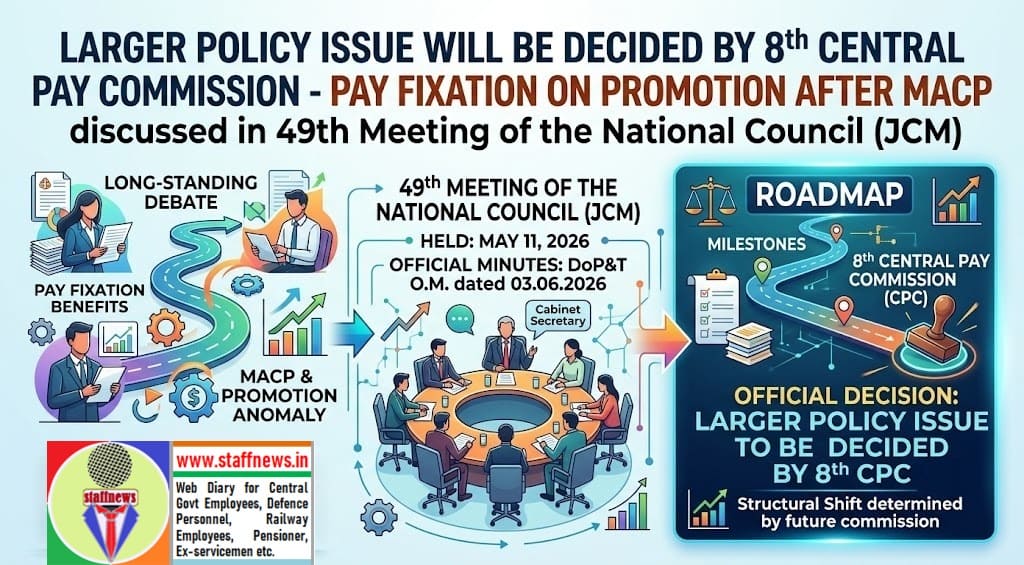
Larger Policy Issue Will Be Decided by 8th Central Pay Commission – Pay Fixation on Promotion After MACP discussed in 49th Meeting of the National Council (JCM)
Larger Policy Issue Will Be Decided by 8th Central Pay Commission
The long-standing debate surrounding pay fixation benefits for Central Government employees promoted after availing of the Modified Assured Career Progression (MACP) scheme has reached a major crossroads. In the 49th Meeting of the National Council (JCM), held on May 11, 2026, under the Chairmanship of the Cabinet Secretary, the government clarified its stance on this structural anomaly.
According to the official minutes circulated via DoP&T O.M. No. 3/1/2025-JCA dated 03.06.2026, while individual anomalies may undergo localized scrutiny, the core demand represents a significant structural shift. Consequently, the official decision dictates that this larger policy issue will be decided by the 8th Central Pay Commission (CPC).
The Core Grievance: MACP vs. Regular Promotion
The dispute centers on Item No. NC-49/8/26: Grant of Pay Fixation Benefit to those employees who are promoted after availing the benefit of MACP.
Under normal conditions, when an employee is promoted to a post carrying higher responsibilities, their pay is fixed using Fundamental Rule (FR) 22(1)(a)(1), which provides financial incentive via an additional financial increment. However, under current regulations, if an employee has already received a financial upgrade via the MACP scheme, they are denied this additional pay fixation benefit upon their actual, regular promotion.
The Staff Side argues that regular promotion brings an objective increase in duties and structural responsibilities. Denying financial recognition for this step-up creates an organizational anomaly where employees take on harder roles without corresponding financial benefits.
Evolution of the Anomaly: 6th CPC vs. 7th CPC
During the council’s deliberations, representatives from the Staff Side highlighted how the transition between pay commissions aggravated this issue:
| Feature | 6th Central Pay Commission (CPC) Framework | 7th Central Pay Commission (CPC) Framework |
| Pay Structure | Grade Pay + Pay Band System | Unified Pay Matrix (Grade Pay Abolished) |
| Fixation Benefit | Allowed under FR 22(1)(a)(1) during MACP. On regular promotion, the employee received the Grade Pay difference. | Allowed during MACP. On regular promotion, no additional increment or pay stage advancement is granted. |
| Staff Side Impact | Ensured an immediate, tangible financial incentive for accepting a promotion. | Eliminated the financial incentive, creating stagnation despite increased responsibility. |
Key Arguments from Staff Side Representatives
- Shri Sivaji Vasireddy (Member, Staff Side): Pointed out that the historical system inherently respected promotional vertical movement by granting the difference in grade pay, a benefit that disappeared under the current layout.
- Shri Ajay (Member, Staff Side): Noted that various related anomalies had been repeatedly escalated in past forums without achieving a systemic resolution.
- Shri C. Srikumar (Member, Staff Side): Argued that because the 7th CPC completely dispensed with the Grade Pay system, the previous mechanism of giving a partial financial lift was broken. He maintained that granting one additional increment on promotion after MACP is entirely justified under the current Pay Matrix format.
The JCM Decision and Its Implications
Faced with these technical arguments, the Chairman balanced the necessity of addressing immediate hardships with the reality of modifying systemic pay architecture.
Official Decision: The Chairman desired that specific cases may be examined, but the larger policy issue may be left for the 8th CPC to decide.
This strategic deferral has two distinct outcomes for the Central Government workforce:
- Short-Term Grievance Redressal: The Department of Personnel and Training (DoPT) retains the authority to review isolated, highly specific administrative anomalies where the transition of rules caused unintended pay disparities.
- Long-Term Policy Restructuring: The baseline demand—altering the definition of FR-22(1)(a)(1) execution to allow an extra increment post-MACP—is recognized as a structural policy matter. This places the responsibility of a permanent solution squarely onto the mandate of the upcoming 8th Central Pay Commission.
By deferring the overarching policy decision to the 8th CPC, the government has acknowledged the depth of the issue while ensuring it undergoes comprehensive evaluation alongside the broader macroeconomic and structural revisions typical of a new Pay Commission cycle. Central Government employee unions will now look toward the 8th CPC as the definitive platform to secure this vital financial correction.
हिन्दी में – बड़ी नीतिगत समस्या पर निर्णय 8वें केंद्रीय वेतन आयोग द्वारा लिया जाएगा: एमएसीपी के बाद पदोन्नति पर वेतन निर्धारण का भविष्य
COMMENTS