
Central Government Pension Reforms: A Positive Update for Employees. Central Government Pension Reforms are currently a major topic of discussion among millions of active employees and retirees across India. With the landscape of retirement benefits rapidly shifting, staying updated is crucial for your financial security.
Recently, the Ministry of Finance addressed several pressing questions regarding these changes during a Rajya Sabha session. This official update sheds much-needed light on the transition from the New Pension Scheme (NPS) to the newly announced Unified Pension Scheme (UPS).
It also clarifies the government’s official stance on the much-debated Old Pension Scheme (OPS) and outlines new digital initiatives designed to make life easier for senior citizens.
Key Highlights of the Central Government Pension Reforms
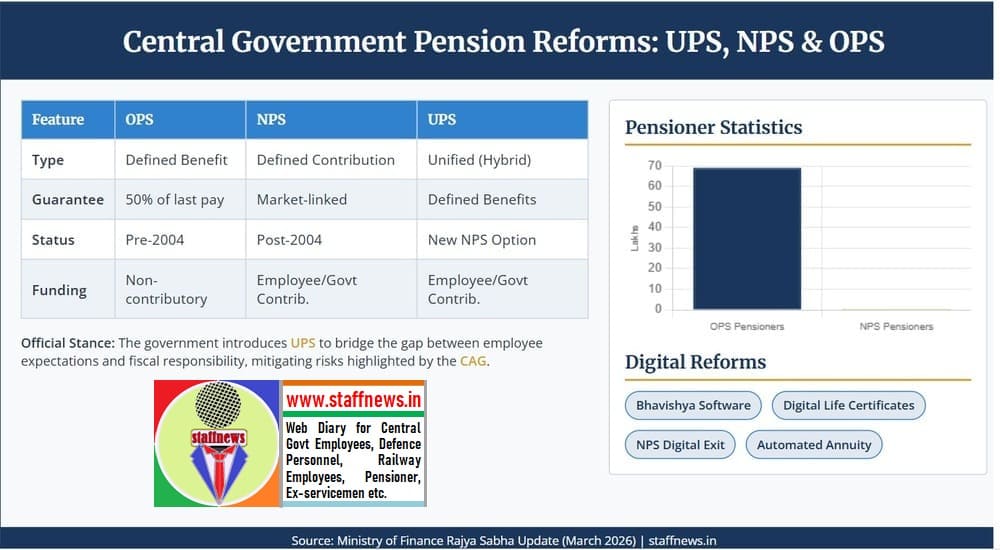
The journey of Central Government Pension Reforms has seen significant milestones over the past two decades. For years, the Old Pension Scheme provided a guaranteed safety net, but the shift to the contribution-based NPS in 2004 changed that dynamic completely.
Many public servants voiced genuine concerns regarding the market-linked nature of the NPS. In a direct response to these concerns, the latest framework introduces the Unified Pension Scheme (UPS) as an option under the NPS architecture.
This hybrid approach aims to provide defined benefits after retirement, effectively bridging the gap between employee expectations and the government’s fiscal responsibilities.
State governments have also been a large part of this broader conversation. While some states have pushed to revert to the OPS, central authorities have clearly outlined the severe fiscal risks associated with such a move, as highlighted by the Comptroller and Auditor General (CAG).
Digitalization in Central Government Pension Reforms
Furthermore, a massive push for technological integration ensures that the administration of these Central Government Pension Reforms is seamless and user-friendly.
The introduction of the Bhavishya software and Digital Life Certificates (DLCs) ensures that retirees no longer face unnecessary bureaucratic hurdles. The digital generation of lump-sum withdrawals and automated annuity processes means retirees can securely manage their funds from the comfort of their own homes.
Official Text: Central Government Pension Reforms Update
Below is the complete, unedited text of the recent Rajya Sabha Unstarred Question No. 1993, which provides the exact official government stance on these matters:
GOVERNMENT OF INDIA
MINISTRY OF FINANCE
DEPARTMENT OF FINANCIAL SERVICES
RAJYA SABHA
UNSTARRED QUESTION NO. 1993
ANSWERED ON TUESDAY, MARCH 10, 2026/PHALGUNA 19, 1947 (SAKA)
PENSION SYSTEM AND REFORMS FOR CENTRAL GOVERNMENT EMPLOYEES
1993#. SHRI PRADIP KUMAR VARMA
Will the Minister of Finance be pleased to state:
(a) the number of Central Government employees and pensioners currently covered under the New Pension Scheme (NPS) and the Old Pension Scheme (OPS), the details thereof category-wise;
(b) the number of cases of delay in pension payments reported in the last three years and the reasons therefor;
(c) the Central Government’s stance on the demand of States for restoration of the Old Pension Scheme (OPS) and the proposed reforms in the National Pension System (NPS); and
(d) the plans for digitalization and the expansion of online services for the welfare of pensioners?
ANSWER
MINISTER OF STATE FOR FINANCE (SHRI PANKAJ CHAUDHARY)
(a) The number of Central Government employees are approximately 50.14 lakhs. The category-wise
number of Central Government pensioners covered under National Pension System (NPS) and Old Pension Scheme (OPS) are as under:
| S.No | Scheme | No. of Pensioners |
| 1 | National Pension System (as on 31.01.2026) | 49,802 |
| 2 | Old Pension Scheme (as on 08.12.2025) | 69 lakh approximately |
(b) The Government/ Pension Fund Regulatory and Development Authority (PFRDA) has not come
across any case of delay reported by the subscribers under National Pension System in payment of monthly pension by the Annuity Service Providers (ASPs).
(c) The restoration of Old Pension Scheme in the States falls exclusively under State policy discretion. However, Comptroller and Auditor General (CAG), in its recent State Finance Audit Reports, has highlighted the fiscal implications of reversion to OPS by the States. NPS is a defined contribution-based scheme which was introduced for Central Government employees (except armed forces) joining service on or after 01.01.2004. With a view of improving upon the pensionary benefits for such employees, a Committee was constituted under the chairpersonship of the then Finance Secretary to suggest measures to modify the NPS. Based on the deliberations of the Committee with stakeholders, Unified Pension Scheme (UPS) has been introduced as an option under NPS with the objective of providing defined benefits after retirement to the Central Government employees covered under the NPS.
(d) The Government has introduced a New Single Simplified Pension Application form through its
centralised pension processing software, Bhavishya, mandatory for all Central Civil Ministries/Departments, significantly improving ease of filing. Further, Government has also introduced Digital Life Certificates (DLCs) in accordance with the National Initiative of digitally empowering citizens. The lump-sum withdrawal/annuity process for NPS is completely digital wherein subscriber can submit the exit request and get the annuity through online process. Email and SMS are sent to the subscribers upon various stages of their Exit as well as credit of lump sum amount/annuities. The life certificate submission facility for subscribers is also through digital mode. Further, new initiatives and technological enhancements are undertaken on an ongoing basis to improve system efficiency for ensuring ease to the subscribers under the NPS architecture.
****
As the landscape of retirement security continues to evolve rapidly, these Central Government Pension Reforms mark a definitive step toward a more digitized, efficient, and balanced financial system. All central employees are highly encouraged to stay informed about their ongoing options, especially regarding the newly introduced Unified Pension Scheme.
COMMENTS
Outstanding
Good 👍
The 8th CPC is visiting Dehradun to know on the spot demands and hold discussion with Unions and Associations.
It is very helpful, as govt employee it very important to know about pension after retirement
A 1/3 pension after 8th pay commission shall be suitable in place of nps or ups in place of ops.
400 EL
As in nps employees very less years of service the pension shall be 8 or 10 years Service be considered. Also in case of more service years in the same way.
It will be a welcome by everyone.