

SAMPATI (System for Asset Monitoring, Presentation and Tracking e-Asset Register) module is being rolled out in Ministries and Departments: CGA, FinMin O.M. dated 19.05.2026
No.ARC-18001/5/2021-TA-CGA/E-7060/48
भारत सरकार
वित्त मंत्रालय, व्यय विभाग
महालेखा नियंत्रक कार्यालय
ए.आर.सी. अनुभाग
महालेखा नियंत्रक भवन
ई-ब्लॉक, जी.पी.ओ. कॉम्प्लेक्स, आई.एन.ए.
नई दिल्ली – 110023
Email: amitabh.ghai72[at]gov.in, Phone: 011-24665647
New Delhi, Dated 19.05.2026
OFFICE MEMORANDUM
Subject: Introduction of SAMPATI (System for Asset Monitoring, Presentation and Tracking e-Asset Register) a new initiative for Civil Ministries and Departments.
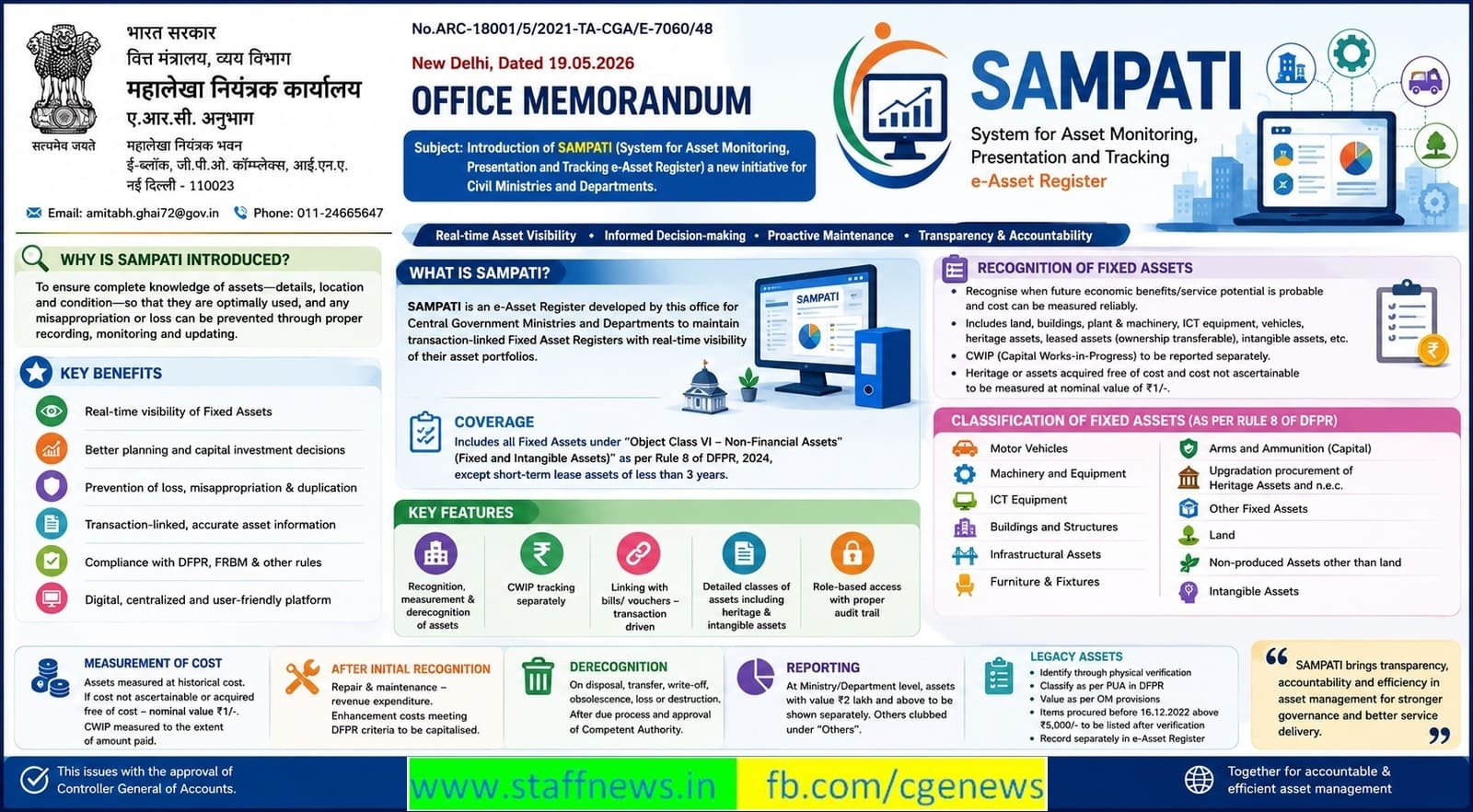
For efficient functioning of any organisation in Government, it is imperative that they should know the complete details, location and condition of their assets and whether they are being optimally used. Any misappropriation or loss can also be prevented and controlled by proper recording, regular monitoring and updating of asset registers. Further capital investment decisions can also be taken effectively by maintaining a proper record of all the Assets.
2. To keep proper record of the fixed Assets in Ministries and Department of Central Government, this office has issued Guidelines for creation, updating and maintenance of Asset Register in the Ministries and Departments of Central Government vide OM No. 3(2)/e-Asset Register/ARC/2017-18/994 dated 20.09.2017 and stated therein that an e-Asset Register portal for all Head of Offices is being considered by Office of the CGA to enable the upload centrally of Basic Asset Registers.
3. The e-Asset Register or SAMPATI (System for Asset Monitoring Presentation and Tracking-eAsset Register) has now been developed by this office to enable Central Government Ministries and Departments to maintain real-time visibility into their portfolios, facilitating informed decision-making and proactive maintenance strategy. The SAMPATI module is being rolled out in Ministries and Departments.

4. In the present system of cash basis of accounting in the Government, capital expenditure up to the Minor Head in the Finance Accounts is disclosed. However, the complete details of Fixed Assets owned/ under construction/ constructed/ purchased/ acquired by Government entities are not available in the Accounts. Also, heritage, intangible and leased Assets are generally not recognised and not included in the Asset Registers. Further, no de-recognition of Assets takes place, even after the Asset is no longer in use. In the present system of cash basis of accounting, the Asset corresponds only to the capital expenditure incurred and does not reflect the true value to the extent of the unpaid liability. Capital Works-in-Progress (CWIP) is subsumed in the capital expenditure booked. Both the Accounts and the Asset Registers being maintained do not separately depict Capital Works-in Progress. Details like bill/ voucher numbers are also not linked, so the information in the existing Asset registers is not transaction-driven.
5. To overcome these challenges, the e-Asset Register provides preparation of transaction-linked Fixed Asset Registers by the Departments. This Register would provide detailed information on the recognition and derecognition of an Asset, measurement of its cost by an entity and depiction of various classes of Assets, viz. land, building, plant & machinery, etc., with an inherent flexibility for entities to add additional classes / sub-classes of Fixed Assets.
6. This e-Asset Register will include all the Fixed Assets mentioned under “Object Class VI -Non-Financial Assets (Fixed and Intangible Assets)” given in Rule 8 of Delegation of Financial Powers Rules, 2024 (DFPR), except the fixed assets obtained on short-term lease of less than 3 years and ownership of which is not transferable to the Government.
7. Recognition of Asset :
(a) Items of Fixed Asset acquired (constructed/ purchased/ donated/leased/ granted/ inherited) should be recognised in the e-Asset Register as and when:
(i) It is probable that future economic benefits or service potential associated with the Asset will flow to the entity; and
(ii) Cost of the Asset can be measured reliably, except where this OM recommends measurement of the Assets at the nominal value of 1/-.
(b) Fixed Assets shall be classified as per the norms, guidelines and definitions given under Rule 8 of DFPR.
(c) Land should be recognized as a Fixed Asset, irrespective of its value and should be recorded in the Fixed Asset Register. The land component should be recognised separately from the built-up structure on it. Ordinarily, land has an unlimited useful life.
(d) Items such as spare parts, stand-by equipment and servicing equipment are recognised as Fixed Assets in accordance with relevant provisions of DFPR. When they meet the definition of a Fixed Asset, such items should be recorded separately along with the concerned Fixed Asset in the e-Assets Register.
(e) The expenditure on Fixed Assets/projects that are in the process of construction or completion and are not ready for intended use on the reporting date, for example, construction of a building or hydroelectric power project, should be recorded under the CWIP column in the Fixed Asset Registers of the relevant class of Fixed Assets. On completion or commissioning of the Fixed Asset/project, the total expenditure of that Asset/project should cease to be depicted in the CWIP column, and the same is to be included towards the cost of the newly created asset under the relevant classification. In cases where parts of a CWIP project are independently ready for intended use, the related/ proportionate cost of such a project should be removed from CWIP, and the partly created asset will be added to the relevant classification of the Asset. The Executive Authority in the entity should conduct an annual review (including physical verification) of all projects under CWIP to assess their readiness for intended use and their removal from CWIP.
(f) Items of Fixed Assets may be required for safety or environmental reasons. The acquisition of such Fixed Assets, although not directly increasing the future economic benefits or service potential of any particular existing items of Fixed Assets, may be necessary for an entity to obtain the future economic benefits or service potential from its other Assets (e.g., the entity’s requirement of a retrofit new sprinkler system for compliance with fire safety regulations). Such items of Fixed Assets qualify for recognition as Fixed Assets, because they enable an entity to derive future economic benefits or service potential from related Assets in excess of what could be derived had those items not been acquired.
(g) Heritage Assets, e.g. historical buildings and monuments, archaeological sites, conservation areas, and works of art, the value of which is unlikely to be reflected fully in financial terms as they are irreplaceable. It may also be difficult to estimate their useful lives. Governments would have acquired many heritage Assets by way of purchase, donation, bequest, etc. Where the cost of the Asset (including land) cannot be ascertained or the asset is acquired without any consideration (such as gifts, donations, sequestration), it should be measured at the nominal value of 1/-.
(h) Leased Assets would be recognised by lease charges for land, buildings, equipment & other assets, the ownership of which is transferable to Government, will be classified as “capital expenditure under the relevant Primary unit of appropriation, viz. “Building and Structure”, “Equipment”, etc.
(j) Internally developed intangible Assets, e.g. computer software, shall be recognized when it is ready for use, and patents shall be recognised at the time of registration with the relevant authority.
8. Classification of Fixed Assets:
(a) Fixed Assets should broadly be classified as per the classification given under Rule 8 of DFPR, for inclusion in the Fixed Asset Registers (including CWIP), so that the cost of the existing Asset could prima facie flow from the accounts and there is a uniform depiction of the Assets across Government organisations. It is recommended to have a direct concordance with the Primary Units of Appropriation (PUA) in the Fixed Asset Register.
(b) The following broad classification of Fixed Assets should be adopted in the Fixed Asset Registers, duly ensuring that an individual Asset does not find a mention in more than one class:
-
- Motor Vehicles
- Machinery and Equipment
- Information, Computer, Telecommunications (ICT) equipment
- Buildings and Structures
- Infrastructural Assets
- Furniture & Fixtures
- Arms and Ammunition (Capital)
- Upgradation procurement of Heritage Assets and n.e.c. (not elsewhere classified).
- Other Fixed Assets
- Land
- Non-produced Assets other than land
- Intangible Assets
(c) An entity may further sub-classify the Assets to capture further details where appropriate. For example, under ‘Buildings’, the details of all buildings such as office buildings, workshop/factory buildings, etc., may be provided.
9. Measurement of Cost at Initial Recognition of Fixed Assets:
(a) An item of Fixed Asset, which qualifies for recognition, should be measured at its historical cost. If the full value has not been paid and the Asset is ready for intended use, the fixed asset is recognised at the amount paid only, and the pending amount should be disclosed in the “Unpaid amount”. Advances paid towards constructing/ acquiring/ purchasing an Asset should also be disclosed in CWIP.
(b) Where the cost of a Fixed Asset (including land) is not ascertainable, it should be measured at the nominal value of ₹1/-,
(c) Where a Fixed Asset is acquired without any consideration (such as gifts, donations, sequestration), it should be measured at the nominal value of ₹1/-.
(d) The CWIP should be measured to the extent of the amount paid. In case parts of a CWIP project are independently ready for intended use, the related/proportionate paid costs of such projects should be removed from CWIP.
(e) Assets obtained on long-term lease (more than 3 years) by a lessee should be recognised at the time of and to the extent of the amount paid and disclosed separately under the relevant class of Fixed Assets. The remaining amount of unpaid lease instalments should be disclosed in the “Unpaid amount”. The interest component of lease payments, wherever separately available, should be recognized as revenue expenditure.
(f) Land acquired through purchase should be recorded at the historical price, and other incidental costs incurred to bring the Asset to its present condition should be included in the cost of land.
(g) All Heritage Assets should be identified and measured at historical cost where records are available, otherwise at a nominal value of ₹1/-.
(h) Intangible Assets should be measured at cost, after it is ready for use. For intangible Fixed Assets still under development, through an external agency, the Asset should be disclosed at the amount paid and the pending amounts should be disclosed in the “Unpaid amount”. If the Asset is acquired free of cost, in which case it shall be measured at the nominal value of ₹1/-. However, internally generated intangible Assets should be recognized at their actual value available in the accounts, otherwise at the nominal value of ₹1/.
(j) Elements of cost of Fixed Assets (tangible/intangible) comprise:
(i) Its purchase price, including import duties and non-refundable purchase prices, after deducting discounts and rebates;
(ii) Any cost directly attributable to bringing the Asset to the location and condition necessary for it to be capable of operating in the manner intended by management.
(iii) Examples of directly attributable costs are:
a) Installation and assembling cost;
b) Initial delivery and handling cost;
c) Cost of testing the equipment;
d) Cost of employee benefits arising directly from the construction or acquisition of Fixed Asset;
e) Cost of site preparation;
f) Professional fee;
g) Registration charges, stamp duty etc. in case of purchase of land;
h) Compensation paid in case of compulsory acquisition of land, cost of development of land, rehabilitation and resettlement cost necessarily incurred in case of compulsory acquisition of land;
(iv) Examples of costs that are not included in the cost of an existing Fixed Asset:
a) Cost of opening a new facility;
b) Cost of introducing a new product or service (including cost of advertising and promotional activities);
c) Cost of providing service to a new class of users;
d) administrative cost (including cost of staff training) and other general overhead costs; and
e) Costs incurred for assets not put to use.
(k) Capital receipts (as per Rule 101 of GFR, 2017 and amended from time to time) insofar as they relate to expenditure previously debited to Capital accruing during the process of construction of a project, shall be utilised in reduction of capital expenditure. Thereafter, their treatment in the accounts will depend on circumstances, but except under special rule or order of Government, they shall not be credited to the revenue account of the department or undertaking.
(l) The amount of compensation (as per rule 56 of GAR, 1990 and amended from time to time) received from third parties for items of Fixed Assets that were lost, destroyed or given up is recognized as revenue receipts may be taken as reduction of expenditure under the major head concerned except where under the rules of allocation applicable to a particular department such receipts have to be taken to revenue.
(m) Interest on amounts borrowed for constructing the Asset, until the Asset is ready for intended use, is recognised as a component of the cost of the constructed item of Fixed Asset.
10. Measurement of Cost after Initial Recognition of Fixed Assets:
(a) Entities incur certain costs of day-to-day servicing of an item e.g. the cost of labour and consumables. Under the recognition principle, an entity recognises such costs as revenue expenditure and they are often described as “repair and maintenance expenditure”.
(b) Costs incurred after initial recognition for enhancing the utility of an existing Fixed Asset e.g. expenditure incurred on widening of a road, is to be included in the cost of the relevant Fixed Asset in case they meet the definition criteria specified in DFPR. This principle is applicable even in the case of those Fixed Assets, which are initially measured at the nominal value of ₹1/-.
11. Derecognition:
(a) A Fixed Asset should be de-recognised from the Fixed Asset Registers of an entity:
(i) on disposal by way of transfer/sale/ dismantling of obsolete Assets/write-off of Asset etc.
(ii) when no future economic benefits or service potential is expected from its use, e.g., on being donated or transferred to any other entity; dismantled/ destroyed on being declared as obsolete or abandoned; or
(iii) lost or destroyed in natural calamity or accident like cyclone, tsunami, fire, public riots, theft, etc.
(b) A Fixed Asset should only be de-recognised after following the due administrative/legal process and approval of the Competent Authority in the Fixed Asset Registers.
(c) Accounting of Depreciation may be done as per the existing rules of the respective government.
12. Head of Offices/Head of Departments shall continue to maintain various ledgers and registers prescribed by various instructions issued from time to time regarding fixed assets.
13. While consolidating the assets at the Ministry/Department level, the assets with a threshold value of Rupees Two Lakh and above should be depicted separately. While summarising, the remaining assets should be clubbed together under a single line item “Others” under each category of asset. In this way, a report of Asset Registers at the Department/Ministry level will be available in the prescribed format D-4 under Rule 6 of the FRBM Rules, 2004 for submission to the Budget Division, Ministry of Finance, through proper channels.
14. In respect of the legacy assets, an exercise of listing of such assets will be carried out in the following manner:
a. The fixed assets that are expected to have future economic benefits or service potential should be identified through physical verification.
b. These should be identified and listed under the given class as per the PUA given in DFPR.
c. The value should be assigned as per the paragraphs above.
d. The items procured under revenue expenditure prior to the revision of Rule 8 of DFPR (i.e. prior to 16.12.2022) like staff car (motor vehicles), furniture and fixtures, office equipment, computers and peripherals etc. above the threshold limit of Rs. 5,000/- and useful life of one year should be listed after verification. This financial limit is not applicable to those fixed assets which have been assigned a nominal value of Rupee One.
e. The fixed assets so identified as per para 14(d) and listed should be recorded separately in the e-Asset Register.
15. This issues with the approval of Controller General of Accounts.
(संचिता शुक्ला)
(Sanchita Shukla)
संयुक्त महालेखानियंत्रक
Jt. Controller General of Accounts
COMMENTS