
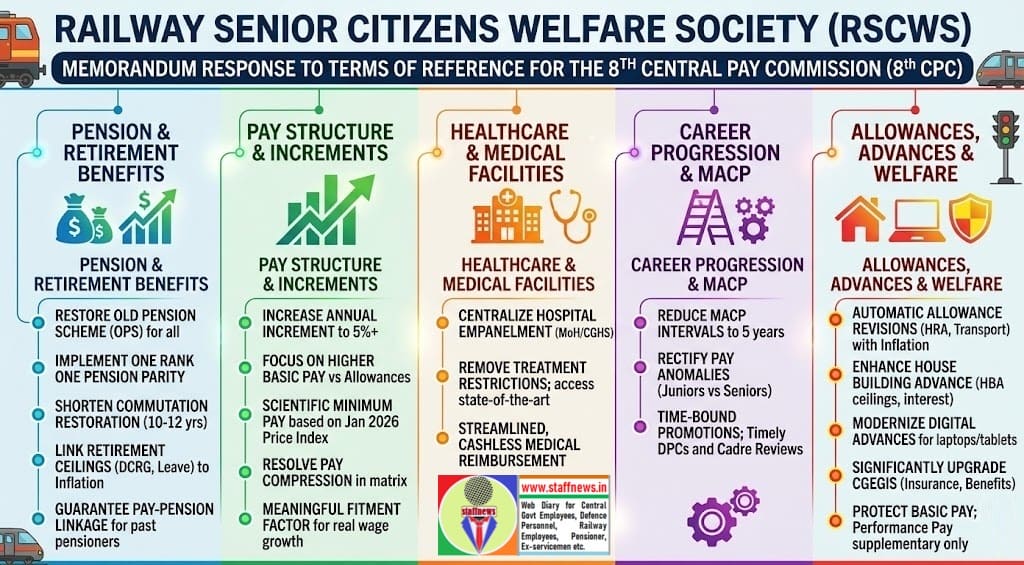
Memorandum to the 8th CPC by Railway Senior Citizens Welfare Society (RSCWS): Pensioners’ Perspectives & Demands
The Railway Senior Citizens Welfare Society (RSCWS) emphasizes that the 8th Central Pay Commission must prioritize long-term social security for retirees to ensure a dignified post-retirement life. The core concern raised is the structural flaw in the current compensation system, which relies too heavily on allowances rather than Basic Pay. Because most allowances cease upon retirement while living expenses—particularly healthcare—continue to rise, pensioners face a sudden and severe drop in real income.
To combat the historical erosion of pensions due to inflation, the RSCWS advocates for a balanced pay structure that strengthens Basic Pay, as it dictates the final pension calculation. The memorandum strongly pushes for systemic equity, demanding parity between past and recent retirees and the restoration of the Old Pension Scheme (OPS) to guarantee predictable financial stability. Furthermore, modernizing medical care access and relaxing stringent commutation recovery periods are highlighted as essential measures to protect the physical and financial well-being of senior citizens.
- Pension & Retirement Benefits
-
- Restore the Old Pension Scheme (OPS): Reinstate OPS for all employees retiring after 2004 to maintain equity and financial security.
- Implement “One Rank One Pension” Parity: Ensure retirees from the same rank with similar lengths of service receive comparable pensions, regardless of their retirement date.
- Reduce Commutation Restoration Period: Shorten the period for restoring commuted pension from 15 years to 10–12 years.
- Enhance Retirement Ceilings: Periodically revise the ceilings for Death-cum-Retirement Gratuity (DCRG) and Leave Encashment to match inflation.
- Guarantee Pay-Pension Linkage: Ensure pay revisions automatically and fully translate into improved fitment formulas and parity measures for past pensioners.
- Pay Structure & Increments
-
- Increase Annual Increment: Raise the annual increment rate from the current 3% to at least 5%.
- Strengthen Basic Pay: Shift the compensation balance to rely more on Basic Pay rather than allowances, as Basic Pay determines the pension.
- Scientific Minimum Pay: Calculate minimum pay using the Price Index as of January 1, 2026.
- Resolve Pay Compression: Widen the spacing between adjacent levels in the Pay Matrix to ensure adequate financial progression upon promotion.
- Meaningful Fitment Factor: Apply a fitment factor that provides real wage growth rather than merely neutralizing Dearness Allowance.
- Healthcare & Medical Facilities
-
- Centralize Empanelment: Shift the empanelment of private hospitals to the Ministry of Health/CGHS level, rather than leaving it to individual departments.
- Remove Treatment Embargoes: Allow pensioners the liberty to seek treatment at any state-of-the-art medical facility without being restricted to designated government/railway health units.
- Streamline Reimbursement: Ensure prompt, simplified, and cashless settlement of medical claims.
- Career Progression & MACP
-
- Reduce MACP Intervals: Shorten the interval for Modified Assured Career Progression (MACP) financial upgradations from 10 years to 5 years.
- Resolve Pay Anomalies: Rectify pay matrix anomalies where junior employees draw higher pay than seniors due to prior promotions or MACP rules.
- Time-Bound Promotions: Mandate timely Departmental Promotion Committees (DPCs) and periodic cadre reviews to eliminate stagnation.
- Allowances, Advances & Welfare
-
- Automatic Allowance Revision: Implement an automatic, periodic revision mechanism for major allowances (like HRA and Transport) linked to inflation indices.
- Enhance House Building Advance (HBA): Substantially increase HBA ceilings, lower interest rates, and rationalize city classifications.
- Modernize Digital Advances: Increase the Personal Computer Advance to cover modern devices (laptops/tablets) and introduce suitable financial support for digital devices for pensioners.
- Upgrade CGEGIS: Significantly enhance the insurance coverage and maturity benefits under the Central Government Employees Group Insurance Scheme to reflect modern financial realities.
- Protect Basic Pay from Performance Pay: Ensure performance-linked incentives remain strictly supplementary and are never used as a substitute for regular pay/pension revisions.
RAILWAY SENIOR CITIZENS WELFARE SOCIETY
Memorandum in response to Terms of Reference for the 8th CPC
1. Pay Matters
Pay Matters
Q1. What concerns / views do you have related to pay matters?
Select those which are applicable Basic Pay, Minimum Pay, Increment/Annual Increment, Level in Pay Matrix, Maximum of Pay Level and Any Other
Concern/Views
The structure of pay recommended by the 8th Central Pay Commission should ensure fairness, sustainability and adequate social security for pensioners vis-à-vis the serving employees. Pay revisions directly influence pension since pension is derived from the last drawn pay or notional pay in the Pay Matrix. Therefore, a balanced approach is essential.
- Basic Pay
Basic Pay should remain the core element of the salary structure as it forms the basis for pension, gratuity and other retirement benefits. The Commission should ensure that the revised Basic Pay adequately reflects inflation, rising living costs and the dignity of public service. Rationalization should avoid excessive compression between entry and higher levels while ensuring equitable growth across all levels.
- Minimum Pay
The minimum pay should be determined on a scientific basis keeping in view the norms evolved by the Indian Labour Conference and the principles considered by the 7th Central Pay Commission. The price Index as on 01.01.2026, is now available and the same should be used for calculation of minimum pay. The calculation should realistically account for current consumption patterns, housing, education, healthcare and digital connectivity. A higher minimum pay is necessary not only for fairness but also to maintain parity with comparable public sector and private sector compensation.
- Annual Increment
Annual increment is a recognition of experience and service continuity. The existing rate of 3% of Basic Pay should be reviewed as it has become relatively modest due to inflation and longer career spans. An enhanced annual increment rate of 5% or a provision for periodic additional increments after certain years of service should be considered to maintain motivation and financial progression.
- Levels in Pay Matrix
The Pay Matrix introduced by the 7th CPC has improved transparency and simplicity. However, certain anomalies and compression between adjacent levels have been noticed. The 8th CPC should review the spacing between levels to ensure adequate financial progression, especially between middle and higher levels. The system should also allow smoother movement between promotional levels.
- Maximum Pay Levels
The maximum levels in the Pay Matrix should maintain a rational relativity with lower levels while reflecting higher responsibilities of senior positions. At the same time, the ratio between minimum and maximum pay should remain balanced so that the structure remains equitable and socially acceptable.
- Pay–Pension Linkage
Any revision in pay structure should automatically translate into fair pension revision. Pensioners should receive full benefit of pay revisions through improved fitment formulas and parity measures so that past retirees are not disadvantaged.
- Fitment Factor and Pay Progression
The fitment factor adopted by the 8th CPC should ensure meaningful real income growth and not merely neutralize inflation. It should be adequate to correct historical erosion in real wages and pensions.
Conclusion
Overall, the pay structure recommended by the 8th Central Pay Commission should ensure transparency, fairness and sustainability while protecting the legitimate interests of pensioners whose financial security depends on the pay structure of serving employees. A well-designed Pay Matrix with adequate minimum pay, fair increments and proper relativity will strengthen both employee morale and pensioner welfare.
Challenge/Problems in Pay Matters
From the perspective of pensioners and employees, several structural challenges exist in the present pay system which the 8th Central Pay Commission needs to address while reviewing pay matters.
- Erosion of Real Wages due to Inflation
Although Dearness Allowance provides partial protection against inflation, the gap between periodic pay revisions and the continuously rising cost of living, results in erosion of real wages and pensions. Over time, the purchasing power of basic pay and pension tends to decline significantly.
- Inadequate Growth in Basic Pay
The existing structure places significant reliance on allowances and DA rather than strengthening the core element of salary, i.e., Basic Pay. Since pension and retirement benefits are linked to Basic Pay, inadequate growth in Basic Pay adversely affects long-term financial security of retirees.
- Low Rate of Annual Increment
The present annual increment of 3% provides only modest financial progression, particularly during periods of high inflation. Over a long career span, the incremental growth in pay is often insufficient to reflect experience, skill development and increased responsibilities. This annual increment rate should atleast be increased to 5%.
- Compression in Pay Levels
In several areas of the Pay Matrix introduced by the 7th Central Pay Commission, the difference between adjacent levels is relatively narrow. This results in pay compression, especially between supervisory and higher responsibility posts, thereby reducing the financial incentive associated with promotions.
- Limited Career Financial Progression
Many employees experience slow financial growth due to limited promotional opportunities, particularly in large organizations such as the Indian Railways. As a result, employees often retire without reaching higher pay levels, which also restricts their pension.
- Pay–Pension Disparities
Differences often arise between past pensioners and recent retirees because pension revisions do not always fully reflect pay revisions granted to serving employees. This creates a sense of inequity among pensioners of different retirement periods.
- Fitment Factor Concerns
The fitment factor applied during pay revisions sometimes focuses mainly on neutralizing Dearness Allowance rather than providing real improvement in pay. This limits the extent of genuine enhancement in both salary and pension.
- Increasing Gap with Private Sector Compensation
While government pay structures emphasize stability and social security, there remains a growing gap between public sector and private sector compensation in certain skilled categories. This may affect the ability to attract and retain talent.
Addressing these challenges requires the 8th Central Pay Commission to adopt a balanced approach that strengthens Basic Pay, ensures meaningful pay progression, removes pay compression and safeguards the financial interests of pensioners. A well-structured pay system will promote fairness, motivation and long-term financial security for both employees and retirees.
2. Allowances
Allowances
Q2. What concerns / views do you face related to Allowances?
Select those which are applicable
Dearness Allowance, Allowance Related to Qualifications, Allowance Related to Additional Duty or Extra Duty or Working on Holidays, Allowance Related to Capacity Building or Knowledge Up gradation or Trainings, Allowance Related to Deputation or Posting, Allowance Related to Housing including HRA Allowance Related to Performance, Merit, Good service, Allowance Related to Risk and Hardship Allowance Related to Travel including Travelling Allowance, Allowance Related to Sports, Allowance Related to Uniform, Allowance Related to Running Staff and Any other.
Concern/Views
Allowances constitute an important component of the compensation structure of government employees as they are intended to meet specific functional, location-based or duty-related requirements. While reviewing the allowance structure, the 8th Central Pay Commission may consider the following concerns and perspectives.
- Excessive Dependence on Allowances
Over time, the compensation structure has seen a growing share of allowances compared to Basic Pay. Since most allowances are not counted for pension, this results in a lower pension base for retirees. A better balance between Basic Pay and allowances is therefore essential.
It is observed that the basic pay forms a smaller part of the total emoluments including various allowances. It would be desirable to enhance the basic pay periodically and correspondingly limit the various allowances which, in due course should be reviewed as per the living cost index.
- Rationalisation without Adverse Impact
Previous Pay Commissions, particularly the 7th Central Pay Commission, rationalised and abolished several allowances. While rationalisation is necessary, care must be taken to ensure that employees performing difficult, hazardous or specialized duties are adequately compensated.
- Revision of Key Allowances
Important allowances such as House Rent Allowance, Transport Allowance and other duty-related allowances require periodic revision in line with current living costs, especially in metropolitan and high-cost areas where expenses have risen substantially.
- Regional and Location-based Disparities
Employees posted in remote, difficult or high-cost areas often face higher living expenses and challenging working conditions. Allowances linked to such postings should realistically compensate for these hardships and should be reviewed regularly.
- Pensioners’ Exclusion from Allowances
A major concern from the pensioners’ perspective is that allowances cease after retirement even though many of the related expenses—such as housing, transport and healthcare—continue and even get enhanced. This results in a sudden decline in overall income after retirement.
- Periodic Automatic Revision
Many allowances remain static for long periods and are revised only after a Pay Commission. A mechanism for periodic automatic revision linked with inflation or cost indices may help maintain their real value.
- Transparency and Simplicity
The allowance structure should remain simple, transparent and easy to administer. Too many small allowances complicate administration and create confusion. Consolidation of similar allowances may improve efficiency.
The allowance framework recommended by the 8th Central Pay Commission should strike a careful balance between rationalisation and adequacy. While allowances should compensate employees for specific conditions of service, the overall structure must also ensure fairness and financial security for pensioners whose retirement benefits depend primarily on Basic Pay rather than allowances.
Response Related to Allowances
Allowances form an essential component of the overall compensation framework of government employees. They are intended to compensate for specific duties, working conditions and location-related expenses that are not covered by Basic Pay. While reviewing the allowance structure, the 8th Central Pay Commission should adopt a balanced approach that ensures adequacy, rationalisation and fairness.
Firstly, the Commission may note that excessive dependence on allowances rather than strengthening Basic Pay has long-term implications, particularly for pensioners, since most allowances are not taken into account for pensioners benefits. Therefore, while allowances should continue to compensate for specific service conditions, the proportion between Basic Pay and allowances should remain balanced so that retirement benefits are not adversely affected.
Secondly, the rationalisation of allowances carried out on the recommendations of the 7th Central Pay Commission simplified the structure to some extent. However, in certain cases the abolition or merger of allowances created, concerns among employees who perform specialized, hazardous or duty-intensive work. The present Commission may therefore review such cases to ensure that employees working in difficult conditions receive appropriate compensation.
Thirdly, key allowances such as House Rent Allowance and Transport Allowance require periodic review in light of rising housing costs, transportation expenses and urban living costs. In metropolitan and high-cost cities, the existing rates may not fully compensate the actual expenditure incurred by employees.
Another important concern relates to employees posted in remote, difficult or hardship areas. Such postings often involve higher living costs, limited facilities and social hardships. Allowances associated with these postings should therefore be realistic and periodically revised to reflect the actual challenges faced by employees.
From the perspective of pensioners, it is also important to recognise that many expenditure heads—such as housing, transport and healthcare—continue even after retirement, rather at higher rates, while most allowances cease. This results in a sudden reduction in overall income after retirement. The Commission may therefore consider strengthening the pay structure so that pensioners are not indirectly disadvantaged due to the allowance-heavy nature of the salary structure.
Further, a mechanism for periodic revision of major allowances linked with inflation or appropriate indices may be considered so that their real value does not erode between two Pay Commissions.
In conclusion, the allowance structure recommended by the 8th Central Pay Commission should remain simple, transparent and periodic need-based, ensuring adequate compensation for service conditions while maintaining a fair balance with Basic Pay so that the long-term financial security of employees and pensioners is protected.
3. Advances
Advances
Q3. What concerns / views do you face related to Advances?
Select those which are applicable, Related to Personal Computer, Related to House Building, Any other
Reply:-
Advances provided by the Government such as House Building Advance (HBA), Personal Computer Advance and other advances are important welfare measures that support employees during service and help them improve their quality of life. From the perspective of employees and future pensioners, the policy relating to advances should be progressive, accessible and aligned with present-day costs.
Firstly, the House Building Advance should be enhanced substantially in view of the steep rise in property and construction costs across the country. The eligibility conditions should be simplified, the ceiling amount revised periodically, and the rate of interest kept nominal so that employees can realistically avail the benefit for purchasing or constructing a house. The procedure for sanction and disbursement should also be streamlined to avoid delays. The classifications of cities to be reviewed to rationalise the advances for this purpose.
Secondly, the Personal Computer Advance should be continued and strengthened in the digital era. In present times, access to a computer, laptop or digital device is essential for education of children, professional development and digital governance. Therefore, the advance amount should be revised to reflect current market prices of modern computing devices and should also include laptops, tablets and similar digital equipment. After retirement, the employees get more dependent on digital interactions and so need suitable compensation on that account.
Thirdly, other advances such as festival advance, medical advance and education-related advances should also be reviewed and rationalized. The ceilings of such advances should be increased periodically and the repayment conditions should remain employee-friendly.
Overall, the approach of the 8th Central Pay Commission towards advances should focus on enhancing financial support, simplifying procedures and ensuring that these facilities remain relevant to contemporary needs and living costs. This will improve employee welfare and financial security during service, which ultimately contributes to a more secure and dignified post-retirement life.
Response regarding Advances
Advances provided by the Government, such as House Building Advance (HBA), Personal Computer Advance and other welfare advances, constitute an important support mechanism for employees during their service period. These facilities help employees meet essential requirements like housing, education, digital access and other pressing needs without resorting to costly commercial borrowing. Therefore, such advances should be strengthened and made more relevant in view of the changing economic environment and rising costs.
The ceiling of House Building Advance should be revised substantially to reflect the prevailing market value of land and housing. In addition, the rate of interest must remain concessional and the procedures for sanction and disbursement should be simplified to ensure timely availability of funds. This will enable employees to secure decent housing during their service period, which also contributes to social and financial stability after retirement.
Similarly, the Personal Computer Advance should continue in the present digital era and the admissible amount should be enhanced to cover the cost of modern digital devices such as laptops and other computing equipment. In a technology-driven environment, access to such devices is essential for education, communication and access to digital government services.
Further, other advances such as festival advance, medical advance and education-related advances should also be reviewed and the existing ceilings revised periodically to keep pace with inflation. The repayment terms should remain reasonable and employee-friendly so that these advances genuinely serve their welfare purpose.
Overall, the approach of the 8th Central Pay Commission should be to retain, strengthen and rationalize the system of advances, ensuring that they remain accessible, adequate and responsive to the contemporary needs of employees and their families. This would significantly contribute to the financial well-being and morale of government employees and future pensioners.
4. Facilities
Facilities:-
Q4. What concerns / views do you face related to Facilities?
Select those which are applicable
Leave, Group Insurance including CGEGIS, Ex – gratia/Compensation, Medical Facility, Provident Fund including GPF, Leave Travel Concession and Any other.
From the perspective of employees and pensioners, several concerns arise regarding facilities such as leave, group insurance, ex-gratia/compensation, medical facilities, provident fund, leave travel concession and other welfare measures. A balanced view should emphasize both protection of employee welfare and administrative efficiency.
- Leave Facilities:
Leave is an essential welfare provision that helps employees maintain work-life balance and physical and mental well-being. However, concerns often arise regarding complicated procedures, delays in sanction, and difficulty in availing leave due to staff shortages. There is also a need for more flexibility in the carry- forward and encashment of leave, especially at the time of retirement, so that employees receive full benefits of the leave accumulated through years of service, therefore, ceiling limit off accumulation may be suitably revised for monetary compensation earned due to dedications towards the duty.
- Group Insurance (CGEGIS):
The Central Government Employees Group Insurance Scheme should provide meaningful financial security to employees and their families. However, the insurance coverage under CGEGIS is often considered inadequate in view of present-day financial realities. It is generally felt that the benefits are not commensurate with the monthly contributions deducted over long periods. Periodic revision of the insurance cover and transparency regarding fund utilization are major concerns.
- Ex-gratia and Compensation:
In cases of death, disability, or accidents during service, the existing provisions for ex-gratia payments and compensation should be adequate and promptly delivered. Delays in sanction and procedural complexities cause hardship to the affected families. There is a strong need for quicker settlement mechanisms and enhanced compensation amounts in line with rising costs of living, therefore, financial limits in workmen compensation acts to be rationalised in the present scenario and existing earning capability.
- Medical Facilities:
Access to quality medical care is a key concern for both serving employees and especially for pensioners. Issues include limited availability of empanelled hospitals, delays in reimbursement of medical bills, shortage of medicines at health units, and difficulties faced by pensioners living far from designated facilities. There is a need to expand empanelment of reputed hospitals, ensure availability of medicines, and simplify reimbursement procedures. Measures to be adopted to avoid imposing the embargo of taking treatment at the hospital earmarked by the government, there should be a liberty to take treatment where state of the art medical facility exist.
Moreover another very essential requirement is that empanelment of private hospitals should be centralised at Min Of Health level, instead of individual departments or establishments taking actions separately to empanel hospitals at their own separate levels.
- Provident Fund (GPF):
The General Provident Fund remains an important financial safeguard for employees. Concerns include delays in sanction of advances or withdrawals, administrative complications in maintaining accounts, and the need for a reasonable interest rate comparable with market savings schemes. Digital access and real- time updates of GPF accounts would improve transparency and convenience.
- Leave Travel Concession (LTC):
While LTC is a valuable benefit that promotes family welfare and national integration, employees often face procedural hurdles in claiming the benefit, including strict timelines, documentation requirements, and travel restrictions. There is also a need to review reimbursement ceilings to reflect current travel costs.
- Other Welfare Measures:
Additional concerns include the need for simplified procedures, timely settlement of claims, digitization of records, and improved communication between departments and beneficiaries. Welfare schemes must remain responsive to changing socio-economic conditions and should be periodically reviewed to ensure that employees and pensioners receive meaningful and accessible benefits.
Overall, the guiding principle should be that welfare facilities are not merely administrative provisions but essential safeguards for the dignity, security, and well-being of employees and their families. Strengthening these facilities will contribute significantly to employee morale, efficiency, and a sense of security during and after service.
Response Regarding Welfare Facilities (Leave, CGEGIS, Ex-gratia/Compensation, Medical Facilities, GPF, LTC and Others)
The general response regarding the above welfare facilities should emphasize simplification, adequacy of benefits, timely settlement and accessibility, particularly keeping in view the needs of employees and pensioners.
- Leave Facilities:
Leave is an essential component of employee welfare and should be administered with a humane and flexible approach. Procedures for sanction of leave should be simplified and unnecessary delays avoided. Employees should be allowed to utilize their legitimate leave without administrative hurdles. The ceiling for leave encashment at the time of retirement may also be reviewed periodically to keep pace with changing economic conditions.
- Group Insurance Scheme (CGEGIS):
The insurance coverage under CGEGIS needs to be enhanced to reflect present-day financial requirements. The scheme should provide adequate financial security to employees’ families in case of untimely death. The benefits received at the time of maturity should be commensurate with the long-term contributions made by employees. Greater transparency and periodic review of the scheme are also desirable.
- Ex-gratia and Compensation:
Ex-gratia payments and compensation in cases of death, disability or accidents during service should be revised periodically to match the rising cost of living. The process of sanction and disbursement should be time-bound so that affected families receive immediate financial relief. Procedures should be simplified to avoid hardship during distress situations.
- Medical Facilities:
Medical facilities should be strengthened with better infrastructure, adequate supply of medicines and wider empanelment of reputed hospitals. Special attention should be given to pensioners and elderly beneficiaries who may not have easy access to railway or government health units. Medical reimbursement procedures should be simplified and settlements should be made promptly and cashless. More over the empanelment of private hospitals must be centralised at CGHS/ Min Of Health levels for all central government employees and pensioners to take advantage of.
- Provident Fund (GPF):
The General Provident Fund should continue to remain a secure savings instrument for employees. The rate of interest should remain competitive with other government-backed savings schemes. Advances and withdrawals should be sanctioned promptly and employees should have easy digital access to their GPF account statements.
- Leave Travel Concession (LTC):
LTC rules should be simplified to make the facility more user-friendly. Reimbursement limits may be periodically revised in line with prevailing travel costs. Procedural requirements should be reduced so that employees can avail the facility without unnecessary complications.
- Other Welfare Measures:
All welfare-related benefits should be administered through transparent, digital and time-bound systems. Greater awareness among employees and pensioners about their entitlements should also be ensured. Periodic review of welfare schemes is necessary so that they remain relevant and effective in providing social security and dignity to employees and retirees.
In summary, the response should aim at strengthening these facilities by ensuring adequacy of benefits, simplification of procedures, timely delivery of services and special care for pensioners and elderly beneficiaries. These measures will improve employee welfare, enhance morale and reinforce trust in the administrative system.
5. Performance Incentive
Performance Incentive
Q5. What concerns / views do you face related to Performance Incentive?
Select those which are applicable
Variable Pay, Performance Pay, Bonus, Any other
Concerns / Views Regarding Performance Incentives (Variable Pay, Performance Pay, Bonus, etc.)
Performance-linked incentives can play a positive role in improving productivity and efficiency in government services. However, from the perspective of employees and pensioners, certain concerns and principles need to be clearly addressed while designing such schemes.
- Transparency and Objectivity:
Any system of variable pays or performance-linked incentives must be based on transparent, objective and measurable criteria. The parameters for assessing performance should be clearly defined to avoid arbitrariness or bias. A fair and uniform evaluation system is essential to maintain trust among employees.
- Collective Nature of Government Work:
In many government departments, particularly in large organizations like Railways, work is largely team- based. Therefore, incentives should also recognize collective or group performance rather than focusing solely on individual performance, so that teamwork and coordination are encouraged rather than unhealthy competition.
- Safeguarding Basic Pay Structure:
Performance incentives should remain supplementary and should not replace or weaken the established pay structure such as basic pay, increments, and allowances. Basic pay must continue to provide financial stability and security, while incentives may be treated as an additional reward for exceptional performance.
- Uniform and Equitable Application:
The scheme should be implemented in a manner that ensures fairness across different departments, cadres and categories of employees. Employees working in support roles, where individual performance is difficult to quantify, should not be disadvantaged.
- Continuation and Rationalization of Bonus:
Existing bonus systems, where applicable, should continue with periodic revision to keep them meaningful in the context of inflation and rising living costs. Bonus payments should remain simple, predictable and not overly dependent on complex performance metrics.
- Protection from Subjectivity:
There is concern that performance-linked pay may become overly dependent on subjective assessments by supervisory authorities. Adequate safeguards, review mechanisms and grievance redressal systems should be put in place to ensure fairness and accountability.
- No Adverse Impact on Pensionary Benefits:
Performance incentives should not be used as a substitute for regular pay revisions or as a means to control long-term financial liabilities. Pension and retirement benefits must continue to be linked with stable components of pay rather than variable incentives.
- Encouragement of Productivity and Innovation:
While safeguarding fairness, performance incentives should also encourage innovation, efficiency, and improved service delivery. Well-designed incentive systems can motivate employees to achieve higher standards of performance.
Performance incentive schemes should be carefully designed to promote efficiency and productivity without compromising fairness, transparency, and financial security of employees. They should complement the existing pay structure rather than replace it, and must be implemented with safeguards to ensure equity and objectivity.
Response Regarding Performance Incentives (Variable Pay, Performance Pay, Bonus, etc.)
The approach towards performance incentives in government service should be balanced, ensuring that incentives encourage efficiency and productivity while maintaining fairness, transparency, and financial security for employees.
- Supplementary to Basic Pay:
Performance incentives such as variable pay or performance pay should be treated only as an additional reward and should not replace the established system of basic pay, annual increments, and allowances. The basic pay structure must remain the primary component of compensation to ensure stability and predictability in earnings.
- Transparent and Objective Criteria:
Any performance-linked incentive scheme should be based on clearly defined, measurable and transparent performance indicators. The assessment process must be objective and free from subjectivity to ensure fairness and maintain confidence among employees.
- Recognition of Team Performance:
Since government functioning, especially in large public organizations, is largely collective in nature, incentive systems should recognize team or organizational performance rather than focusing only on individual performance. This will promote cooperation, coordination and collective responsibility.
- Continuation of Existing Bonus System:
The existing system of bonus should continue with suitable revision from time to time so that it remains meaningful in the context of rising costs of living. Bonus should remain simple, predictable and uniformly applicable to eligible categories of employees.
- Equity across Cadres and Departments:
The design of performance incentive schemes should ensure that employees in all cadres and departments are treated fairly. Special consideration should be given to employees whose work output is difficult to quantify but is essential for overall functioning.
- Safeguards against Arbitrary Evaluation:
Adequate safeguards, review mechanisms and grievance redressal systems should be established to prevent arbitrary or biased assessment of performance. Employees should have an opportunity to seek clarification or review of their performance evaluation.
- No Linkage with Pensionary Benefits:
Performance incentives should not affect pensionary benefits or retirement entitlements. Pension and related benefits must continue to be determined on the basis of stable components of pay rather than variable incentives.
Performance incentives may be used as a tool to encourage higher productivity and improved service delivery, but they must be implemented in a transparent, equitable and well-regulated manner. Such incentives should complement the existing pay structure without undermining the financial security and morale of employees.
6. Empanelment / Postings in GOI
Empanelment / Postings in GOI:-
Q6. What concerns / views do you face related to Empanelment/ Postings in GOI?
Select those which are applicable Empanelment, Postings in GOI and Any other
Concerns / Views Regarding Empanelment and Posting in Government of India
From the perspective of employees and service organizations, the system of empanelment and posting in the Government of India should be guided by the principles of transparency, merit, fairness and administrative efficiency. While empanelment provides opportunities for experienced officers to serve at higher levels of policy formulation and administration, certain concerns require attention.
- Transparency in the Empanelment Process:
The criteria and procedure for empanelment should be clearly defined and transparent. Employees often feel that the empanelment process lacks adequate clarity regarding eligibility, evaluation parameters and the weightage given to different aspects such as service record, experience and performance.
- Merit-Based Selection:
Empanelment and subsequent postings should primarily be based on merit, competence, integrity, confidential evaluation and experience. A fair and objective assessment system is essential to ensure that the most capable officers are selected for important positions in the Government of India.
- Equal Opportunity:
All eligible officers across departments, services and regions should have equal opportunities for empanelment. There should be no perception of favouritism or bias based on cadre, background or personal influence.
- Clarity in Posting Policy:
Once empanelled, the process of posting to various ministries or departments should be systematic, time bound and transparent. Clear guidelines regarding tenure, responsibilities and transfer policies should be in place to avoid uncertainty and administrative disruptions.
- Recognition of Field Experience:
In many cases, officers with substantial field experience may not receive adequate recognition in the empanelment process. Field-level service and operational experience should be valued appropriately on the basis of good works done in the past, as it contributes significantly to practical policy implementation.
- Fairness and Accountability:
The system should include mechanisms for review or representation if an officer feels that the empanelment process has not been fair or transparent. This will help strengthen confidence in the system.
- Balance between Cadre and Central Posting:
While empanelment for central postings is important for national administration, adequate balance should be maintained so that parent cadres and departments do not face shortages of experienced officers.
The empanelment and posting system in the Government of India should aim to select competent and experienced officers through a transparent and merit-based process. Strengthening fairness, clarity and accountability in this system will enhance administrative efficiency and ensure better governance.
Response Regarding Empanelment and Posting in Government of India
The system of empanelment and posting in the Government of India should be strengthened to ensure transparency, fairness and merit-based selection so that capable and experienced officers are entrusted with higher responsibilities in national administration.
- Transparent Empanelment Process:
The empanelment process should be based on clearly defined and publicly known criteria. The parameters for assessment, including service record, experience, performance appraisal and integrity, should be objective and uniformly applied so that the process commands confidence among employees.
- Merit and Competence as the Primary Basis:
Empanelment and subsequent postings should primarily depend on merit, professional competence, administrative ability and proven track record. This will ensure that officers with the required capability and experience are selected for key positions in the Government of India.
- Equal and Fair Opportunities:
All eligible officers across various services and departments should have equal opportunity for empanelment. The system should avoid any perception of favouritism or bias and should ensure a level playing field for all eligible officers.
- Clear Policy on Postings and Tenure:
After empanelment, postings in different ministries or departments should follow a clear and consistent policy regarding tenure, roles and responsibilities. Stability of tenure is important so that officers can contribute effectively to policy formulation and implementation.
- Recognition of Field and Operational Experience:
Officers who have gained substantial field experience should receive due recognition during the empanelment process. Practical administrative experience at field level is valuable for effective decision- making at higher levels.
- Accountability and Review Mechanism:
A mechanism for review or representation should be available to address any concerns related to empanelment or postings. This will improve transparency and strengthen confidence in the system.
The empanelment and posting system should aim to place the most competent and experienced officers in key positions through a fair, transparent and merit-based process. Such an approach will strengthen governance, improve administrative efficiency and ensure effective delivery of public services.
7. Cadre Management
Cadre Management:-
Q7. What concerns / views do you face related to Cadre Management?
Select those which are applicable Cadre Management and Any other
Concern / Views related to Cadre Management
Effective cadre management is essential for maintaining efficiency, transparency, and morale within government services. From the perspective of employees and pensioners, the following concerns and views are generally observed:
- Transparency in Cadre Management:
There should be complete transparency in matters relating to cadre strength, vacancies, promotions, transfers, deputations, and postings. Lack of clear and timely information often leads to uncertainty and dissatisfaction among employees.
- Timely Promotions:
Delays in holding Departmental Promotion Committees (DPCs) and filling up promotional vacancies adversely affect career progression. Promotions should be conducted regularly and vacancies filled promptly to avoid stagnation in various cadres.
- Scientific Cadre Review:
Periodic cadre reviews should be undertaken to align cadre strength with changing workload, technological developments, and organizational restructuring. Many cadres suffer from imbalance due to outdated sanctioned strength.
- Merit and Seniority Balance:
Cadre management policies should maintain a fair balance between merit and seniority. Promotions and postings should be based on transparent and objective criteria to ensure fairness and motivation among employees.
- Avoidance of Long Stagnation:
In several cadres, employees remain in the same grade for long periods due to limited promotional avenues. Measures such as cadre restructuring, additional intermediate grades, or financial upgradations should be considered to reduce stagnation.
- Fair Posting and Transfer Policy:
Transfers and postings should follow a well-defined and transparent policy ensuring fairness, stability, and consideration of personal circumstances such as health, family issues, and nearing retirement.
- Proper Manpower Planning:
Cadre management should ensure optimal utilization of manpower by maintaining the right balance between different grades and avoiding both shortages and surplus staff in particular categories.
- Succession Planning and Skill Development:
Proper planning should be undertaken to ensure that experienced officers are available for higher responsibilities. Training and capacity building should form an integral part of cadre management.
A well-structured and transparent cadre management system is essential for maintaining organizational efficiency, ensuring fair career progression, and improving employee morale. Regular cadre reviews, timely promotions, and transparent policies in postings and transfers will strengthen confidence among employees and contribute to better public service delivery.
Response regarding Cadre Management
Cadre management in government services should be based on principles of transparency, fairness, efficiency, and proper manpower planning. A well-structured cadre management system ensures balanced distribution of posts, timely promotions, and optimum utilization of human resources. It is essential that periodic cadre reviews are conducted to assess the adequacy of sanctioned strength in view of increasing workload, technological changes, and organizational restructuring.
One of the major concerns in cadre management is the delay in filling vacancies and holding Departmental Promotion Committees (DPCs), which leads to stagnation and adversely affects employee morale.
Therefore, promotional vacancies should be filled in a time-bound manner to ensure proper career progression and maintain motivation among employees.
There should also be a transparent and well-defined policy for postings, transfers, deputations, and empanelment so that employees are treated fairly and decisions are based on objective criteria. Proper balance between seniority and merit should be maintained while considering promotions and appointments to higher responsibilities.
In addition, cadre management should focus on rational manpower planning and capacity building through training and skill development so that employees are adequately prepared to meet emerging challenges.
Overall, an efficient and transparent cadre management system will improve administrative efficiency, ensure fair career opportunities, and enhance the confidence and morale of employees.
8. Career Progression
Career Progression:-
Q8. What concerns / views do you face related to Career Progression?
Select those which are applicable: Modified Assured Career Progression (MACP) and any other
Concern / Views related to Career Progression (MACP or any other schemes)
Career progression is a critical factor in maintaining employee motivation, efficiency, and job satisfaction in government services. However, many employees face prolonged stagnation due to limited promotional avenues, delays in promotions, and structural limitations in cadre hierarchies.
One of the major concerns relates to the Modified Assured Career Progression (MACP) Scheme, which provides financial up gradation after long intervals of service when regular promotions are not available. While the scheme has provided some relief, several issues remain. The long gap of 10 years between financial up gradations results in extended stagnation, particularly in cadres where promotional posts are limited. A shorter interval of 5 years or a more flexible mechanism would help address this concern.
Another issue is that MACP provides financial up gradation without change in designation or responsibilities, which sometimes leads to dissatisfaction among employees because the status and functional role remain unchanged despite long years of service.
There are also concerns regarding anomalies arising from the pay matrix levels after MACP up gradations, especially where junior employees drawing higher pay due to earlier promotions or MACP benefits create disparities. These anomalies need to be addressed through clearer and more equitable rules.
Further, career progression should not rely solely on financial up gradations. There should be adequate opportunities for regular promotions through cadre restructuring, creation of intermediate grades, and periodic cadre reviews to ensure balanced career growth.
In conclusion, the career progression system should aim to reduce stagnation, ensure fair financial and status progression, and maintain employee morale. Strengthening MACP provisions, addressing anomalies, and expanding promotional avenues will significantly improve career development and overall efficiency in government services.
Response regarding Career Progression
Career progression is an important aspect of service conditions as it directly affects employee motivation, efficiency, and long-term commitment to public service. In many government cadres, promotional avenues are limited, resulting in long periods of stagnation. Therefore, an effective and equitable career progression mechanism is essential.
The Modified Assured Career Progression (MACP) Scheme has provided partial relief by granting financial up gradations in cases where regular promotions are not available. However, there is a need to review and strengthen the scheme to ensure that employees receive timely career advancement and adequate financial growth during their service.
Financial up gradations should be implemented in a fair and transparent manner and anomalies arising out of pay fixation or differences between senior and junior employees should be promptly addressed. In addition, regular promotions should remain the primary mode of career progression, and steps such as cadre restructuring, periodic cadre reviews, and creation of additional promotional levels may be considered to reduce stagnation in various cadres.
Career progression policies should also encourage skill development, professional growth, and recognition of experience, enabling employees to take on higher responsibilities over a time.
Overall, a well-designed career progression system combining timely promotions and financial up gradations will enhance employee morale, improve efficiency in administration, and contribute to better delivery of public services.
9. Retirement Benefits
Retirement Benefits:-
Q9. What concerns / views do you face related to Retirement Benefits?
Select those which are applicable: Death-cum-Retirement Gratuity (DCRG) under OPS/NPS/UPS OROP, Leave Salary/Encashment, Pension Commutation and Any other.
Concern / Views related to Retirement Benefits
Retirement benefits constitute an essential component of social security for government employees after long years of service. Adequate and timely post-retirement benefits ensure financial stability and dignity for retirees and their dependents. The following concerns and views are generally observed with regard to various retirement benefits:
- Death-cum-Retirement Gratuity (DCRG):
The ceiling of gratuity should be reviewed periodically in line with rising cost of living. The payment of gratuity must be ensured promptly at the time of retirement without procedural delays. In addition, the gratuity provisions under different pension systems such as the Old Pension Scheme (OPS), New Pension Scheme (NPS), and Unified Pension Scheme (UPS) should be rationalized to maintain parity and fairness.
- Old Pension Scheme / New Pension Scheme / UPS:
Many employees have expressed concerns regarding the long-term financial security under contributory pension systems. There is a need for stronger safeguards to ensure predictable and adequate pension benefits after retirement. Adequate government contribution, guaranteed minimum pension provisions, and transparent fund management are essential to protect the interests of employees and retirees.
- One Rank One Pension (OROP):
The principle that employees retiring from the same rank and with similar length of service should receive comparable pension deserves consideration in civilian services as well. Addressing pension disparities among retirees of different periods would promote equity and reduce anomalies.
- Leave Salary Encashment:
Leave encashment at the time of retirement is an important financial support. The existing ceiling should be periodically reviewed and revised in line with inflation and pay revisions so that retirees receive fair compensation for unutilized leave.
- Pension Commutation:
Pensioners often opt for commutation to meet immediate financial needs after retirement. However, the commutation restoration period of 15 years is considered relatively long. A review of this period may be considered so that pensioners regain their full pension earlier. In the present era of low interest regime, the restoration period should be 10 to12 years.
- Timely Settlement of Retirement Dues:
Delays in settlement of pension, gratuity, and other retirement benefits cause considerable hardship to retirees. A robust system should be in place to ensure that all retirement dues are finalized and disbursed promptly.
Retirement benefits should provide adequate financial security, fairness, and dignity to employees after their long service to the government. Periodic review of gratuity limits, strengthening pension systems, addressing pension disparities, and ensuring timely settlement of dues will greatly enhance the welfare and confidence of retirees.
Response regarding Retirement Benefits
Retirement benefits are a vital component of social security for government employees and pensioners, ensuring financial stability and dignity after long years of public service. These benefits should be adequate, equitable, and settled in a timely manner so that retirees and their dependents do not face financial hardship.
With regard to Death-cum-Retirement Gratuity (DCRG), the existing ceiling should be periodically reviewed and revised in line with increases in pay levels and the cost of living. The process of sanctioning and disbursing gratuity should be simplified and completed promptly at the time of retirement.
Regarding pension systems such as the Old Pension Scheme (OPS), New Pension Scheme (NPS), and Unified Pension Scheme (UPS), it is important that adequate safeguards are provided to ensure long-term financial security for retirees. Pension arrangements should aim to provide stable and predictable income after retirement, with sufficient protection against inflation. Old Pension scheme should be restored in case of pensioners retiring after 2004, to maintain equity among all time category of pensioners.
The principle of equity among pensioners, similar to the concept of “one rank one pension”, may also be considered so that retirees with the same rank and length of service receive comparable pensionary benefits, thereby reducing disparities among different batches of retirees.
Leave salary encashment at the time of retirement should continue as an important benefit, and the existing limits may be reviewed periodically to keep pace with pay revisions. Similarly, the commutation of pension should remain available as a voluntary option, and the restoration period may be reviewed in order to provide greater financial comfort to pensioners.
Overall, retirement benefits should aim to provide adequate financial security, fairness, and timely settlement of dues, thereby recognizing the valuable service rendered by government employees throughout their careers.
COMMENTS