
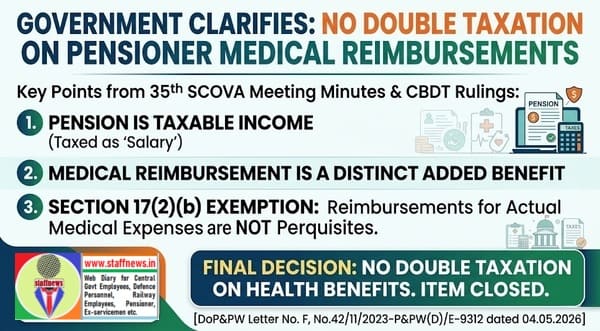
Abolition of double taxation on medical reimbursement for pensioners – 35th SCOVA discussion on new agenda Items.
Government Clarifies Taxation Rules on Pensioners’ Medical Reimbursements
Reference: DoP&PW Letter No. F, No.42/11/2023-P&PW(D)/E-9312 (Dated: May 4, 2026)
Following the 35th Standing Committee of Voluntary Agencies (SCOVA) meeting held in New Delhi, the Department of Pension & Pensioners’ Welfare (DoP&PW) has issued a definitive clarification regarding the taxation of medical reimbursements for pensioners.
The meeting, chaired by the Hon’ble Minister of State for Personnel, Public Grievances and Pensions (MOS PP) on March 10, 2026, addressed several new agenda items, including a prominent concern regarding the alleged “double taxation” on medical expenses reimbursed to pensioners.
The Core Issue
Pensioners had raised concerns that medical reimbursements were being unfairly taxed alongside their regular pension payouts, prompting a request for the abolition of this perceived double taxation.
The CBDT’s Clarification
The Central Board of Direct Taxes (CBDT) reviewed the agenda item and provided a clear breakdown of how pensions and medical reimbursements are treated under current tax laws:
- Pensions vs. Reimbursements: Regular pension payouts are legally included under the definition of salary and are taxed under the “Salaries” head. However, medical reimbursements are entirely distinct. They are an added benefit provided over and above the standard pension.
- No Double Taxation: Because the reimbursement is separate from the pension already received, the CBDT concluded that the same income is not being taxed twice.
- Exemption from “Perquisite” Tax: Crucially, the CBDT noted that under Section 17(2)(b) of the Income-tax Act, 2025 [and corresponding clauses in the 1961 Act], any sum paid by an employer to reimburse actual medical expenditures incurred by an employee or their family members is not treated as a taxable perquisite.
Final Decision
Given that existing income tax provisions already protect these specific medical reimbursements from being taxed as perquisites, the CBDT affirmed that there is no double taxation taking place. Consequently, the SCOVA committee has officially treated this agenda item as closed.
Key Takeaway for Pensioners: Your regular pension is taxable under “Salaries,” but any actual medical expenditures reimbursed by your employer/government are protected under Section 17(2)(b) and are not treated as taxable perks. You are not being taxed twice on these health benefits.
Details of Agenda Item No. 26.:-
[DoP&PW’s letter No. F, No.42/11/2023-P&PW(D)/E-9312 dated 04.05.2026]
Minutes of the meeting of 35th SCOVA held on 10.03.2026 under the Chairmanship of Hon’ble MOS (PP) at CSOI, KG Marg, New Delhi —reg.
NEW AGENDA ITEMS
| SL No. | Agenda Item | Discussion/Decision on the agenda item |
|
CBDT |
||
| 26. | Abolition of double taxation on medical reimbursement for pensioners |
The pension received is included under the definition Hence, the item may be treated as closed. |
Click to view:
Minutes of the meeting of 35th SCOVA held on 10.03.2026 under the Chairmanship of Hon’ble MOS (PP)
सरकार द्वारा पेंशनभोगियों की चिकित्सा प्रतिपूर्ति पर कराधान नियमों का स्पष्टीकरण
संदर्भ: पेंशन एवं पेंशनभोगी कल्याण विभाग (DoP&PW) पत्र संख्या एफ, सं.42/11/2023-P&PW(D)/E-9312 (दिनांक: 04 मई 2026)
नई दिल्ली में आयोजित स्वैच्छिक एजेंसियों की स्थायी समिति (SCOVA) की 35वीं बैठक के पश्चात, पेंशन एवं पेंशनभोगी कल्याण विभाग (DoP&PW) ने पेंशनभोगियों की चिकित्सा प्रतिपूर्ति (Medical Reimbursements) के कराधान के संबंध में एक अंतिम स्पष्टीकरण जारी किया है।
10 मार्च 2026 को माननीय राज्य मंत्री (कार्मिक, लोक शिकायत तथा पेंशन) की अध्यक्षता में संपन्न इस बैठक में कई नए एजेंडा बिंदुओं पर चर्चा की गई, जिनमें पेंशनभोगियों को दी जाने वाली चिकित्सा व्यय प्रतिपूर्ति पर कथित “दोहरे कराधान” को समाप्त करने की एक प्रमुख मांग भी शामिल थी।
मुख्य मुद्दा
पेंशनभोगियों ने यह चिंता व्यक्त की थी कि उनके नियमित पेंशन भुगतान के साथ-साथ उनकी चिकित्सा प्रतिपूर्ति पर भी अनुचित रूप से कर लगाया जा रहा है, जिसके कारण उन्होंने इस कथित दोहरे कराधान को समाप्त करने का अनुरोध किया था।
सीबीडीटी (CBDT) का स्पष्टीकरण
केंद्रीय प्रत्यक्ष कर बोर्ड (CBDT) ने इस एजेंडा बिंदु की समीक्षा की और इस बात का स्पष्ट ब्यौरा दिया कि वर्तमान कर कानूनों के तहत पेंशन और चिकित्सा प्रतिपूर्ति के साथ कैसा व्यवहार किया जाता है:
पेंशन बनाम प्रतिपूर्ति: नियमित पेंशन से प्राप्त राशि को कानूनी रूप से वेतन की परिभाषा के अंतर्गत रखा जाता है और “वेतन” (Salaries) मद के तहत इस पर कर लगाया जाता है। हालाँकि, चिकित्सा प्रतिपूर्ति इससे पूर्णतः भिन्न है। यह मानक पेंशन के अतिरिक्त प्रदान किया जाने वाला एक अतिरिक्त लाभ (Added benefit) है।
दोहरा कराधान नहीं: चूँकि प्रतिपूर्ति की राशि पहले से प्राप्त की जा चुकी पेंशन से अलग है, इसलिए सीबीडीटी ने यह निष्कर्ष निकाला है कि एक ही आय पर दो बार कर नहीं लगाया जा रहा है।
“अनुलाभ” (Perquisite) के रूप में कर से छूट: सबसे महत्वपूर्ण बात यह है कि सीबीडीटी ने उल्लेख किया है कि आयकर अधिनियम, 2025 की धारा 17(2)(b) [और आयकर अधिनियम, 1961 की धारा 17(2) के परंतुक के खंड (ii)] के प्रावधानों के अनुसार, किसी कर्मचारी द्वारा स्वयं के या उसके परिवार के किसी सदस्य के चिकित्सा उपचार पर वास्तव में किए गए व्यय के संबंध में नियोक्ता (Employer) द्वारा भुगतान की गई राशि को कर-योग्य अनुलाभ नहीं माना जाता है।
अंतिम निर्णय
इस तथ्य को ध्यान में रखते हुए कि मौजूदा आयकर प्रावधान पहले से ही इन विशिष्ट चिकित्सा प्रतिपूर्तियों को अनुलाभ के रूप में कर-योग्य होने से बचाते हैं, सीबीडीटी ने पुष्टि की है कि यहाँ कोई दोहरा कराधान नहीं हो रहा है। परिणामस्वरूप, स्कोवा (SCOVA) समिति द्वारा आधिकारिक तौर पर इस एजेंडा बिंदु को बंद (Closed) मान लिया गया है।
पेंशनभोगियों के लिए मुख्य निष्कर्ष (Key Takeaway): आपकी नियमित पेंशन “वेतन” मद के तहत कर-योग्य है, लेकिन आपके नियोक्ता या सरकार द्वारा प्रतिपूर्ति किए गए किसी भी वास्तविक चिकित्सा व्यय को धारा 17(2)(b) के तहत सुरक्षित रखा गया है और इन्हें कर-योग्य अनुलाभ (Perks) नहीं माना जाता है। इन स्वास्थ्य लाभों पर आपसे दो बार कर नहीं लिया जा रहा है।
COMMENTS