
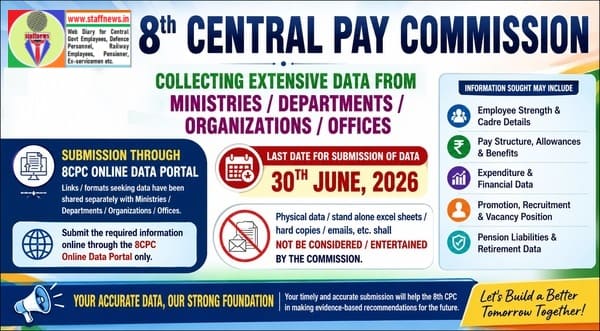
8th CPC Intensifies Data Collection Exercise from Ministries, Departments, Organizations and Offices. The Eighth Central Pay Commission (8th CPC) is currently engaged in a comprehensive data collection exercise from Central Government Ministries, Departments, Organizations and Offices as part of its ongoing work towards formulating recommendations on pay, allowances, pensions and service conditions. Through its dedicated 8CPC Online Data Portal, the Commission has sought extensive information from various Government entities in prescribed formats that have been shared separately with them.
The Commission has requested that the required information be submitted online through the portal by 30 June 2026, while making it clear that physical documents, standalone Excel sheets, hard copies, emails and other offline submissions will not be considered.
Official Message on 8CPC Online Data Portal
According to the information hosted on the 8th CPC website:
“The 8th Central Pay Commission has extensive data requirements. Links/formats seeking data are being shared with Ministries/Departments/Organizations/Offices separately. Submission of data is requested on this portal for 8th Central Pay Commission.”
The Commission has further emphasized:
“Physical data/stand alone excel sheets/hard copies/emails, etc. shall not be considered/entertained by the Commission.”
This reflects the Commission’s intention to maintain a centralized, standardized and digitally verifiable database for its analysis.
What Does the Current Exercise Indicate?
Rather than signalling the beginning or conclusion of the data-gathering process, the current exercise indicates that the Commission is actively building a comprehensive database for detailed analysis. The information received from Ministries, Departments, Organizations and Offices will help the Commission evaluate employee strength, pay structures, allowances, pension liabilities, cadre management issues and expenditure patterns across the Central Government.
The Commission may continue to seek clarifications, supplementary information or additional datasets from stakeholders as required during the course of its examination.
Why Is the Data Collection Exercise Important?
Pay Commissions do not formulate recommendations merely on the basis of demands raised by employee associations or staff federations. They require detailed empirical data relating to:
- Number of employees
- Existing pay structure
- Cadre strength
- Vacancy position
- Recruitment patterns
- Promotional avenues
- Retirement trends
- Pension liabilities
- Department-wise expenditure
- Allowances and benefits
- Regional deployment of staff
- Workload indicators
- Technological changes affecting manpower requirements
The information being collected now is expected to become the primary database on which the Commission will assess the current compensation framework and recommend future revisions.
Three Major Stages of Information Collection by 8th CPC
The activities undertaken by the Commission so far indicate a structured and systematic approach.
-
Public Questionnaire Phase
The first stage involved seeking views from stakeholders through an online questionnaire.
The Commission hosted an 18-question survey on the MyGov portal and invited responses from:
- Central Government employees
- Union Territory employees
- Pensioners
- Service Associations and Unions
- Regulatory Bodies
- Judicial Officers
- Court Employees
- Researchers
- Academicians
- State Governments and UT Administrations
- Individual citizens
The questionnaire remained open from:
5 February 2026 to 31 March 2026
The Commission clarified that only online responses submitted through the MyGov platform would be considered.
This phase helped the Commission understand broad concerns and expectations regarding:
- Pay revision
- Pension reforms
- Allowances
- Career progression
- Compensation structure
- Working conditions
-
Memorandum Submission Phase
The second stage involved inviting formal representations and memoranda from stakeholders.
The Commission sought detailed submissions from:
- Central Government employees
- Defence personnel
- All India Services officers
- Union Territory employees
- Pensioners
- Service Associations
- Ministries and Departments
- Regulatory Bodies
- Audit and Accounts Department
- Supreme Court and High Court employees
- Judicial Officers
The memorandum submission window remained open from:
5 March 2026 to 15 June 2026
Stakeholders were required to submit their demands in a structured format through the online system.
The Commission again clarified that physical copies, emails and PDF submissions would not be entertained.
-
Institutional Data Collection Phase
The third and current stage is the collection of quantitative and administrative data from Government organizations.
This phase is widely regarded as the most significant because it provides the factual foundation for:
- Cost calculations
- Pay matrix redesign
- Cadre restructuring
- Allowance rationalization
- Pension projections
- Future manpower planning
The information being collected is expected to help the Commission understand the actual financial and administrative implications of various proposals received during the earlier consultation stages.
What Kind of Data May Be Sought?
Although the detailed formats shared with Ministries and Departments have not been publicly released, previous Pay Commissions have generally collected information relating to:
Employee Strength
- Sanctioned posts
- Filled posts
- Vacant posts
- Group-wise distribution
Pay Structure
- Existing pay levels
- Grade-wise employee distribution
- Pay progression data
Recruitment Data
- Direct recruitment
- Promotion quotas
- Educational qualifications
Promotion and Career Progression
- Average promotion period
- Stagnation levels
- Cadre hierarchy
Retirement and Pension
- Annual retirements
- Pension expenditure
- Family pension liabilities
Financial Data
- Salary expenditure
- Allowance expenditure
- Pension expenditure
- Budget allocation trends
Allowances
- House Rent Allowance
- Transport Allowance
- Risk and hardship allowances
- Special duty allowances
Organizational Performance
- Nature of duties
- Technological transformation
- Workload patterns
- Service delivery requirements
What Does This Indicate About the Progress of 8th CPC?
The launch of the Online Data Portal suggests that the Commission is moving steadily through its planned roadmap.
The sequence appears to be:
- Constitution of the Commission (November 2025)
- Stakeholder consultation through Questionnaire
- Receipt of Memoranda and Representations
- Collection of detailed departmental data
- Data analysis and examination
- Interaction with stakeholders
- Formulation of recommendations
- Submission of final report to the Government
The present data collection exercise is therefore one of the most important milestones in the Commission’s work.
Significance for Central Government Employees and Pensioners
For employees and pensioners, the ongoing data collection exercise is significant because:
- It demonstrates that the Commission is actively progressing with its mandate.
- Employee demands received through questionnaires and memoranda will now be examined against actual administrative and financial data.
- Future recommendations on pay, allowances, pensions and career progression will be supported by factual evidence collected from Government organizations.
- The quality and accuracy of data submitted by Ministries and Departments may substantially influence the Commission’s final recommendations.
Digital-First Approach of the 8th CPC
A notable feature of the 8th CPC is its emphasis on digital submissions.
For all major activities, including:
- Questionnaire responses,
- Memorandum submissions, and
- Departmental data collection,
the Commission has adopted an online-only approach.
This reflects the Government’s broader objective of promoting:
- Transparency,
- Standardization,
- Faster data processing,
- Better analytics, and
- Reduced administrative burden.
The 8th Central Pay Commission is presently undertaking an extensive data collection exercise from Ministries, Departments, Organizations and Offices through its Online Data Portal. This follows earlier phases involving stakeholder questionnaires and memorandum submissions. The data being collected will play a crucial role in assisting the Commission’s analysis of pay, allowances, pensions and service conditions across the Central Government.
While 30 June 2026 is the currently prescribed last date for submission of data through the portal, it should not necessarily be viewed as the end of the Commission’s information-gathering activities. Depending on its requirements, the Commission may seek additional inputs, clarifications or further data from concerned organizations during subsequent stages of its work. The ongoing exercise underscores the Commission’s efforts to base its recommendations on comprehensive and evidence-based analysis before submitting its final report to the Government.
Source: 8th CPC Website and
View/Download Source PDF
COMMENTS
LTC benefits may be extended to retired persons, to visit the religious shrines only once in each year. May be restricted to only rail fares, not the flight ticket fares to save the expenditure of government.
This is mere a suggestion only.
Regards.
Maharaj ab to picchaa chhod do
The pensioner who was retired under 6th cpc and his pay scale was 9300-34800+ Grade pay ₹4200 or ₹4600 (group-B, non-gazetted),they were the only entitled for General Ward Cghs card but their revised pension were fixed with above ₹50,500 at the time of (pre-2016) 7th CPC.
Now, my suggestion is that the pensioners have get the facility and upgraded their cghs card from general Ward to private Ward as per cghs om dated 28th October, 2022. On the basis of the said OM, pensioners get the upgraded Ward facility as serving employees so that they could get the comfort zone in emergency at Hospitals.
The pensioner who was retired under 6th cpc and his pay scale was 9300-34800+ Grade pay ₹2400, they were the only entitled for General Ward Cghs card but their revises pension were fixed with above ₹50,500 at the time of pre-2016 7th CPC. Now, my suggestion is that the pensioners have get the facility and upgraded their cghs card from general Ward to private Ward as per cghs om dated 28th October, 2022. On the basis of the said OM, pensioners get the upgraded Ward facility as serving employees so that they could get the comfort zone in emergency at Hospitals.
The pensioners who have retired on 6th CPC and get pension below the 36500 but they have get the revised pension in 7th CPC above RS. 36500 OR 50500 at the time of 7th CPC, will be benefitted/ updated the cghs card from General Ward to Semi-Private ward or Private ward so that they should get the comfort zone in the hospital at the time of sick eas or illness.
Dear Sir, It is very painful when calculating the restoration of commuted value of pension which is almost double. Recovery time may please reduce from 15 years to 11 years so that poor paided group C and group D employees atleast can relief from their eve of life.