
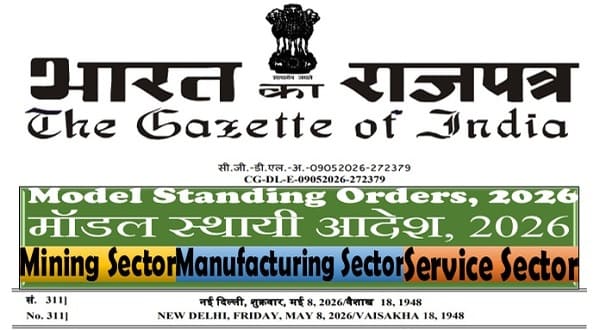
Model Standing Orders, 2026 for mining, manufacturing and service sectors: Notification No. S.O. 2312(E) dated 08.05.2026 by Ministry of Labour and Employment
MINISTRY OF LABOUR AND EMPLOYMENT
NOTIFICATION
New Delhi, the 8th May, 2026
S.O. 2312(E).—In exercise of the powers conferred by sub-section (1) of section 29 of the Industrial Relations Code, 2020 (35 of 2020), and in supersession of the Industrial Employment (Standing Orders) Central Rules, 1946, in so far as they relate to these Model Standing Orders except as respects things done or omitted to be done before such supersession, the Central Government hereby makes the Model Standing Orders, namely:-
1. Short title and commencement. (1) These orders may be called the Model Standing Orders, 2026.
(2) They shall come into force on the date of their publication in the official gazette.
2. Application.- The model standing orders in the industrial establishments in the mining sector, manufacturing sector and service sector are set out in Schedule A, B and C, appended to these model orders.
3. Definition.- (1) In these model standing orders, unless the context otherwise requires,-
(a) “Code” means the Industrial Relations Code, 2020 (35 of 2020);
(b) “Code on Occupational Safety” means the Occupational Safety, Health and Working Condition Code, 2020 (37 of 2020);
(c) “Code on Social Security” means the Code on Social Security, 2020 (36 of 2020).
(d) “Code on Wages” means the Code on Wages, 2019 (29 of 2019);
(e) “Form” means the forms set forth in the Schedule appended to these model standing orders;
(2) The words and expressions used in these model standing orders and not defined but defined in the Industrial Relations Code, 2020, shall have the same meaning as assigned to them in the said Code.

Schedule- A
Draft Model Standing Orders in Mining Sector
1. Short title and commencement. (1) These Standing Orders may be called as the Mines Sector Standing Orders, 2026.
(2) These orders shall came into force as on the date of their publication in the official gazette.
1. A. Definition.– (1) In these Model Standing Orders, unless there is anything repugnant to the subject or the context,-
(a) “Code” means the Industrial Relations Code, 2020 (35 of 2020);
(b) “Form” means the form set forth in the Schedules appended to these standing orders;
(c) “Habitual” means with respect to indiscipline, a worker shall be habitual if committing misconduct three or more times in preceding twelve months; and
(d) “standing order” with its grammatical variation and cognate expressions means the standing order of these model standing orders.
(2) The words or expressions used in these model standing orders and not defined therein but defined in the Industrial Relations Code, 2020 shall have the respective meanings assigned to them in the definitions in the Code.
2. (1) Classification of workers.– For the purposes of these standing orders, the workers are classified as below,
namely:-
(a) permanent;
(b) temporary;
(c) apprentices;
(d) probationers;
(e) Badlis;
(f) fixed term employment; and
(g) casual.
—-[View PDF for full Schedule]—-
Schedule- B
Draft Model Standing Orders in Manufacturing Sector
1. Short title and commencement. (1) These Standing Orders may be called as the Manufacturing Sector Standing Orders, 2026.
(2) These orders shall came into force as on the date of their publication in the official gazette.
1. A. Definition.- (1) In these Model Standing Orders, unless there is anything repugnant to the subject or the context,-
(a) “Code” means the Industrial Relations Code, 2020 (35 of 2020);
(b) “Form” means the form set forth in the Schedules appended to these standing orders;
(c) “Habitual” means with respect to indiscipline, a worker shall be habitual if committing misconduct three or more times in preceding twelve months; and
(d) “standing order” with its grammatical variation and cognate expressions means the standing order of these model standing orders.
(2) The words or expressions used in these model standing orders and not defined therein but defined in the Industrial Relations Code, 2020 shall have the respective meanings assigned to them in the definitions in the Code.
2. (1) Classification of workers.– For the purposes of these standing orders, the workers are classified as below, namely:-
(a) permanent;
(b) temporary;
(c) apprentices;
(d) probationers;
(e) Badlis;
(f) fixed term employment; and
(g) casual.
—-[View PDF for full Schedule]—-
Schedule- C
Draft Model Standing Orders in Service Sector
1. Short title and commencement. (1) These Standing Orders may be called as the Service Sector Standing Orders, 2026.
(2) They shall come into force on the date of their publication in the official gazette.
1. A. Definition.– (1) In these Model Standing Orders, unless there is anything repugnant to the subject or the context,-
(a) “Code” means the Industrial Relations Code, 2020 (35 of 2020);
(b) “Form” means the form set forth in the Schedules appended to these standing orders;
(c) “Habitual” means with respect to indiscipline, a worker shall be habitual if committing misconduct three or more times in preceding twelve months; and
(d) “standing order” with its grammatical variation and cognate expressions means the standing order of these model standing orders.
(2) The words or expressions used in these model standing orders and not defined therein but defined in the Industrial Relations Code, 2020 shall have the respective meanings assigned to them in the definitions in the Code.
2. (1) Classification of workers.- For the purposes of these standing orders, the workers are classified as below, namely:-
(a) permanent;
(b) temporary;
(c) apprentices;
(d) probationers;
(e) Badlis;
(f) fixed term employment; and
(g) casual.
—-[View PDF for full Schedule]—-
View/Download the PDF
COMMENTS