
8th Central Pay Commission – Collection of Age Profile Data Across All Pay Levels: Major Exercise Signals Focus on Workforce Planning
8th Central Pay Commission – Collection of Age Profile Data Across All Pay Levels
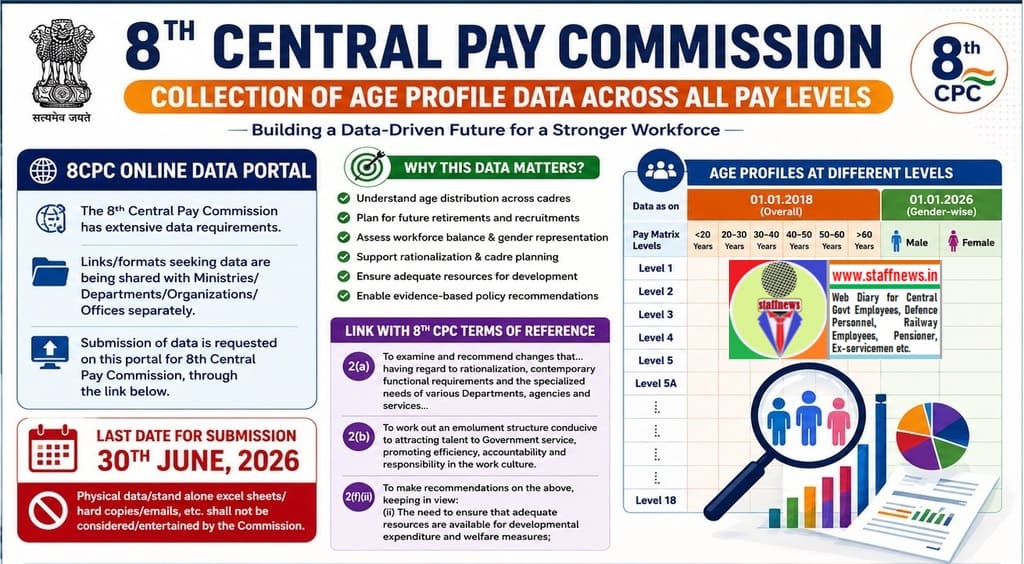
With just 30 June 2026 as the deadline, the 8th Central Pay Commission (8th CPC) is collecting detailed employee data from all Central Government Ministries, Departments, Attached Offices, Autonomous Bodies and other organizations through its 8CPC Online Data Portal.
The latest exercise goes far beyond the collection of salary-related information. The Commission has sought comprehensive age-wise and gender-wise employee data across every Pay Matrix Level (Level 1 to Level 18), indicating that manpower planning, workforce demographics and future recruitment requirements will play an important role while framing its recommendations.
8th CPC Makes Online Submission Mandatory
According to the message displayed on the 8CPC Online Data Portal, Ministries and Departments have been informed that data formats are being shared separately and that all information must be uploaded only through the online portal.
The Commission has clearly stated:
- Last date for submission of data: 30 June 2026
- Physical copies, hard copies, Excel sheets sent separately or submissions through email will not be accepted.
- Only data uploaded through the official portal will be considered by the Commission.
This indicates the Commission’s intention to create a centralized digital database for evidence-based decision making.
Why is the 8th CPC Collecting Age Profile Data?
One of the important formats circulated by the Commission seeks Age Profiles at Different Levels of Government employees.
The information has been sought separately for:
Historical Position (as on 01.01.2018)
- Employees below 20 years
- 20–30 years
- 30–40 years
- 40–50 years
- 50–60 years
- Above 60 years
Current Position (as on 01.01.2026)
For every Pay Matrix Level, Ministries have to provide:
- Male employees below 20 years
- Female employees below 20 years
- Male employees between 20–30 years
- Female employees between 20–30 years
- Male employees between 30–40 years
- Female employees between 30–40 years
- Male employees between 40–50 years
- Female employees between 40–50 years
- Male employees between 50–60 years
- Female employees between 50–60 years
- Male employees above 60 years
- Female employees above 60 years
The data has been sought separately for every Pay Matrix Level from Level 1 to Level 18, including intermediary levels such as Level 5A, 10A, 10B, 12A, 12B, 13A and 13B.
Format on which data required by 8th CPC:-
| Age profiles at different levels | Number of employees less than 20 years of age as on 01.01.2018 | Number of employees between 20 and 30 years of age as on 01.01.2018 | Number of employees between 30 and 40 years of age as on 01.01.2018 | Number of employees between 40 and 50 years of age as on 01.01.2018 | Number of employees between 50 and 60 years of age as on 01.01.2018 | Number of employees more than 60 years of age as on 01.01.2018 | Number of male employees less than 20 years of age as on 01.01.2026 | Number of female employees less than 20 years of age as on 01.01.2026 | Number of male employees between 20 and 30 years of age as on 01.01.2026 | Number of female employees between 20 and 30 years of age as on 01.01.2026 | Number of male employees between 30 and 40 years of age as on 01.01.2026 | Number of female employees between 30 and 40 years of age as on 01.01.2026 | Number of male employees between 40 and 50 years of age as on 01.01.2026 | Number of female employees between 40 and 50 years of age as on 01.01.2026 | Number of male employees between 50 and 60 years of age as on 01.01.2026 | Number of female employees between 50 and 60 years of age as on 01.01.2026 | Number of male employees more than 60 years of age as on 01.01.2026 | Number of female employees more than 60 years of age as on 01.01.2026 |
| Level 1 | ||||||||||||||||||
| Level 2 | ||||||||||||||||||
| Level 3 | ||||||||||||||||||
| Level 4 | ||||||||||||||||||
| Level 5 | ||||||||||||||||||
| Level 5A | ||||||||||||||||||
| Level 6 | ||||||||||||||||||
| Level 7 | ||||||||||||||||||
| Level 8 | ||||||||||||||||||
| Level 9 | ||||||||||||||||||
| Level 10 | ||||||||||||||||||
| Level 10A | ||||||||||||||||||
| Level 10B | ||||||||||||||||||
| Level 11 | ||||||||||||||||||
| Level 12 | ||||||||||||||||||
| Level 12A | ||||||||||||||||||
| Level 12B | ||||||||||||||||||
| Level 13 | ||||||||||||||||||
| Level 13A | ||||||||||||||||||
| Level 13B | ||||||||||||||||||
| Level 14 | ||||||||||||||||||
| Level 15 | ||||||||||||||||||
| Level 16 | ||||||||||||||||||
| Level 17 | ||||||||||||||||||
| Level 18 |
Why This Data May Be Important
Although the Commission has not officially explained the purpose behind this specific exercise, the nature of the information suggests several possible objectives:
- Understanding the age distribution across different cadres.
- Identifying departments facing large-scale retirements over the coming years.
- Assessing recruitment trends after implementation of the 7th CPC.
- Examining representation of male and female employees across different pay levels.
- Estimating future manpower and pension liabilities.
- Supporting recommendations on cadre restructuring and career progression.
Such data will enable the Commission to analyse whether existing pay structures and service conditions remain suitable for the present-day workforce.
Link with the Terms of Reference of the 8th CPC
The information sought also aligns closely with the Terms of Reference notified by the Government.
Para 2(a)
The Commission has been asked to recommend changes keeping in view:
- Rationalisation of Government services.
- Contemporary functional requirements.
- Specialised needs of various Departments, agencies and services.
Para 2(b)
The Commission has also been tasked with recommending an emolument structure that promotes:
- Attraction of talented candidates.
- Greater efficiency.
- Accountability.
- Responsibility in Government work culture.
Para 2(f)(ii)
While making recommendations, the Commission must also ensure that:
- Adequate Government resources remain available for developmental expenditure and welfare measures.
These provisions indicate that the 8th CPC is expected to balance employee welfare with administrative efficiency and fiscal sustainability.
A Strong Indication of a Data-Driven Pay Commission
Unlike earlier Pay Commissions that relied heavily on representations and departmental reports, the 8th CPC appears to be adopting a more evidence-based approach.
The collection of detailed demographic information across all Ministries suggests that the Commission intends to examine:
- Workforce ageing trends.
- Recruitment patterns.
- Gender composition.
- Distribution of employees across Pay Matrix Levels.
- Future staffing requirements.
Such analysis could significantly influence recommendations on pay structure, career progression, recruitment policies and service conditions.
What Ministries Need to Do
All Ministries, Departments and Government organizations are required to:
- Compile accurate employee data.
- Verify age-wise and gender-wise details for every Pay Matrix Level.
- Upload the information through the 8CPC Online Data Portal.
- Complete the submission before 30 June 2026.
Since offline submissions will not be entertained, timely compliance is essential.
StaffNews Analysis
The age-profile exercise is one of the clearest indications so far that the 8th Central Pay Commission is looking beyond pay revision alone. By collecting granular demographic data from Level 1 to Level 18, the Commission appears to be building a comprehensive picture of the Central Government workforce before finalising its recommendations.
The outcome of this analysis may influence not only salary structures but also recruitment strategy, promotion avenues, cadre management, pension projections and the long-term human resource planning of the Central Government.
View:
-
8th Central Pay Commission is collecting Personnel Data i.e. Strength, Vacancies, Retirement Metrics, Resignation trends etc.
-
8th Central Pay Commission is collecting of Pension Data from Offices: Major Exercise Ahead of Recommendations on OPS, NPS & UPS
-
8th Central Pay Commission Seeks Detailed Salary & Allowance Expenditure Data from Ministries to undertake a comprehensive financial analysis
-
8th Central Pay Commission Seeks Detailed GPF Data Across All Pay Levels from Ministries to Assess Provident Fund Trends
-
8th Central Pay Commission Seeks Three-Year Data on Employee Advances Across All Pay Levels: Major Financial Review Underway
-
8th Central Pay Commission Seeks Detailed Data on Bonus, Honorarium & Performance Incentives Across All Pay Levels
-
8th Central Pay Commission Collects Three-Year Data on Medical, LTC, CEA & Other Claims from Ministries: Major Exercise to Review Employee Welfare Benefits
-
8th Central Pay Commission Seeks Three-Year MACP Promotion Data from Ministries: Is a Review of Career Progression Scheme on the Cards?
-
8th Central Pay Commission Seeks Data on Individual Consultants, Retired Experts & Professionals from Ministries: Is the Existing Consultancy Framework Under Review?
-
8th Central Pay Commission Seeks Three-Year Data on Contractual & Outsourced Manpower from Ministries: Major Review of Workforce Deployment
COMMENTS