
8th Central Pay Commission Seeks Three-Year Data on Contractual & Outsourced Manpower from Ministries: Major Review of Workforce Deployment Begins. 8th CPC collects data on Skilled, Semi-Skilled and Unskilled outsourced manpower deployed across Central Government offices
8th Central Pay Commission Seeks Three-Year Data on Contractual & Outsourced Manpower from Ministries
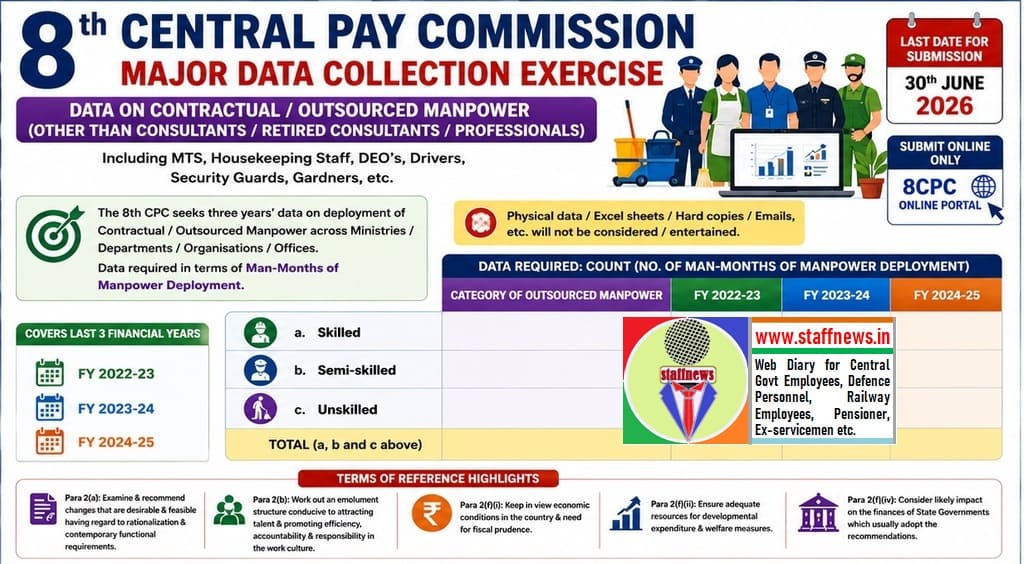
The 8th Central Pay Commission (8th CPC) has expanded its nationwide data collection exercise by seeking comprehensive information on the deployment of contractual and outsourced manpower across Central Government Ministries, Departments, Attached and Subordinate Offices, Constitutional Bodies and Autonomous Organisations.
Unlike the previous data collection on Individual Consultants, Retired Consultants and Professionals, this exercise specifically focuses on outsourced manpower engaged through agencies, including Multi-Tasking Staff (MTS), Housekeeping Staff, Data Entry Operators (DEOs), Drivers, Security Guards, Gardeners and similar categories of personnel.
The information was required to be submitted through the 8th CPC Online Data Collection Portal, with 30 June 2026 being the last date for submission.
The Commission has made it clear that physical data, standalone Excel sheets, hard copies, emails or any other offline submissions shall not be considered or entertained. Accordingly, Ministries and Departments were required to furnish the prescribed information exclusively through the online portal.
View: 8th CPC Intensifies Data Collection Exercise from Ministries, Departments, Organizations and Offices
Since the submission deadline has now expired, the exercise is expected to have been completed. However, considering the volume of information to be collected from thousands of Government establishments, the Commission may decide to extend the deadline if required.
What Information Has the 8th CPC Sought?
The Commission has sought three years’ data relating to contractual and outsourced manpower deployed in Government organisations.
The prescribed format covers the following financial years:
- FY 2022-23
- FY 2023-24
- FY 2024-25
Instead of asking only for the number of workers engaged, the Commission has sought the count in terms of Man-Months of Manpower Deployment, thereby measuring the total duration of outsourced manpower engagement during each financial year.
Categories of Outsourced Manpower Covered
The format specifically excludes Individual Consultants, Retired Consultants and Professionals, whose data has been sought separately.
This exercise covers outsourced manpower such as:
- Multi-Tasking Staff (MTS)
- Housekeeping Staff
- Data Entry Operators (DEOs)
- Drivers
- Security Guards
- Gardeners
- Similar outsourced support staff
The manpower has been classified into three broad categories: Format on which data required by 8th CPC:-
| Data on number of contractual/ outsourced Manpower (Other than consultants/ retired consultants/ professionals) (including MTS, Housekeeping Staff, DEO’s, Drivers, Security Guards, Gardners, etc) | Count (No of Man months of Manpower deployment) FY 2022-23 | Count (No of Man months of Manpower deployment) FY 2023- 24 | Count (No of Man months of Manpower deployment) FY 2024- 25 |
| a. Skilled | |||
| b. Semi-skilled | |||
| c. Unskilled | |||
| TOTAL (a, b and c above) |
Why Is the 8th CPC Collecting This Data?
The collection of outsourced manpower data indicates that the Commission intends to understand how extensively Government organisations depend upon external manpower for routine administrative and support functions.
Over the last decade, many Central Government offices have increasingly relied upon outsourcing agencies for non-core services such as housekeeping, security, data entry, driving and office support.
By collecting three years’ deployment data, the Commission will be able to assess:
- Overall dependence on outsourced manpower.
- Trends in workforce deployment.
- Distribution between skilled, semi-skilled and unskilled categories.
- Administrative implications of outsourcing.
- Financial implications associated with manpower deployment.
Terms of Reference Support Such Data Collection
The Government Resolution constituting the 8th Central Pay Commission provides adequate authority for collecting such information.
Para 2(a): Rationalisation and Contemporary Functional Requirements
The Commission has been asked:
“To examine and recommend changes that are desirable and feasible … having regard to rationalization, contemporary functional requirements…”
The deployment of outsourced manpower directly relates to organisational rationalisation and changing functional requirements.
Para 2(b): Efficient Workforce Structure
The Commission has also been entrusted:
“To work out an emolument structure conducive to attracting talent to Government service, promoting efficiency, accountability and responsibility in the work culture.”
Understanding the extent of outsourced manpower deployment may help the Commission evaluate the balance between regular employees and outsourced personnel.
Para 2(f)(i): Fiscal Prudence
The Commission is required to consider:
“The economic conditions in the country and the need for fiscal prudence.”
Outsourcing expenditure constitutes an important component of administrative expenditure.
Para 2(f)(ii): Developmental Priorities
The Terms of Reference further require:
“The need to ensure that adequate resources are available for developmental expenditure and welfare measures.”
Para 2(f)(iv): Impact on State Governments
The Commission must also consider:
“The likely impact of the recommendations on the finances of the State Governments which usually adopt the recommendations with some modifications.”
Many State Governments also engage outsourced manpower on similar lines.
Para 3: Authority to Collect Information
The Resolution authorises the Commission:
“The Commission will devise its own procedure… It may call for such information and take such evidence, as it may consider necessary. Ministries and Departments of Government of India shall furnish such information and documents and other assistance as may be required by the Commission.”
The present exercise is therefore fully supported by the Commission’s mandate.
View: 8th Central Pay Commission – Resolution on Constitution and Terms of Reference: Gazette Notification
StaffNews Analysis
The format prescribed by the 8th CPC offers several important insights into the Commission’s broader approach towards administrative reforms.
Focus Beyond Pay Revision
Traditionally, Pay Commissions have been associated with pay scales, allowances and pensions. However, the present Commission is examining the entire ecosystem of Government workforce deployment, including regular employees, consultants and outsourced manpower.
This indicates a much broader review of administrative structures.
Understanding Workforce Composition
By collecting deployment data separately for skilled, semi-skilled and unskilled outsourced manpower, the Commission will gain a clearer picture of where outsourcing is concentrated and how support services are being delivered across Government organisations.
Assessing Long-Term Trends
Using Man-Months of deployment instead of headcount enables the Commission to assess the intensity and duration of outsourced manpower engagement over time rather than capturing only a snapshot.
No Indication of Policy Changes Yet
Employees should avoid interpreting this exercise as an indication that outsourcing policies are about to change. The Commission is presently gathering factual information to understand existing practices before making any recommendations.
What Could Be the Next Step?
Once the nationwide data has been analysed, the Commission may examine:
- Trends in outsourced manpower deployment.
- Dependence on different categories of outsourced workers.
- Administrative efficiency of the existing model.
- Financial implications of outsourcing.
- Relationship between outsourced manpower and regular Government staffing.
The findings may subsequently be considered along with stakeholder consultations, departmental inputs and economic considerations before final recommendations are formulated.
StaffNews View
The 8th Central Pay Commission’s decision to collect three years’ data on contractual and outsourced manpower demonstrates that its review extends well beyond salary structures. By examining the deployment of skilled, semi-skilled and unskilled outsourced personnel across Ministries and Departments, the Commission appears to be building a comprehensive evidence base on how the Central Government workforce is currently organised.
At this stage, the exercise should be viewed as a data-driven assessment rather than a signal of imminent policy changes. Any recommendations relating to outsourcing, workforce planning or organisational restructuring will emerge only after the Commission analyses the information received from Ministries and balances administrative efficiency with fiscal prudence and service delivery objectives.
With the online submission deadline of 30 June 2026 now over, the next phase will be the Commission’s analysis of the nationwide data, which could influence future recommendations on workforce deployment and administrative reforms under the 8th Central Pay Commission.
******
View:
-
8th Central Pay Commission is collecting Personnel Data i.e. Strength, Vacancies, Retirement Metrics, Resignation trends etc.
-
8th Central Pay Commission is collecting of Pension Data from Offices: Major Exercise Ahead of Recommendations on OPS, NPS & UPS
-
8th Central Pay Commission – Collection of Age Profile Data Across All Pay Levels: Major Exercise Signals Focus on Workforce Planning
-
8th Central Pay Commission Seeks Detailed Salary & Allowance Expenditure Data from Ministries to undertake a comprehensive financial analysis
-
8th Central Pay Commission Seeks Detailed GPF Data Across All Pay Levels from Ministries to Assess Provident Fund Trends
-
8th Central Pay Commission Seeks Three-Year Data on Employee Advances Across All Pay Levels: Major Financial Review Underway
-
8th Central Pay Commission Seeks Detailed Data on Bonus, Honorarium & Performance Incentives Across All Pay Levels
-
8th Central Pay Commission Collects Three-Year Data on Medical, LTC, CEA & Other Claims from Ministries: Major Exercise to Review Employee Welfare Benefits
-
8th Central Pay Commission Seeks Three-Year MACP Promotion Data from Ministries: Is a Review of Career Progression Scheme on the Cards?
-
8th Central Pay Commission Seeks Data on Individual Consultants, Retired Experts & Professionals from Ministries: Is the Existing Consultancy Framework Under Review?
COMMENTS